

 登录
登录
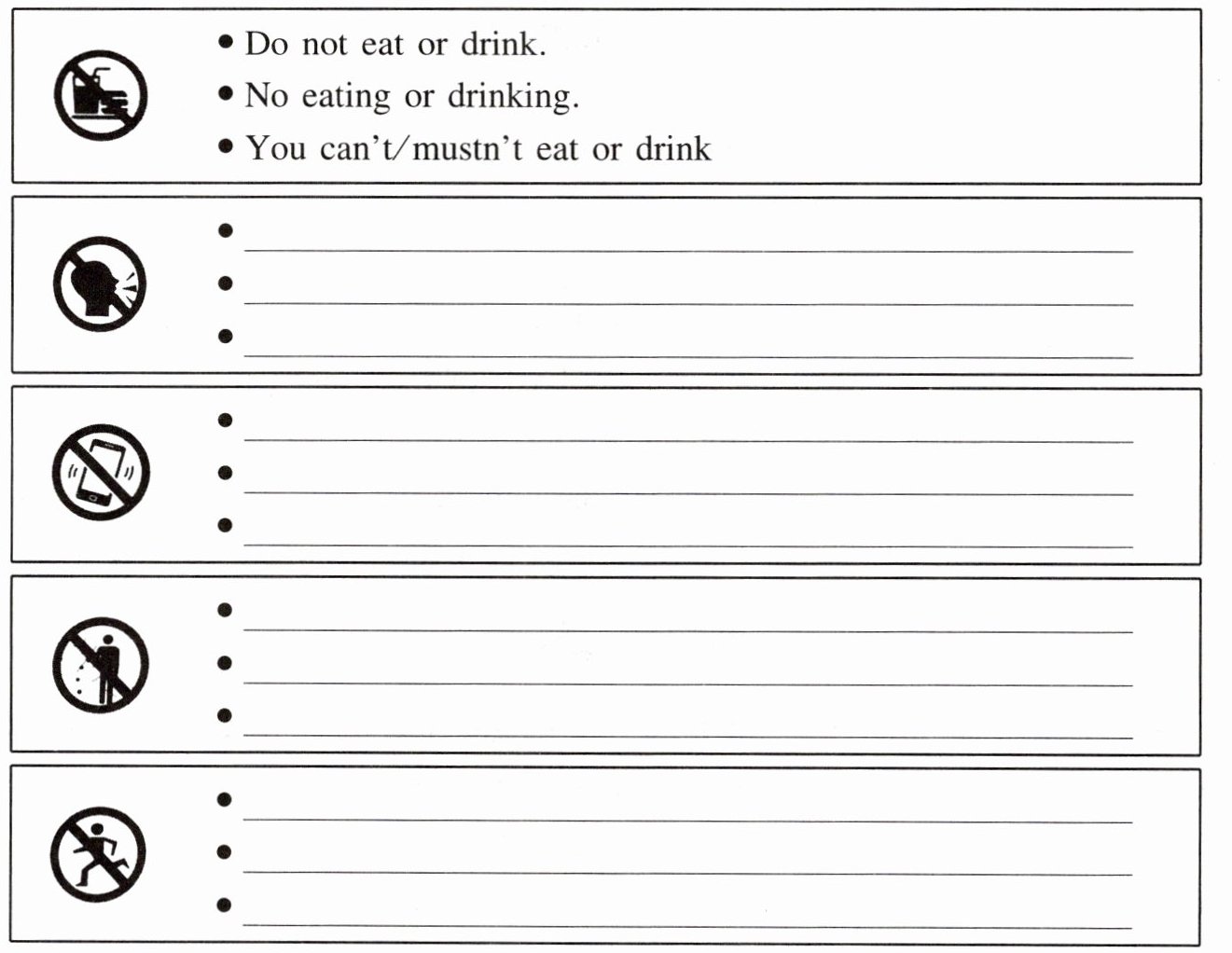
Ⅱ. Look at the first sign and read the rules. Then write the rules for the other signs. 仿写规则。
答案
第二行(禁止喧哗)
Do not talk loudly.
No talking loudly.
You can't/mustn't talk loudly.
第三行(禁止使用手机)
Do not use mobile phones.
No using mobile phones.
You can't/mustn't use mobile phones.
第四行(禁止乱扔垃圾)
Do not litter.
No littering.
You can't/mustn't litter.
第五行(禁止奔跑)
Do not run.
No running.
You can't/mustn't run.
Do not talk loudly.
No talking loudly.
You can't/mustn't talk loudly.
第三行(禁止使用手机)
Do not use mobile phones.
No using mobile phones.
You can't/mustn't use mobile phones.
第四行(禁止乱扔垃圾)
Do not litter.
No littering.
You can't/mustn't litter.
第五行(禁止奔跑)
Do not run.
No running.
You can't/mustn't run.
Ⅲ. Read the Grammar Focus on page 13 and the Modal Verbs on pages 90 - 91.
阅读课本第 13 页语法和第 90 - 91 页的情态动词。
A) 情态动词 can, have to 和 must 的用法。
情态动词 can 可表示“”“”和“”;情态动词 have to 表示“或”;情态动词 must 表示“”。
have to 表示“必须”时,与 must 含义很接近,有时可与 must 互换。但它们在以下方面有所不同:must 通常表示的是说话人的 看法,语气比较强烈,have to 往往强调 ;它们的否定形式含义大不相同,mustn't 表示“或”,而 don't have to 表示“”;must 人称和数的变化,have to 人称和数的变化。
阅读课本第 13 页语法和第 90 - 91 页的情态动词。
A) 情态动词 can, have to 和 must 的用法。
情态动词 can 可表示“”“”和“”;情态动词 have to 表示“或”;情态动词 must 表示“”。
have to 表示“必须”时,与 must 含义很接近,有时可与 must 互换。但它们在以下方面有所不同:must 通常表示的是说话人的 看法,语气比较强烈,have to 往往强调 ;它们的否定形式含义大不相同,mustn't 表示“或”,而 don't have to 表示“”;must 人称和数的变化,have to 人称和数的变化。
答案
A) 能力、请求、允许;客观需要或外部压力、责任;必须;主观;客观需要;禁止、不允许;不必;没有;有
解析
本题主要考察对情态动词can,have to和must的用法及区别,需要根据教材知识内容进行填空。can表示能力、请求、允许;have to表示客观需要或外部压力、责任;must表示必须。must通常表示说话人主观看法,have to强调客观需要。mustn't表示禁止或不允许,don't have to表示不必。must没有人称和数的变化,have to有人称和数的变化。
B) Complete the sentences with the modal verbs in the box.
从方框中选择恰当的情态动词,完成下列句子。
can, have to, has to, must, can't, don't have to, doesn't have to, mustn't
1. Jack is a music teacher, and he play the piano very well.
2. —Excuse me, you lend your pencil to me? —Of course.
3. You come if you don't want to.
4. It's sunny outside. Tony play at home. He can go out.
5. We stop when the traffic lights are red.
6. Tom's parents go out today. Tom cook his own meal.
7. You put up your hand if you want to ask your teacher a question.
8. In our class, we fight. We treat everyone with respect.
9. If she doesn't feel well, Alice tell her teacher about it when she be absent from class.
10. I feed my cat many kinds of food, but I give him an orange. It's bad for him!
11. We talk loudly in the library.
12. Put on your seat belt. We wear one when we're in a car.
从方框中选择恰当的情态动词,完成下列句子。
can, have to, has to, must, can't, don't have to, doesn't have to, mustn't
1. Jack is a music teacher, and he play the piano very well.
2. —Excuse me, you lend your pencil to me? —Of course.
3. You come if you don't want to.
4. It's sunny outside. Tony play at home. He can go out.
5. We stop when the traffic lights are red.
6. Tom's parents go out today. Tom cook his own meal.
7. You put up your hand if you want to ask your teacher a question.
8. In our class, we fight. We treat everyone with respect.
9. If she doesn't feel well, Alice tell her teacher about it when she be absent from class.
10. I feed my cat many kinds of food, but I give him an orange. It's bad for him!
11. We talk loudly in the library.
12. Put on your seat belt. We wear one when we're in a car.
答案
1. can 2. can 3. don't have to 4. doesn't have to 5. must 6. has to 7. must 8. mustn't; must 9. must; has to 10. can; can't 11. mustn't 12. must
解析
1. Jack是音乐老师,表能力用can;2. 请求借铅笔用can;3. 不想来就不必来,用don't have to;4. Tony不必在家玩,主语三单,用doesn't have to;5. 红灯必须停,用must;6. Tom不得不做饭,主语三单,用has to;7. 问问题必须举手,用must;8. 禁止打架用mustn't,必须尊重用must;9. 必须告诉老师用must,不得不缺席用has to;10. 可以喂多种食物用can,不能给橘子用can't;11. 图书馆禁止大声说话用mustn't;12. 必须系安全带用must。
