

 登录
登录
一、(2025·徐州泉山区月考改编)游园会的第一站亮亮来到了充满喜庆元素的春节摊位。在手工艺区,亮亮不仅学会了剪纸,还了解了一些有关丰宁剪纸的信息。阅读短文,判断正(T)误(F)。
主题:人与社会——历史、社会与文化
话题:丰宁剪纸
体裁:说明文
难度:★★★
新趋势 传统文化 We usually see paper - cuts during the Spring Festival. But in Fengning County(县) of Hebei, we can see them everywhere and at any time!
Paper - cuts are a part of Fengning people's everyday life. When autumn comes, villagers make paper - cuts for a good harvest. Mothers put paper - cuts on the bed when their kids get sick. They believe the paper - cuts can help the kids get better soon. Businessmen put paper - cuts on their doors. They hope they can make more money. At weddings(婚礼) and funerals(葬礼), people also use paper - cuts to decorate.
The pictures on the paper - cuts are very beautiful. There are many patterns(图案), such as people, plants, fruit and so on. There are also animal patterns, like tortoises, birds, dogs and rabbits.
Most Fengning paper - cuts are red. Fengning is in the north of China. When autumn comes, the leaves fall and the grass turns yellow. Red paper - cuts on doors and windows make the county look livelier(更有生机的).
Fengning paper - cuts are not just decorations, but a cultural symbol that carries the emotions, hopes and traditions of the local people. They will continue to shine bright in Fengning people's daily lives.
(
(
(
(
(
主题:人与社会——历史、社会与文化
话题:丰宁剪纸
体裁:说明文
难度:★★★
新趋势 传统文化 We usually see paper - cuts during the Spring Festival. But in Fengning County(县) of Hebei, we can see them everywhere and at any time!
Paper - cuts are a part of Fengning people's everyday life. When autumn comes, villagers make paper - cuts for a good harvest. Mothers put paper - cuts on the bed when their kids get sick. They believe the paper - cuts can help the kids get better soon. Businessmen put paper - cuts on their doors. They hope they can make more money. At weddings(婚礼) and funerals(葬礼), people also use paper - cuts to decorate.
The pictures on the paper - cuts are very beautiful. There are many patterns(图案), such as people, plants, fruit and so on. There are also animal patterns, like tortoises, birds, dogs and rabbits.
Most Fengning paper - cuts are red. Fengning is in the north of China. When autumn comes, the leaves fall and the grass turns yellow. Red paper - cuts on doors and windows make the county look livelier(更有生机的).
Fengning paper - cuts are not just decorations, but a cultural symbol that carries the emotions, hopes and traditions of the local people. They will continue to shine bright in Fengning people's daily lives.
(
T
)1. In Fengning, we can see paper - cuts everywhere and at any time.(
F
)2. Mothers put paper - cuts on the windows when their kids get sick.(
F
)3. Businessmen put paper - cuts on their doors because they hope they can get love.(
T
)4. There are pictures of people and animals on the paper - cuts.(
F
)5. All the paper - cuts in Fengning are red.答案
1. T 2. F 3. F 4. T
5. F 解析·根据“Most Fengning paper-cuts are red.”可知,丰宁的大多数剪纸是红色的,而不是所有的剪纸都是红色的。故填 F。
5. F 解析·根据“Most Fengning paper-cuts are red.”可知,丰宁的大多数剪纸是红色的,而不是所有的剪纸都是红色的。故填 F。
解析
【分析】
做这类判断正误题,解题思路如下:
1. 先通读全文,整体了解丰宁剪纸的相关背景、用途、图案、颜色等核心信息;
2. 逐个分析题目,根据题目中的关键信息(如人物、行为、目的等)回到原文定位对应句子;
3. 仔细对比题目表述与原文细节,判断是否一致,注意细节差异(如地点、目的、范围词等)。
【解析】
1. 定位原文第一段最后一句:"But in Fengning County(县) of Hebei, we can see them everywhere and at any time!",题目表述与原文完全一致,故判断为T。
2. 定位原文第二段第三句:"Mothers put paper - cuts on the bed when their kids get sick.",题目中说“put paper-cuts on the windows”,与原文中“on the bed”不符,故判断为F。
3. 定位原文第二段第五、六句:"Businessmen put paper - cuts on their doors. They hope they can make more money.",题目中说“hope they can get love”,与原文中“make more money”不符,故判断为F。
4. 定位原文第三段第二、三句:"There are many patterns(图案), such as people, plants, fruit and so on. There are also animal patterns, like tortoises, birds, dogs and rabbits.",可知剪纸包含人物和动物图案,题目表述与原文一致,故判断为T。
5. 定位原文第四段第一句:"Most Fengning paper - cuts are red.",“most”表示“大多数”,而题目中用“All(所有)”,范围表述不符,故判断为F。
【答案】
1. T;2. F;3. F;4. T;5. F
【知识点】
细节理解题,说明文阅读,传统文化类阅读
【点评】
本文以传统文化丰宁剪纸为主题,通过说明文的形式介绍了其应用场景、图案、颜色等内容。题目聚焦细节考查,需要学生精准定位原文信息并仔细对比差异,既锻炼了阅读理解的细节捕捉能力,也帮助学生了解传统文化知识。
【难度系数】
0.6
做这类判断正误题,解题思路如下:
1. 先通读全文,整体了解丰宁剪纸的相关背景、用途、图案、颜色等核心信息;
2. 逐个分析题目,根据题目中的关键信息(如人物、行为、目的等)回到原文定位对应句子;
3. 仔细对比题目表述与原文细节,判断是否一致,注意细节差异(如地点、目的、范围词等)。
【解析】
1. 定位原文第一段最后一句:"But in Fengning County(县) of Hebei, we can see them everywhere and at any time!",题目表述与原文完全一致,故判断为T。
2. 定位原文第二段第三句:"Mothers put paper - cuts on the bed when their kids get sick.",题目中说“put paper-cuts on the windows”,与原文中“on the bed”不符,故判断为F。
3. 定位原文第二段第五、六句:"Businessmen put paper - cuts on their doors. They hope they can make more money.",题目中说“hope they can get love”,与原文中“make more money”不符,故判断为F。
4. 定位原文第三段第二、三句:"There are many patterns(图案), such as people, plants, fruit and so on. There are also animal patterns, like tortoises, birds, dogs and rabbits.",可知剪纸包含人物和动物图案,题目表述与原文一致,故判断为T。
5. 定位原文第四段第一句:"Most Fengning paper - cuts are red.",“most”表示“大多数”,而题目中用“All(所有)”,范围表述不符,故判断为F。
【答案】
1. T;2. F;3. F;4. T;5. F
【知识点】
细节理解题,说明文阅读,传统文化类阅读
【点评】
本文以传统文化丰宁剪纸为主题,通过说明文的形式介绍了其应用场景、图案、颜色等内容。题目聚焦细节考查,需要学生精准定位原文信息并仔细对比差异,既锻炼了阅读理解的细节捕捉能力,也帮助学生了解传统文化知识。
【难度系数】
0.6
二、交换生 Michael 表示没有见过饺子,于是亮亮带着他来到美食区体验如何包饺子和煮饺子。阅读 Michael 和亮亮的对话,完成下面的表格。
主题:人与社会——社会服务与人际沟通
话题:包饺子、煮饺子
体裁:记叙文
难度:★★★★
Michael: Hi, Liangliang. What's this?
Liangliang: Hi, Michael. It's jiaozi. It's yummy and lots of Chinese like eating it.
Michael: It looks like half a moon. How do you make it?
Liangliang: Oh, it's easy.
Michael: Really? Could you teach me?
Liangliang: Of course. Look at this. It's filling. I cut up some vegetables and meat, and put them in a bowl. Next, I add some salt and oil, and mix them together.
Michael: It smells good. What should we do next?
Liangliang: Look at this. It's a dumpling wrapper(饺子皮). Put a spoon of filling on a wrapper and fold the wrapper around the filling.
Michael: OK. Let me try. Er … Why? Your jiaozi is cute, but mine is ugly(难看的).
Liangliang: Take it easy. Let's do it again.
(After some minutes, Michael can make jiaozi too. They make lots of jiaozi together. )
Liangliang: Now, let's put jiaozi in the boiling water.
Michael: When can we eat it?
Liangliang: Wait! It'll come up to the surface(表面) of the water. And then it's time to enjoy the yummy food.
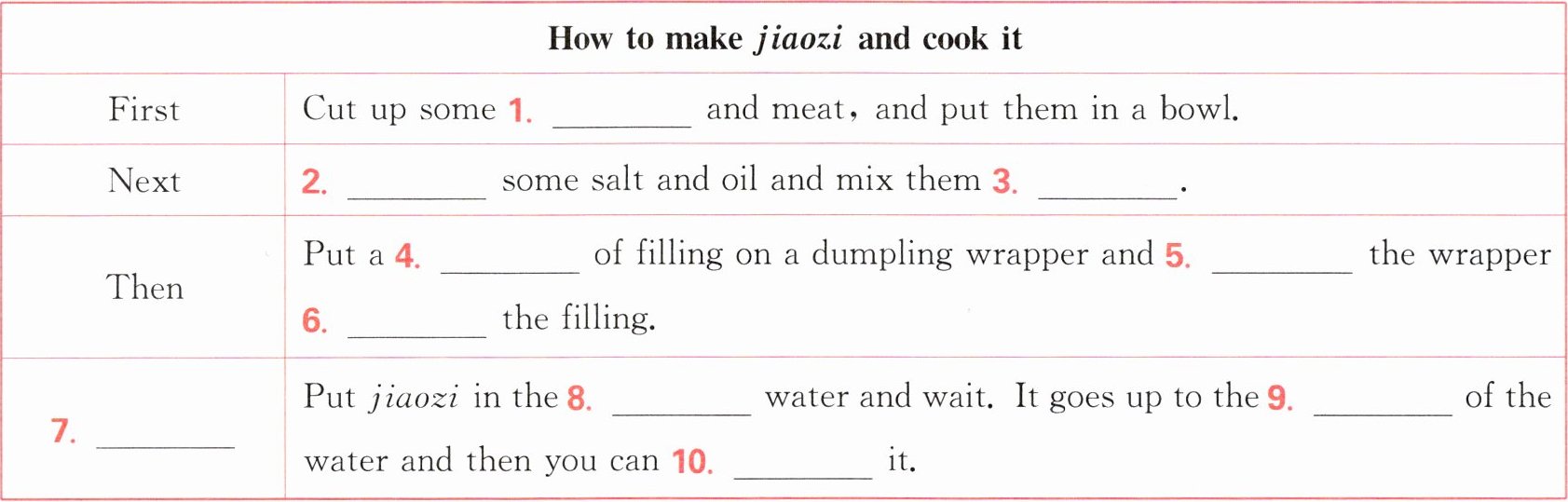
主题:人与社会——社会服务与人际沟通
话题:包饺子、煮饺子
体裁:记叙文
难度:★★★★
Michael: Hi, Liangliang. What's this?
Liangliang: Hi, Michael. It's jiaozi. It's yummy and lots of Chinese like eating it.
Michael: It looks like half a moon. How do you make it?
Liangliang: Oh, it's easy.
Michael: Really? Could you teach me?
Liangliang: Of course. Look at this. It's filling. I cut up some vegetables and meat, and put them in a bowl. Next, I add some salt and oil, and mix them together.
Michael: It smells good. What should we do next?
Liangliang: Look at this. It's a dumpling wrapper(饺子皮). Put a spoon of filling on a wrapper and fold the wrapper around the filling.
Michael: OK. Let me try. Er … Why? Your jiaozi is cute, but mine is ugly(难看的).
Liangliang: Take it easy. Let's do it again.
(After some minutes, Michael can make jiaozi too. They make lots of jiaozi together. )
Liangliang: Now, let's put jiaozi in the boiling water.
Michael: When can we eat it?
Liangliang: Wait! It'll come up to the surface(表面) of the water. And then it's time to enjoy the yummy food.
答案
1. vegetables 2. Add 3. together
4. spoon 5. fold 6. around 7. Finally
8. boiling 9. surface 10. enjoy/eat/have
4. spoon 5. fold 6. around 7. Finally
8. boiling 9. surface 10. enjoy/eat/have
解析
【分析】
这是一道基于对话的信息补全题,解题思路如下:
1. 先梳理表格中包饺子、煮饺子的步骤分类(First/Next/Then/最终烹饪步骤),对应对话中讲解的操作流程;
2. 针对每个空的语境,在对话里定位到描述对应步骤的原句,提取符合语法和语境的词汇;
3. 注意细节,如句首动词的首字母大写、词汇的语境适配性。
【解析】
1. 根据对话中“I cut up some vegetables and meat, and put them in a bowl.”,可知第一步是切蔬菜和肉,故填vegetables。
2.3. 从“add some salt and oil, and mix them together.”可知,第二步是添加调料并混合,句首动词首字母大写,故2填Add,3填together。
4.5.6. 由“Put a spoon of filling on a dumpling wrapper and fold the wrapper around the filling.”可知,第三步是放一勺馅料,再把饺子皮折起来包住馅料,故4填spoon,5填fold,6填around。
7. 前文步骤为First、Next、Then,最后煮饺子是最终操作步骤,故填Finally。
8. 根据“Put jiaozi in the boiling water.”,可知要把饺子放入沸水中,故填boiling。
9. 从“It'll come up to the surface of the water.”可知饺子会浮到水面,故填surface。
10. 由“then it's time to enjoy the yummy food.”可知,饺子浮起后就可以享用,eat/have也符合语境,故填enjoy/eat/have。
【答案】
1. vegetables
2. Add
3. together
4. spoon
5. fold
6. around
7. Finally
8. boiling
9. surface
10. enjoy/eat/have
【知识点】
1. 信息定位提取
2. 日常场景英语
3. 动词短语运用
【点评】
本题结合中国传统美食饺子的制作、烹饪场景,考查学生从对话文本中提取关键信息的能力,贴近生活实际,能锻炼学生的信息匹配与语境理解能力。解题时需仔细对应步骤与对话内容,注意词汇的细节规范。
【难度系数】
0.6
这是一道基于对话的信息补全题,解题思路如下:
1. 先梳理表格中包饺子、煮饺子的步骤分类(First/Next/Then/最终烹饪步骤),对应对话中讲解的操作流程;
2. 针对每个空的语境,在对话里定位到描述对应步骤的原句,提取符合语法和语境的词汇;
3. 注意细节,如句首动词的首字母大写、词汇的语境适配性。
【解析】
1. 根据对话中“I cut up some vegetables and meat, and put them in a bowl.”,可知第一步是切蔬菜和肉,故填vegetables。
2.3. 从“add some salt and oil, and mix them together.”可知,第二步是添加调料并混合,句首动词首字母大写,故2填Add,3填together。
4.5.6. 由“Put a spoon of filling on a dumpling wrapper and fold the wrapper around the filling.”可知,第三步是放一勺馅料,再把饺子皮折起来包住馅料,故4填spoon,5填fold,6填around。
7. 前文步骤为First、Next、Then,最后煮饺子是最终操作步骤,故填Finally。
8. 根据“Put jiaozi in the boiling water.”,可知要把饺子放入沸水中,故填boiling。
9. 从“It'll come up to the surface of the water.”可知饺子会浮到水面,故填surface。
10. 由“then it's time to enjoy the yummy food.”可知,饺子浮起后就可以享用,eat/have也符合语境,故填enjoy/eat/have。
【答案】
1. vegetables
2. Add
3. together
4. spoon
5. fold
6. around
7. Finally
8. boiling
9. surface
10. enjoy/eat/have
【知识点】
1. 信息定位提取
2. 日常场景英语
3. 动词短语运用
【点评】
本题结合中国传统美食饺子的制作、烹饪场景,考查学生从对话文本中提取关键信息的能力,贴近生活实际,能锻炼学生的信息匹配与语境理解能力。解题时需仔细对应步骤与对话内容,注意词汇的细节规范。
【难度系数】
0.6
