

 登录
登录
(1) —Hello, may I speak to Ms Li, please?
—Hello, Ms Li ______.
A.speak
B.speaks
C.speaking
—Hello, Ms Li ______.
A.speak
B.speaks
C.speaking
答案
C
解析
本题考查电话用语中自我介绍的表达。在电话用语中,表达“我是……”要用“This is ... speaking.”或直接用“... speaking.” ,这里表示“我就是李女士”,用“Ms Li speaking” 。A选项“speak”是动词原形,B选项“speaks”是第三人称单数形式,均不符合电话用语表达习惯。
(2) I have ______ headache.
A.a
B.the
C./
A.a
B.the
C./
答案
A
解析
在英语中,“头痛”常用短语“have a headache”来表达,这是固定搭配,需要用不定冠词“a”。
(3) He is ill. He has to ______ some medicine.
A.eat
B.take
C.have
A.eat
B.take
C.have
答案
B
解析
在英语中,“吃药”常用固定搭配“take some medicine”,这是六年级上册Unit 6“I am ill today”中涉及的核心短语。“eat”通常指吃具体的食物,“have”虽然有“吃、喝”等含义,但“take medicine”是更规范、常用的表达。所以此处应选B。
(4) He must get some rest and stay ______ bed.
A.in
B.on
C.at
A.in
B.on
C.at
答案
A
解析
本题考查固定搭配。“stay in bed”为固定短语,意为“卧床休息”,其中介词使用“in”。选项A正确,选项B和C不符合固定搭配用法。
(5) —What's my body temperature?
—Let me see. Oh, 39.2℃. You have a ______.
A.headache
B.cough
C.fever
—Let me see. Oh, 39.2℃. You have a ______.
A.headache
B.cough
C.fever
答案
C
解析
根据对话内容,提问者询问体温,回答为39.2℃,属于发烧温度。"have a fever"为固定搭配,表示“发烧”,与题意和选项匹配。
4. 看图补全句子。
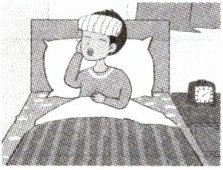
(1) —I cannot go to school today.
—Why?
—I'm ______. I have a ______.
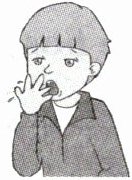
(2) —Do you have a toothache?
—No, I don't. But I ______.
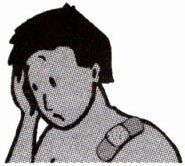
(3) —What's wrong with you?
—I hurt my ______. I have a fever, too.
(1) —I cannot go to school today.
—Why?
—I'm ______. I have a ______.
(2) —Do you have a toothache?
—No, I don't. But I ______.
(3) —What's wrong with you?
—I hurt my ______. I have a fever, too.
答案
(1) ill; fever (2) have a headache (3) arm
解析
(1) 图中人物躺在床上,额头有毛巾,推测生病发烧,“生病的”是ill,“发烧”是fever。(2) 图中人物捂嘴,结合问句“牙疼吗”及否定回答,推测是“头疼”,即have a headache。(3) 图中人物手臂有绷带,“手臂”是arm。
