

 登录
登录
四、用所给单词正确的形式填空。
1. We have two (music) lessons in a week.
2. Don't (eat) in class.
3. I want (borrow) books from the library.
4. How many (science) lessons do you have?
5. You must (wait) for the green light.
1. We have two (music) lessons in a week.
2. Don't (eat) in class.
3. I want (borrow) books from the library.
4. How many (science) lessons do you have?
5. You must (wait) for the green light.
答案
1. music
2. eat
3. to borrow
4. science
5. wait
2. eat
3. to borrow
4. science
5. wait
解析
1. 本题考查名词作定语的用法,“音乐课”的常用固定表达是music lessons,直接用所给名词music修饰lessons即可。
2. 本题考查否定祈使句的规则,Don't开头的否定祈使句后需要接动词原形,因此填eat。
3. 本题考查固定搭配want to do sth.,该搭配意为“想要做某事”,因此要把所给动词borrow变为不定式形式to borrow。
4. 本题考查名词作定语的用法,“科学课”的常用固定表达是science lessons,直接用所给名词science修饰lessons即可。
5. 本题考查情态动词的使用规则,情态动词must后面必须接动词原形,因此填wait。
2. 本题考查否定祈使句的规则,Don't开头的否定祈使句后需要接动词原形,因此填eat。
3. 本题考查固定搭配want to do sth.,该搭配意为“想要做某事”,因此要把所给动词borrow变为不定式形式to borrow。
4. 本题考查名词作定语的用法,“科学课”的常用固定表达是science lessons,直接用所给名词science修饰lessons即可。
5. 本题考查情态动词的使用规则,情态动词must后面必须接动词原形,因此填wait。
五、选词填空。
1. They often (draw/drawing) in the art club.
2. She (have/has) a meeting in the meeting room.
3. You shouldn't (read/reads) in bed.
4. How much (is/are) these short pants?
5. Can you (play/plays) the piano?
1. They often (draw/drawing) in the art club.
2. She (have/has) a meeting in the meeting room.
3. You shouldn't (read/reads) in bed.
4. How much (is/are) these short pants?
5. Can you (play/plays) the piano?
答案
1. draw 2. has 3. read 4. are 5. play
解析
1. 句中often是一般现在时的标志词,表示经常性的动作,主语They是复数,谓语动词需要用原形,因此选draw。
2. 主语She是第三人称单数,在一般现在时中,主语为第三人称单数时谓语动词要使用对应的第三人称单数形式,have的第三人称单数形式是has,因此选has。
3. shouldn't是情态动词的否定形式,情态动词后面必须接动词原形,因此选read。
4. 句子的主语these short pants是复数名词,对应的be动词要使用are,因此选are。
5. Can是情态动词,情态动词后面需要接动词原形,因此选play。
2. 主语She是第三人称单数,在一般现在时中,主语为第三人称单数时谓语动词要使用对应的第三人称单数形式,have的第三人称单数形式是has,因此选has。
3. shouldn't是情态动词的否定形式,情态动词后面必须接动词原形,因此选read。
4. 句子的主语these short pants是复数名词,对应的be动词要使用are,因此选are。
5. Can是情态动词,情态动词后面需要接动词原形,因此选play。
六、情境对话:补全对话,将其序号填在横线上。
Li Yan: Hello! Welcome to our school! My name's Li Yan. 1. This way, please. This is our art club.
Visitor: Oh, it's big and clean. 2.
Li Yan: We have two.
Visitor: What do you often do in the art club?
Li Yan: 3.
Visitor: These pictures are nice. Are you good at drawing?
Li Yan: No, 4. But my friend Peter is good at it. He likes it very much.
Visitor: 5.
Li Yan: I like PE best. I'm good at high jump.
Visitor: Oh, that's great!
A. How many art lessons do you have in a week?
B. I'll show you around our school.
C. I'm not good at dra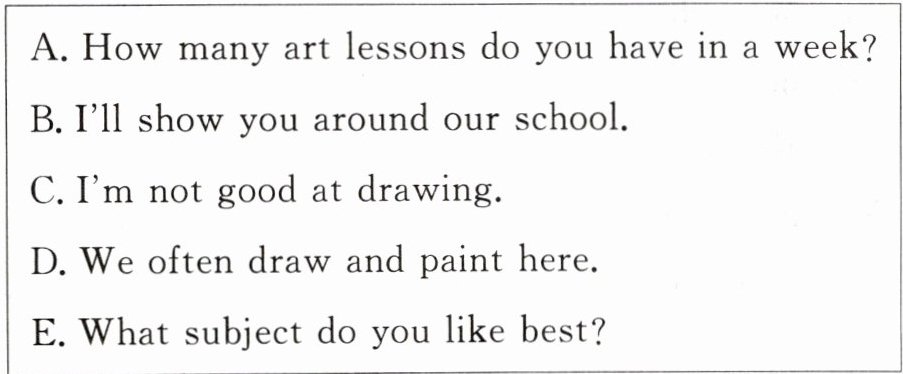 g.
g.
D. We often draw and paint here.
E. What subject do you like best?
Li Yan: Hello! Welcome to our school! My name's Li Yan. 1. This way, please. This is our art club.
Visitor: Oh, it's big and clean. 2.
Li Yan: We have two.
Visitor: What do you often do in the art club?
Li Yan: 3.
Visitor: These pictures are nice. Are you good at drawing?
Li Yan: No, 4. But my friend Peter is good at it. He likes it very much.
Visitor: 5.
Li Yan: I like PE best. I'm good at high jump.
Visitor: Oh, that's great!
A. How many art lessons do you have in a week?
B. I'll show you around our school.
C. I'm not good at dra
g.D. We often draw and paint here.
E. What subject do you like best?
答案
1. B 2. A 3. D 4. C 5. E
解析
我们可以根据上下文逻辑匹配选项:
1. 第一空:李燕欢迎来宾来到学校,后文引导来宾参观美术俱乐部,B选项“我将带你参观我们的学校”符合引出参观的语境。
2. 第二空:后文李燕的回答是“We have two.(我们有两节)”,说明此处是询问数量的问句,A选项“你们一周有多少节美术课?”和答句匹配。
3. 第三空:问句询问“你们经常在美术俱乐部做什么?”,需要回答对应的活动,D选项“我们经常在这里画画和涂色”符合问题要求。
4. 第四空:前文是一般疑问句“你擅长画画吗?”,且给出否定回答No,后文补充说朋友Peter擅长画画,C选项“我不擅长画画”衔接前后内容。
5. 第五空:后文李燕回答“我最喜欢体育”,说明此处是询问最喜欢的学科的问句,E选项“你最喜欢什么学科?”和答句匹配。
1. 第一空:李燕欢迎来宾来到学校,后文引导来宾参观美术俱乐部,B选项“我将带你参观我们的学校”符合引出参观的语境。
2. 第二空:后文李燕的回答是“We have two.(我们有两节)”,说明此处是询问数量的问句,A选项“你们一周有多少节美术课?”和答句匹配。
3. 第三空:问句询问“你们经常在美术俱乐部做什么?”,需要回答对应的活动,D选项“我们经常在这里画画和涂色”符合问题要求。
4. 第四空:前文是一般疑问句“你擅长画画吗?”,且给出否定回答No,后文补充说朋友Peter擅长画画,C选项“我不擅长画画”衔接前后内容。
5. 第五空:后文李燕回答“我最喜欢体育”,说明此处是询问最喜欢的学科的问句,E选项“你最喜欢什么学科?”和答句匹配。
