

 登录
登录
四、完成表格
阅读短文,根据短文内容,完成表格中所缺的信息。每空一词。
Maybe there's something personal you want to share with your parents. Or you're feeling stressed about something. When it comes to difficult topics, you may not know how to talk to your parents. Here is some advice.
Think about what you want from your parents.
Do you want them to listen and hear you out? Or help with a problem you're having? It helps if you know what you want. Put it into words. For example, "I need to tell you about a problem I'm having." "I need your advice about something. Can we talk?" "I have difficulty getting on with my deskmates. Could you please tell me what I should do?"
Think about how you feel.
Are you afraid that your parents will be angry or sad because you get in some trouble? Don't let those feelings stop you from talking. Parents are always there for us when we are in trouble. Instead, put your feelings into words. For example, "I need to talk to you. But I'm afraid I'll let you down."
Practise before you talk.
When it comes to talk time, you may be afraid to start or forget what you want to say. Then, try practising what you want to say in front of a mirror. Or practise with a friend. Practice can help you feel more comfortable when you're talking.
Pick a good time and place to talk.
Find a time when your parents aren't busy. Ask, "Can we talk? Is now a good time?" Try to find a space where there are no other people around. And then, just get started.
| Making talks about difficult topics easier | | |
| --- | --- | --- |
| 16.
| Think about your needs | * Make sure you're clear about what you want and speak it 17.
| Think about how you feel | * Don't be afraid that they will be angry.
Don't let those feelings stop you from 18.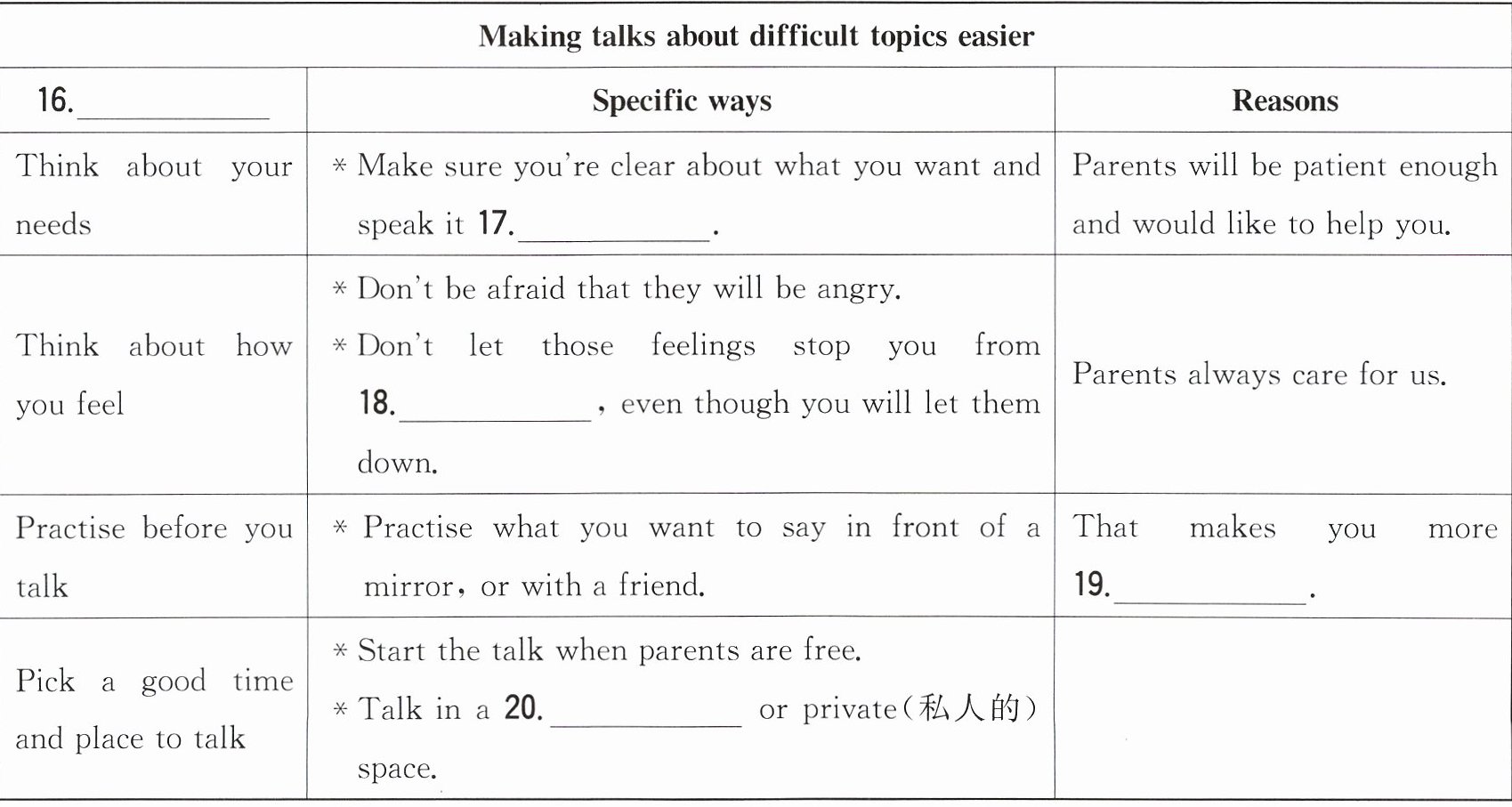 | Parents always care for us. |
| Practise before you talk | * Practise what you want to say in front of a mirror, or with a friend. | That makes you more 19.
| Pick a good time and place to talk | * Start the talk when parents are free.
Talk in a 20.
阅读短文,根据短文内容,完成表格中所缺的信息。每空一词。
Maybe there's something personal you want to share with your parents. Or you're feeling stressed about something. When it comes to difficult topics, you may not know how to talk to your parents. Here is some advice.
Think about what you want from your parents.
Do you want them to listen and hear you out? Or help with a problem you're having? It helps if you know what you want. Put it into words. For example, "I need to tell you about a problem I'm having." "I need your advice about something. Can we talk?" "I have difficulty getting on with my deskmates. Could you please tell me what I should do?"
Think about how you feel.
Are you afraid that your parents will be angry or sad because you get in some trouble? Don't let those feelings stop you from talking. Parents are always there for us when we are in trouble. Instead, put your feelings into words. For example, "I need to talk to you. But I'm afraid I'll let you down."
Practise before you talk.
When it comes to talk time, you may be afraid to start or forget what you want to say. Then, try practising what you want to say in front of a mirror. Or practise with a friend. Practice can help you feel more comfortable when you're talking.
Pick a good time and place to talk.
Find a time when your parents aren't busy. Ask, "Can we talk? Is now a good time?" Try to find a space where there are no other people around. And then, just get started.
| Making talks about difficult topics easier | | |
| --- | --- | --- |
| 16.
Advice
| Specific ways | Reasons || Think about your needs | * Make sure you're clear about what you want and speak it 17.
out
. | Parents will be patient enough and would like to help you. || Think about how you feel | * Don't be afraid that they will be angry.
Don't let those feelings stop you from 18.
talking
, even though you will let them down. | Parents always care for us. || Practise before you talk | * Practise what you want to say in front of a mirror, or with a friend. | That makes you more 19.
comfortable
. || Pick a good time and place to talk | * Start the talk when parents are free.
Talk in a 20.
quiet
or private(私人的) space. | |答案
16. Advice
17. out
18. talking
19. comfortable
20. quiet
17. out
18. talking
19. comfortable
20. quiet
解析
【分析】
本题为阅读理解信息匹配题,需根据短文内容补全表格空缺。解题思路:先通读短文,明确每段的核心内容;再对应表格的“总起内容、具体方法、原因”三列,定位每个空缺处对应的原文细节,确保每空一词,匹配准确。
【解析】
16. 短文开头明确给出核心内容“Here is some advice”,表格第一列是总起的建议类内容,故填Advice;
17. 对应“Think about your needs”部分,原文有“hear you out”及“Put it into words”,结合“speak it”的结构,固定搭配speak out(说出),故填out;
18. 对应“Think about how you feel”部分,原文直接提到“Don't let those feelings stop you from talking”,故填talking;
19. 对应“Practise before you talk”部分,原文最后一句“Practice can help you feel more comfortable”,故填comfortable;
20. 对应“Pick a good time and place to talk”部分,原文提到找“no other people around”的空间,即安静的空间,故填quiet。
【答案】
16. Advice 17. out 18. talking 19. comfortable 20. quiet
【知识点】
阅读理解;信息匹配;固定搭配
【点评】
本题考查学生快速定位原文信息的能力,需仔细对应表格与短文内容,注意固定搭配的运用,整体难度适中。
【难度系数】
0.7
本题为阅读理解信息匹配题,需根据短文内容补全表格空缺。解题思路:先通读短文,明确每段的核心内容;再对应表格的“总起内容、具体方法、原因”三列,定位每个空缺处对应的原文细节,确保每空一词,匹配准确。
【解析】
16. 短文开头明确给出核心内容“Here is some advice”,表格第一列是总起的建议类内容,故填Advice;
17. 对应“Think about your needs”部分,原文有“hear you out”及“Put it into words”,结合“speak it”的结构,固定搭配speak out(说出),故填out;
18. 对应“Think about how you feel”部分,原文直接提到“Don't let those feelings stop you from talking”,故填talking;
19. 对应“Practise before you talk”部分,原文最后一句“Practice can help you feel more comfortable”,故填comfortable;
20. 对应“Pick a good time and place to talk”部分,原文提到找“no other people around”的空间,即安静的空间,故填quiet。
【答案】
16. Advice 17. out 18. talking 19. comfortable 20. quiet
【知识点】
阅读理解;信息匹配;固定搭配
【点评】
本题考查学生快速定位原文信息的能力,需仔细对应表格与短文内容,注意固定搭配的运用,整体难度适中。
【难度系数】
0.7
