

 登录
登录
3. 听Aiwen和Sam讨论台风应急措施,记录他们的分工安排。
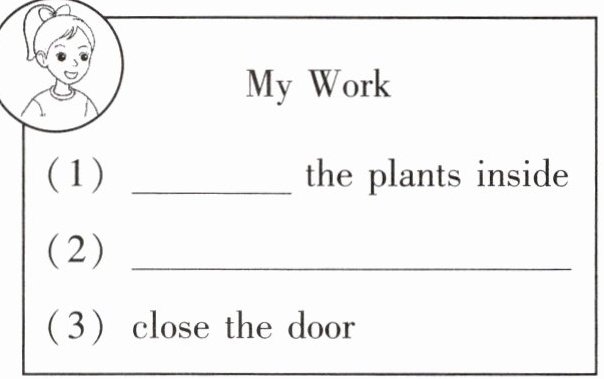
My Work
(1)
(2)
(3) close the door
My Work
(4) carry the books
(5) turn off the computer
(6)
My Work
(1)
bring
the plants inside(2)
close the windows
(3) close the door
My Work
(4) carry the books
inside
(5) turn off the computer
(6)
turn off the lights
答案
3. (1) bring (2) close the windows (4) inside (6) turn off the lights
提升4. 根据校园广播发布的台风应急通知,判断下列信息是否与通知相符。如相符,在括号内写“T”,否则写“F”。
(
(
(
(
(
(
F
) (1) The typhoon will come at 3:00 a. m. tomorrow.(
F
) (2) School will end at 11:00 a. m. today.(
T
) (3) The students need to turn off the lights, fans, and computers before they leave school.(
F
) (4) If the typhoon comes, run quickly and stay under the tree.(
T
) (5) A raincoat is better than an umbrella in strong winds.答案
4. (1) F (2) F (3) T (4) F (5) T
解析
【分析】
本题要求判断校园广播发布的台风应急通知相关信息的正误,解题思路为:逐一分析每小题的描述,结合台风应急的常规常识(校园台风通知的常见要求),判断描述是否与通知内容相符,相符则写“T”,不符则写“F”。
【解析】
(1) 台风到来的时间通常不会设定在凌晨3点,不符合台风应急通知的常规安排,故判断为F;
(2) 校园应对台风的放学时间一般不会是上午11点,不符合常规通知,故判断为F;
(3) 台风来临前,学生离校关闭灯光、风扇、电脑等电器是必要的应急措施,符合通知要求,故判断为T;
(4) 台风来临时躲在树下易被树枝等砸伤,属于危险行为,不符合应急要求,故判断为F;
(5) 强风天气下雨伞易被吹翻,雨衣的防护性更好,符合台风应急的建议,故判断为T。
【答案】
4. (1)F (2)F (3)T (4)F (5)T
【知识点】
台风应急常识、信息正误判断
【点评】
本题结合台风应急的生活常识进行信息判断,难度较低,学生通过日常积累即可完成解答。
【难度系数】
0.7
本题要求判断校园广播发布的台风应急通知相关信息的正误,解题思路为:逐一分析每小题的描述,结合台风应急的常规常识(校园台风通知的常见要求),判断描述是否与通知内容相符,相符则写“T”,不符则写“F”。
【解析】
(1) 台风到来的时间通常不会设定在凌晨3点,不符合台风应急通知的常规安排,故判断为F;
(2) 校园应对台风的放学时间一般不会是上午11点,不符合常规通知,故判断为F;
(3) 台风来临前,学生离校关闭灯光、风扇、电脑等电器是必要的应急措施,符合通知要求,故判断为T;
(4) 台风来临时躲在树下易被树枝等砸伤,属于危险行为,不符合应急要求,故判断为F;
(5) 强风天气下雨伞易被吹翻,雨衣的防护性更好,符合台风应急的建议,故判断为T。
【答案】
4. (1)F (2)F (3)T (4)F (5)T
【知识点】
台风应急常识、信息正误判断
【点评】
本题结合台风应急的生活常识进行信息判断,难度较低,学生通过日常积累即可完成解答。
【难度系数】
0.7
5. 读Aiwen与外国好友Lisa的对话,选择问题的最佳答案,将其英文大写字母编号写在括号内。
Aiwen: Hi, Lisa! A typhoon is coming!
Lisa: Do you call the big storm(暴风雨)a "typhoon"? We call it a hurricane(飓风)in the USA.
Aiwen: A hurricane? What's it like?
Lisa: It often comes in summer and autumn. It will bring big waves near the seaside. It's very dangerous.
Aiwen: What will you do if you happen to be outside?
Lisa: Stay away from trees, rivers, and the seaside. And wear a colourful raincoat, so others can see you in heavy rain and strong winds.
Aiwen: Right! A raincoat is better than an umbrella. Strong winds may blow away the umbrella.
Lisa: Yes! Safety first!
(
A. A typhoon.
B. A hurricane.
C. A rainstorm.
(
A. In summer and autumn.
B. In spring and summer.
C. In winter and spring.
(
A. Because it is too hot there.
B. Because there is no raincoat there.
C. Because big waves are dangerous.
(
A. Because it is more beautiful than a dark raincoat.
B. Because it can keep us away from strong winds.
C. Because it can help others see us clearly in bad weather.
(
A. how to stay safe indoors
B. the different names of big storms and safety rules
C. when to wear a colourful raincoat on rainy days
Aiwen: Hi, Lisa! A typhoon is coming!
Lisa: Do you call the big storm(暴风雨)a "typhoon"? We call it a hurricane(飓风)in the USA.
Aiwen: A hurricane? What's it like?
Lisa: It often comes in summer and autumn. It will bring big waves near the seaside. It's very dangerous.
Aiwen: What will you do if you happen to be outside?
Lisa: Stay away from trees, rivers, and the seaside. And wear a colourful raincoat, so others can see you in heavy rain and strong winds.
Aiwen: Right! A raincoat is better than an umbrella. Strong winds may blow away the umbrella.
Lisa: Yes! Safety first!
(
B
) (1) What do people in the USA call the big storm?A. A typhoon.
B. A hurricane.
C. A rainstorm.
(
A
) (2) When does a hurricane often come in the USA?A. In summer and autumn.
B. In spring and summer.
C. In winter and spring.
(
C
) (3) Why should we stay away from the seaside in a hurricane?A. Because it is too hot there.
B. Because there is no raincoat there.
C. Because big waves are dangerous.
(
C
) (4) Why should we wear a colourful raincoat in heavy rain?A. Because it is more beautiful than a dark raincoat.
B. Because it can keep us away from strong winds.
C. Because it can help others see us clearly in bad weather.
(
B
) (5) From the dialogue, we know .A. how to stay safe indoors
B. the different names of big storms and safety rules
C. when to wear a colourful raincoat on rainy days
答案
5. (1) B (2) A (3) C (4) C (5) B
解析
【分析】本题为对话类阅读理解题,解题思路是:先通读对话,把握核心内容;再针对每个问题,定位对话中对应的关键语句,将语句信息与选项逐一匹配,选出最佳答案。
【解析】(1) 根据对话中Lisa所说“We call it a hurricane in the USA.”,可知美国对大风暴的称呼是hurricane,对应选项B;(2) 根据Lisa所说“It often comes in summer and autumn.”,可知飓风常出现在夏季和秋季,对应选项A;(3) 根据Lisa所说“It will bring big waves near the seaside. It's very dangerous.”,可知飓风时海边有危险的大浪,因此要远离,对应选项C;(4) 根据Lisa所说“And wear a colourful raincoat, so others can see you in heavy rain and strong winds.”,可知穿彩色雨衣是为了让他人在恶劣天气中看清自己,对应选项C;(5) 对话既介绍了大风暴的不同名称(台风、飓风),又说明了飓风来临时的安全规则,对应选项B。
【答案】(1)B (2)A (3)C (4)C (5)B
【知识点】阅读理解(细节理解、主旨归纳)
【点评】本题为贴近生活的对话型阅读理解,主要考查学生提取文本细节信息和归纳主旨的能力,难度适中。
【难度系数】0.6
【解析】(1) 根据对话中Lisa所说“We call it a hurricane in the USA.”,可知美国对大风暴的称呼是hurricane,对应选项B;(2) 根据Lisa所说“It often comes in summer and autumn.”,可知飓风常出现在夏季和秋季,对应选项A;(3) 根据Lisa所说“It will bring big waves near the seaside. It's very dangerous.”,可知飓风时海边有危险的大浪,因此要远离,对应选项C;(4) 根据Lisa所说“And wear a colourful raincoat, so others can see you in heavy rain and strong winds.”,可知穿彩色雨衣是为了让他人在恶劣天气中看清自己,对应选项C;(5) 对话既介绍了大风暴的不同名称(台风、飓风),又说明了飓风来临时的安全规则,对应选项B。
【答案】(1)B (2)A (3)C (4)C (5)B
【知识点】阅读理解(细节理解、主旨归纳)
【点评】本题为贴近生活的对话型阅读理解,主要考查学生提取文本细节信息和归纳主旨的能力,难度适中。
【难度系数】0.6
