

 登录
登录
二、将括号内的单词或短语连成正确的句子,并加上恰当的标点符号
1. (came up with / what / a brilliant idea / Archimedes)
2. (through / you / did / come up with / observation / a great idea)
3. (learn / we / from / what / can / the story)
4. (stop / when / you / a challenge / never / face / thinking)
5. (our / creativity / make / with / the world / can / we / to / a difference)
1. (came up with / what / a brilliant idea / Archimedes)
What a brilliant idea Archimedes came up with!
2. (through / you / did / come up with / observation / a great idea)
Did you come up with a great idea through observation?
3. (learn / we / from / what / can / the story)
What can we learn from the story?
4. (stop / when / you / a challenge / never / face / thinking)
Never stop thinking when you face a challenge.
5. (our / creativity / make / with / the world / can / we / to / a difference)
We can make a difference to the world with our creativity.
答案
1. What a brilliant idea Archimedes came up with!
2. Did you come up with a great idea through observation?
3. What can we learn from the story?
4. Never stop thinking when you face a challenge.
5. We can make a difference to the world with our creativity.
2. Did you come up with a great idea through observation?
3. What can we learn from the story?
4. Never stop thinking when you face a challenge.
5. We can make a difference to the world with our creativity.
解析
【分析】
做这类连词成句题,首先观察括号内的内容和要求的标点,判断句子类型(感叹句、疑问句、陈述句等);再根据英语句子基本结构,结合特殊疑问词、助动词位置及固定短语搭配,将单词/短语按正确语序排列;最后加上符合句式的标点符号。
【解析】
1. 括号内有特殊疑问词what,构成感叹句,结构为“What + a/an + 形容词 + 名词 + 主语 + 谓语!”,排列为:What a brilliant idea Archimedes came up with!
2. 括号内有助动词did,构成一般疑问句,结构为“Did + 主语 + 动词短语 + 其他?”,结合固定搭配come up with、方式状语through observation,排列为:Did you come up with a great idea through observation?
3. 括号内有特殊疑问词what,构成特殊疑问句,结构为“特殊疑问词 + 情态动词 + 主语 + 谓语 + 其他?”,结合固定搭配learn from,排列为:What can we learn from the story?
4. 括号内有否定词never,构成否定祈使句,结构为“Never + 动词原形 + 其他 + 时间状语从句”,结合when引导的时间状语,排列为:Never stop thinking when you face a challenge.
5. 括号内为陈述句,结构为“主语 + 情态动词 + 动词短语 + 其他”,结合固定搭配make a difference to、方式状语with our creativity,排列为:We can make a difference to the world with our creativity.
【答案】
1. What a brilliant idea Archimedes came up with!
2. Did you come up with a great idea through observation?
3. What can we learn from the story?
4. Never stop thinking when you face a challenge.
5. We can make a difference to the world with our creativity.
【知识点】
英语连词成句、感叹句、疑问句
【点评】
本题为基础英语连词成句题,考查不同句式的语序掌握及常用固定短语运用,是英语学习的基础题型,需熟悉各类句式结构规则。
【难度系数】
0.3
做这类连词成句题,首先观察括号内的内容和要求的标点,判断句子类型(感叹句、疑问句、陈述句等);再根据英语句子基本结构,结合特殊疑问词、助动词位置及固定短语搭配,将单词/短语按正确语序排列;最后加上符合句式的标点符号。
【解析】
1. 括号内有特殊疑问词what,构成感叹句,结构为“What + a/an + 形容词 + 名词 + 主语 + 谓语!”,排列为:What a brilliant idea Archimedes came up with!
2. 括号内有助动词did,构成一般疑问句,结构为“Did + 主语 + 动词短语 + 其他?”,结合固定搭配come up with、方式状语through observation,排列为:Did you come up with a great idea through observation?
3. 括号内有特殊疑问词what,构成特殊疑问句,结构为“特殊疑问词 + 情态动词 + 主语 + 谓语 + 其他?”,结合固定搭配learn from,排列为:What can we learn from the story?
4. 括号内有否定词never,构成否定祈使句,结构为“Never + 动词原形 + 其他 + 时间状语从句”,结合when引导的时间状语,排列为:Never stop thinking when you face a challenge.
5. 括号内为陈述句,结构为“主语 + 情态动词 + 动词短语 + 其他”,结合固定搭配make a difference to、方式状语with our creativity,排列为:We can make a difference to the world with our creativity.
【答案】
1. What a brilliant idea Archimedes came up with!
2. Did you come up with a great idea through observation?
3. What can we learn from the story?
4. Never stop thinking when you face a challenge.
5. We can make a difference to the world with our creativity.
【知识点】
英语连词成句、感叹句、疑问句
【点评】
本题为基础英语连词成句题,考查不同句式的语序掌握及常用固定短语运用,是英语学习的基础题型,需熟悉各类句式结构规则。
【难度系数】
0.3
一、根据音标写出对应的单词
1. /prɪns/
2. /'sætɪsfaɪd/
3. /dɪs'pleɪs/
4. /fuːl/
5. /pruːv/
6. /'hɑːdli/
7. /'bælənst/
8. /'fænsi/
9. /ˌæplɪ'keɪʃn/
10. /'ɪgnərəns/
1. /prɪns/
prince
2. /'sætɪsfaɪd/
satisfied
3. /dɪs'pleɪs/
displace
4. /fuːl/
fool
5. /pruːv/
prove
6. /'hɑːdli/
hardly
7. /'bælənst/
balanced
8. /'fænsi/
fancy
9. /ˌæplɪ'keɪʃn/
application
10. /'ɪgnərəns/
ignorance
答案
1. prince 2. satisfied 3. displace 4. fool 5. prove 6. hardly 7. balanced 8. fancy 9. application 10. ignorance
解析
【分析】
解答此类根据音标写单词的题目,需按以下思路操作:① 先识别音标中的重音符号('表示该音节重读,ˌ表示次重读),明确单词的重音位置;② 结合英语词汇的发音规则,匹配每个音素对应的字母组合,回忆符合该发音的常用英语单词;③ 核对单词拼写,确保与音标完全对应,避免形近或音近词的混淆。
【解析】
根据音标逐一匹配对应单词:
1. /prɪns/ 对应单词为prince;
2. /'sætɪsfaɪd/ 对应单词为satisfied;
3. /dɪs'pleɪs/ 对应单词为displace;
4. /fuːl/ 对应单词为fool;
5. /pruːv/ 对应单词为prove;
6. /'hɑːdli/ 对应单词为hardly;
7. /'bælənst/ 对应单词为balanced;
8. /'fænsi/ 对应单词为fancy;
9. /ˌæplɪ'keɪʃn/ 对应单词为application;
10. /'ɪgnərəns/ 对应单词为ignorance。
【答案】
1. prince 2. satisfied 3. displace 4. fool 5. prove 6. hardly 7. balanced 8. fancy 9. application 10. ignorance
【知识点】
英语音标与单词对应、英语单词拼写
【点评】
本题考查基础英语词汇的音形对应关系,是英语学习中的常规基础题型,侧重对核心常用单词发音和拼写的掌握,难度较低。
【难度系数】
0.8
解答此类根据音标写单词的题目,需按以下思路操作:① 先识别音标中的重音符号('表示该音节重读,ˌ表示次重读),明确单词的重音位置;② 结合英语词汇的发音规则,匹配每个音素对应的字母组合,回忆符合该发音的常用英语单词;③ 核对单词拼写,确保与音标完全对应,避免形近或音近词的混淆。
【解析】
根据音标逐一匹配对应单词:
1. /prɪns/ 对应单词为prince;
2. /'sætɪsfaɪd/ 对应单词为satisfied;
3. /dɪs'pleɪs/ 对应单词为displace;
4. /fuːl/ 对应单词为fool;
5. /pruːv/ 对应单词为prove;
6. /'hɑːdli/ 对应单词为hardly;
7. /'bælənst/ 对应单词为balanced;
8. /'fænsi/ 对应单词为fancy;
9. /ˌæplɪ'keɪʃn/ 对应单词为application;
10. /'ɪgnərəns/ 对应单词为ignorance。
【答案】
1. prince 2. satisfied 3. displace 4. fool 5. prove 6. hardly 7. balanced 8. fancy 9. application 10. ignorance
【知识点】
英语音标与单词对应、英语单词拼写
【点评】
本题考查基础英语词汇的音形对应关系,是英语学习中的常规基础题型,侧重对核心常用单词发音和拼写的掌握,难度较低。
【难度系数】
0.8
二、阅读并补全对话
A: What problem do you want to solve, Linda?
B: My schoolbag is too heavy. It hurts my shoulders. I just had an idea about how to solve this problem.
A: Really? 1.
B: It's really simple. We can use e-textbooks at school. Then I only need to carry a lightweight tablet to school.
A: 2.
A: What problem do you want to solve, Linda?
B: My schoolbag is too heavy. It hurts my shoulders. I just had an idea about how to solve this problem.
A: Really? 1.
What’s your idea
?B: It's really simple. We can use e-textbooks at school. Then I only need to carry a lightweight tablet to school.
A: 2.
That’s amazing / What a creative idea
!答案
1. What’s your idea 2. That’s amazing / What a creative idea
解析
【分析】
先通读对话梳理上下文逻辑:A询问Linda的问题,Linda说明书包重且有解决办法,因此A第一空需询问Linda的具体想法;Linda提出用电子课本、携带轻平板的方案,A第二空需对这个好主意表达赞叹,结合日常情景交际用语即可得出答案。
【解析】
1. 上文B提到有解决问题的想法,A此处应询问具体想法,故填What’s your idea;
2. B提出的用电子课本的方案很实用,A需表达赞叹,故填That’s amazing / What a creative idea。
【答案】
1. What’s your idea 2. That’s amazing / What a creative idea
【知识点】
英语情景交际,补全对话
【点评】
本题考查日常情景对话的补全,需结合上下文语境选择合适的交际用语,属于基础题型,注重日常用语的积累。
【难度系数】
0.8
先通读对话梳理上下文逻辑:A询问Linda的问题,Linda说明书包重且有解决办法,因此A第一空需询问Linda的具体想法;Linda提出用电子课本、携带轻平板的方案,A第二空需对这个好主意表达赞叹,结合日常情景交际用语即可得出答案。
【解析】
1. 上文B提到有解决问题的想法,A此处应询问具体想法,故填What’s your idea;
2. B提出的用电子课本的方案很实用,A需表达赞叹,故填That’s amazing / What a creative idea。
【答案】
1. What’s your idea 2. That’s amazing / What a creative idea
【知识点】
英语情景交际,补全对话
【点评】
本题考查日常情景对话的补全,需结合上下文语境选择合适的交际用语,属于基础题型,注重日常用语的积累。
【难度系数】
0.8
三、请根据以下表格写一篇短文,讲述圆珠笔发明的故事,字数不少于80
| Problem | use fountain pens, refill the pens, make a mess on the paper |
| Who | László Bíró, Hungarian |
|
| Inspiration | see newspaper ink dry quickly |
续表
| What idea | develop a new type of pen(ballpoint pen) |
| How he solved the problem | • make a tiny metal ball and put it on the pen tip;
• fill the pen with thick, quick-drying ink;
• roll ink onto paper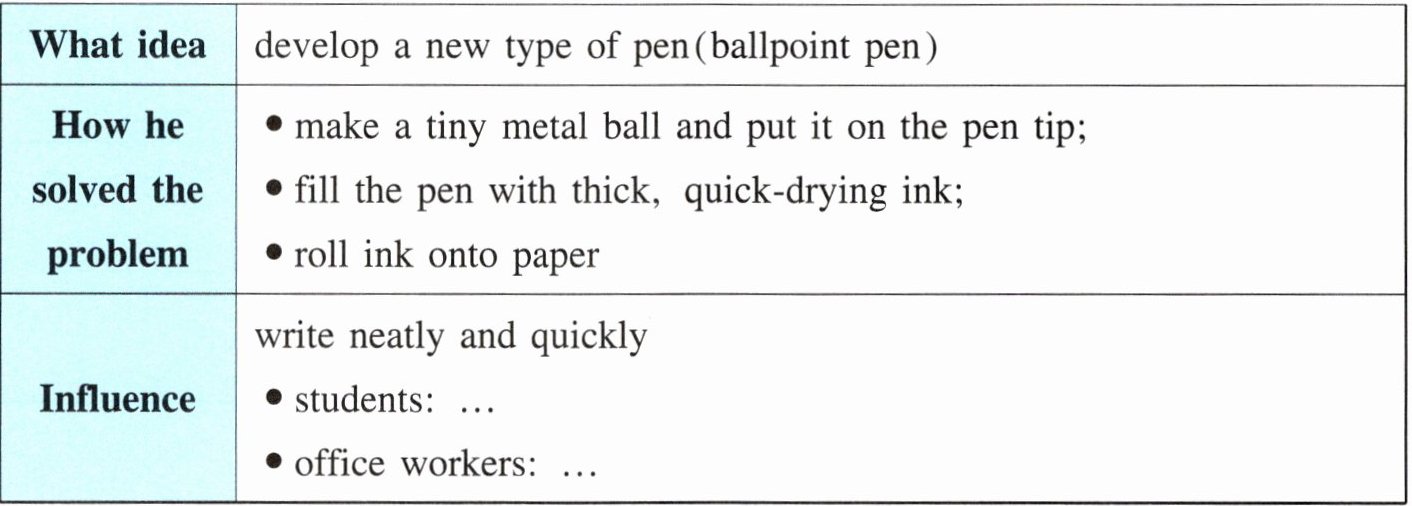 |
|
| Influence | write neatly and quickly
• students: ...
• office workers: ... |
Focusing on culture
阅读课文,回答问题
1. Who wrote Daodejing?
2. What is the central idea in Daodejing?
3. What does Laozi’s saying “The highest good is like water.” mean?
4. Why is Daodejing still popular today?
| Problem | use fountain pens, refill the pens, make a mess on the paper |
| Who | László Bíró, Hungarian
|| Inspiration | see newspaper ink dry quickly |
续表
| What idea | develop a new type of pen(ballpoint pen) |
| How he solved the problem | • make a tiny metal ball and put it on the pen tip;
• fill the pen with thick, quick-drying ink;
• roll ink onto paper
|| Influence | write neatly and quickly
• students: ...
• office workers: ... |
Focusing on culture
阅读课文,回答问题
1. Who wrote Daodejing?
It is believed that Laozi wrote Daodejing.
2. What is the central idea in Daodejing?
The central idea in Daodejing is Dao, which is commonly translated as “Way”, and the title Daodejing is understood as “Way of nature as a whole”.
3. What does Laozi’s saying “The highest good is like water.” mean?
It means Dao or “Way” is everywhere(like water), and teaches us not to control things but to accept what we have and go with the way of nature.
4. Why is Daodejing still popular today?
Because its ideas about living in harmony with nature still inspire us in our modern lives, and it has influenced philosophy, art and literature around the world.
答案
In the past, people used fountain pens. They had to refill the pens all the time. The ink did not dry easily and it sometimes made a mess on the paper.
A Hungarian inventor named László Bíró came up with a brilliant idea when he saw that newspaper ink dried very quickly. He decided to develop a new type of pen. First, he made a tiny metal ball and put it on the pen tip. Then he filled the pen with thick, quick-drying ink. The ball rolled ink onto paper as it moved. In this way, the ballpoint pen was invented.
Thanks to this great idea, people can write quickly and neatly. Students use ballpoint pens for homework every day. They are also used by office workers to sign documents and fill forms. What a useful invention it is!
1. It is believed that Laozi wrote Daodejing.
2. The central idea in Daodejing is Dao, which is commonly translated as “Way”, and the title Daodejing is understood as “Way of nature as a whole”.
3. It means Dao or “Way” is everywhere(like water), and teaches us not to control things but to accept what we have and go with the way of nature.
4. Because its ideas about living in harmony with nature still inspire us in our modern lives, and it has influenced philosophy, art and literature around the world.
A Hungarian inventor named László Bíró came up with a brilliant idea when he saw that newspaper ink dried very quickly. He decided to develop a new type of pen. First, he made a tiny metal ball and put it on the pen tip. Then he filled the pen with thick, quick-drying ink. The ball rolled ink onto paper as it moved. In this way, the ballpoint pen was invented.
Thanks to this great idea, people can write quickly and neatly. Students use ballpoint pens for homework every day. They are also used by office workers to sign documents and fill forms. What a useful invention it is!
1. It is believed that Laozi wrote Daodejing.
2. The central idea in Daodejing is Dao, which is commonly translated as “Way”, and the title Daodejing is understood as “Way of nature as a whole”.
3. It means Dao or “Way” is everywhere(like water), and teaches us not to control things but to accept what we have and go with the way of nature.
4. Because its ideas about living in harmony with nature still inspire us in our modern lives, and it has influenced philosophy, art and literature around the world.
解析
【分析】
本题包含两部分任务:第一部分需根据给定表格信息撰写关于圆珠笔发明的短文,解题思路为:先梳理表格中传统钢笔的弊端(需频繁灌墨、墨水易弄脏纸张)、发明者身份、灵感来源(报纸墨水快干)、发明的具体方法(金属球笔尖、快干厚墨水)、使用影响(学生与上班族的用途),将这些信息按逻辑串联成通顺的英语短文,满足字数要求;第二部分是关于《道德经》的文化问答,需准确掌握《道德经》的作者、核心思想、名言含义及当代价值,对应作答即可。
【解析】
1. 短文写作:先点明过去人们使用钢笔的问题(需频繁灌墨、墨水干得慢易弄脏纸张),再介绍匈牙利发明家László Bíró看到报纸墨水快干后产生发明新笔的想法,具体方法是在笔尖装小金属球、灌入厚的快干墨水,金属球滚动将墨水涂在纸上,最后说明圆珠笔的影响(书写快且整齐,学生和上班族常用),确保字数达标。
2. 问答部分:
1. 对应《道德经》作者的知识点作答;
2. 对应《道德经》核心思想的知识点作答;
3. 对应“上善若水”的含义作答;
4. 对应《道德经》当代价值的知识点作答。
【答案】
In the past, people used fountain pens. They had to refill the pens all the time. The ink did not dry easily and it sometimes made a mess on the paper.
A Hungarian inventor named László Bíró came up with a brilliant idea when he saw that newspaper ink dried very quickly. He decided to develop a new type of pen. First, he made a tiny metal ball and put it on the pen tip. Then he filled the pen with thick, quick-drying ink. The ball rolled ink onto paper as it moved. In this way, the ballpoint pen was invented.
Thanks to this great idea, people can write quickly and neatly. Students use ballpoint pens for homework every day. They are also used by office workers to sign documents and fill forms. What a useful invention it is!
1. It is believed that Laozi wrote Daodejing.
2. The central idea in Daodejing is Dao, which is commonly translated as “Way”, and the title Daodejing is understood as “Way of nature as a whole”.
3. It means Dao or “Way” is everywhere(like water), and teaches us not to control things but to accept what we have and go with the way of nature.
4. Because its ideas about living in harmony with nature still inspire us in our modern lives, and it has influenced philosophy, art and literature around the world.
【知识点】
英语应用写作、中国传统文化、英语文化问答
【点评】
本题结合英语应用写作与中国传统文化知识,既考察信息整合与书面表达能力,又检验对经典文化的理解,题型综合,难度适中。
【难度系数】
0.6
本题包含两部分任务:第一部分需根据给定表格信息撰写关于圆珠笔发明的短文,解题思路为:先梳理表格中传统钢笔的弊端(需频繁灌墨、墨水易弄脏纸张)、发明者身份、灵感来源(报纸墨水快干)、发明的具体方法(金属球笔尖、快干厚墨水)、使用影响(学生与上班族的用途),将这些信息按逻辑串联成通顺的英语短文,满足字数要求;第二部分是关于《道德经》的文化问答,需准确掌握《道德经》的作者、核心思想、名言含义及当代价值,对应作答即可。
【解析】
1. 短文写作:先点明过去人们使用钢笔的问题(需频繁灌墨、墨水干得慢易弄脏纸张),再介绍匈牙利发明家László Bíró看到报纸墨水快干后产生发明新笔的想法,具体方法是在笔尖装小金属球、灌入厚的快干墨水,金属球滚动将墨水涂在纸上,最后说明圆珠笔的影响(书写快且整齐,学生和上班族常用),确保字数达标。
2. 问答部分:
1. 对应《道德经》作者的知识点作答;
2. 对应《道德经》核心思想的知识点作答;
3. 对应“上善若水”的含义作答;
4. 对应《道德经》当代价值的知识点作答。
【答案】
In the past, people used fountain pens. They had to refill the pens all the time. The ink did not dry easily and it sometimes made a mess on the paper.
A Hungarian inventor named László Bíró came up with a brilliant idea when he saw that newspaper ink dried very quickly. He decided to develop a new type of pen. First, he made a tiny metal ball and put it on the pen tip. Then he filled the pen with thick, quick-drying ink. The ball rolled ink onto paper as it moved. In this way, the ballpoint pen was invented.
Thanks to this great idea, people can write quickly and neatly. Students use ballpoint pens for homework every day. They are also used by office workers to sign documents and fill forms. What a useful invention it is!
1. It is believed that Laozi wrote Daodejing.
2. The central idea in Daodejing is Dao, which is commonly translated as “Way”, and the title Daodejing is understood as “Way of nature as a whole”.
3. It means Dao or “Way” is everywhere(like water), and teaches us not to control things but to accept what we have and go with the way of nature.
4. Because its ideas about living in harmony with nature still inspire us in our modern lives, and it has influenced philosophy, art and literature around the world.
【知识点】
英语应用写作、中国传统文化、英语文化问答
【点评】
本题结合英语应用写作与中国传统文化知识,既考察信息整合与书面表达能力,又检验对经典文化的理解,题型综合,难度适中。
【难度系数】
0.6
