

 登录
1. 如图,在△ABC中,D、E分别是边AB和AC上的点,DE//BC,AD=3BD,△ABC的面积为32,则△ADE的面积为
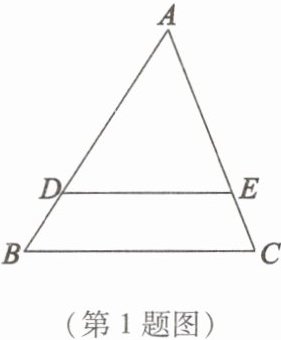
(第1题图)
18
。(第1题图)
答案
18
2. 如图,在$△ ABC$中,点D在边AB上,点E在边AC上,$∠ AEB=∠ EDB$.
(1)求证:$△ BDE ∽ △ BEA$.
(2)若$∠ C=∠ BEC$,$BD=1$,$AD=2$,求BC的长度.
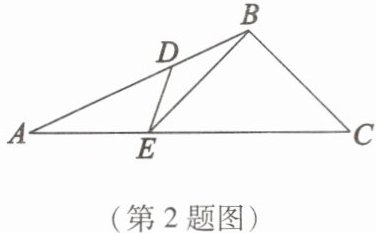
(第2题图)
(1)求证:$△ BDE ∽ △ BEA$.
(2)若$∠ C=∠ BEC$,$BD=1$,$AD=2$,求BC的长度.
(第2题图)
答案
(1)$\because ∠ ABE= ∠ EBD,∠ AEB= ∠ EDB$,
$\therefore △ BDE ∽ △ BEA$.
(2)$\because △ BDE ∽ △ BEA$,
$\therefore BD:BE=BE:BA$,即$BE^{2}=BD · BA$.
$\because BD=1,AD=2$,
$\therefore AB=3$.
$\therefore BE^{2}=1 × 3$.
$\therefore BE=\sqrt{3}$.
$\because ∠ C= ∠ BEC$,
$\therefore BC=BE=\sqrt{3}$.
$\therefore △ BDE ∽ △ BEA$.
(2)$\because △ BDE ∽ △ BEA$,
$\therefore BD:BE=BE:BA$,即$BE^{2}=BD · BA$.
$\because BD=1,AD=2$,
$\therefore AB=3$.
$\therefore BE^{2}=1 × 3$.
$\therefore BE=\sqrt{3}$.
$\because ∠ C= ∠ BEC$,
$\therefore BC=BE=\sqrt{3}$.
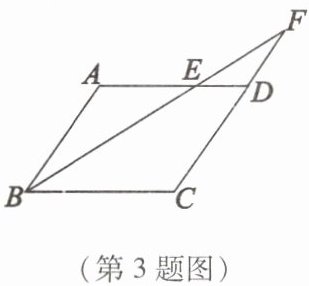
3.如图,点E是$□ ABCD$的边AD上的一点,且$DE:AE=1:2$,连结BE并延长,交CD的延长线于点F,若$DE=3,DF=4$,则$□ ABCD$的周长为(
A.21
B.28
C.34
D.48
C
).A.21
B.28
C.34
D.48
答案
C
4. 如图,在四边形ABCD中,对角线AC、BD相交于点E,且∠ABD=∠ACD.
(1)求证:$\frac{EB}{EC}=\frac{EA}{ED}$.
(2)求证:∠DAC=∠CBD.
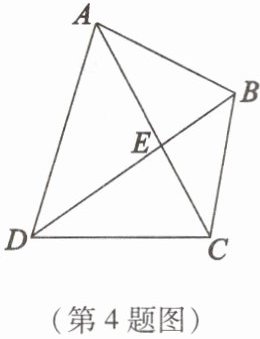
(第4题图)
(1)求证:$\frac{EB}{EC}=\frac{EA}{ED}$.
(2)求证:∠DAC=∠CBD.
(第4题图)
答案
(1)$\because ∠ ABD= ∠ ACD,∠ AEB= ∠ DEC$,
$\therefore △ ABE ∽ △ DCE$.
$\therefore \frac{EB}{EC}=\frac{EA}{ED}$.
(2)$\because \frac{EB}{EC}=\frac{EA}{ED}$,
$\therefore \frac{BE}{AE}=\frac{CE}{DE}$.
又$\because ∠ AED= ∠ BEC$,
$\therefore △ ADE ∽ △ BCE$.
$\therefore ∠ DAC= ∠ CBD$.
$\therefore △ ABE ∽ △ DCE$.
$\therefore \frac{EB}{EC}=\frac{EA}{ED}$.
(2)$\because \frac{EB}{EC}=\frac{EA}{ED}$,
$\therefore \frac{BE}{AE}=\frac{CE}{DE}$.
又$\because ∠ AED= ∠ BEC$,
$\therefore △ ADE ∽ △ BCE$.
$\therefore ∠ DAC= ∠ CBD$.
5. (1)如图1,$△ ACB$和$△ DCE$为等腰直角三角形,$∠ ACB=∠ DCE=90°$,求证:$BD=AE$.
(2)如图2,$∠ ACB=∠ DCE=90°$,$∠ ABC=∠ EDC$,$BC=2AC$,试探究线段$BD$与线段$AE$的关系,并加以证明.
(3)如图3,$∠ ACB=90°$,$AC=3BC$,$AD=6$,$CD=\sqrt{10}$,求$BD$的最大值.
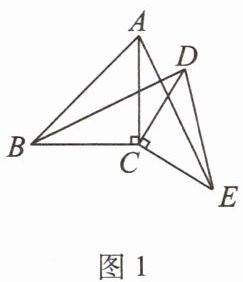
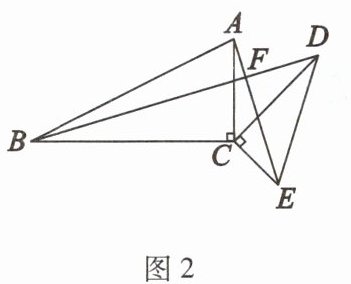
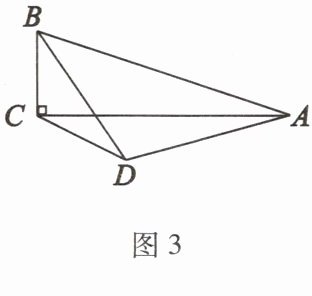
(第5题图)
(2)如图2,$∠ ACB=∠ DCE=90°$,$∠ ABC=∠ EDC$,$BC=2AC$,试探究线段$BD$与线段$AE$的关系,并加以证明.
(3)如图3,$∠ ACB=90°$,$AC=3BC$,$AD=6$,$CD=\sqrt{10}$,求$BD$的最大值.
(第5题图)
答案
(1)根据题意,得$CB=CA,CE=CD$.
$\because ∠ ACB= ∠ DCE=90^{ \circ }$,
$\therefore ∠ DCB= ∠ ECA$.
$\therefore △ DCB ≌ △ ECA(\mathrm{SAS})$.
$\therefore BD=AE$.
(2)$BD=2AE,BD ⊥ AE$.
证明:$\because ∠ ACB = ∠ DCE = 90^{ \circ }$,$∠ ABC= ∠ EDC$,
$\therefore △ ACB ∽ △ ECD$.
$\therefore \frac{CB}{CD}=\frac{CA}{CE}$.
$\therefore \frac{CB}{CA}=\frac{CD}{CE}$.
$\because ∠ ACB= ∠ DCE=90^{ \circ }$,
$\therefore ∠ DCB= ∠ ECA$.
$\therefore △ DCB ∽ △ ECA$.
$\therefore \frac{BD}{AE}=\frac{BC}{AC}$,$∠ BDC= ∠ AEC$.
$\because BC=2AC$,
$\therefore BD=2AE$.
$\because ∠ BDC+ ∠ DFE= ∠ AEC+ ∠ DCE$,
$\therefore ∠ DFE= ∠ DCE=90^{ \circ }$,
即$BD ⊥ AE$.
(3)如图,过点$C$作$CE ⊥ CD$,在$CE$上取点$E$,使$CE=3CD$,连结$DE$、$AE$.
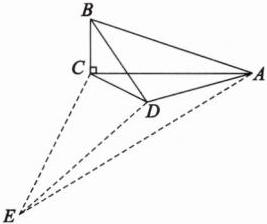
$\because CE ⊥ CD$,
$\therefore ∠ ECD=90^{ \circ }$.
$\because ∠ ACB=90^{ \circ }$,
$\therefore ∠ BCD= ∠ ACE$.
$\because AC=3BC$,
$\therefore \frac{AC}{BC}=\frac{CE}{CD}=3$.
$\therefore △ ACE ∽ △ BCD$.
$\therefore \frac{BD}{AE}=\frac{BC}{AC}$.
$\because AC=3BC$,
$\therefore AE=3BD$.
$\because CD=\sqrt{10}$,
$\therefore CE=3\sqrt{10}$.
$\therefore DE=10$.
$\because AD=6$,
$\therefore AE ≤ AD+DE=16$.
$\therefore AE$的最大值为16.
$\therefore BD$的最大值为$\frac{16}{3}$.
