

 登录
Managing money well
Think Before You Spend
Read & answer: What tips does Mr Davis give to help students spend money wisely?
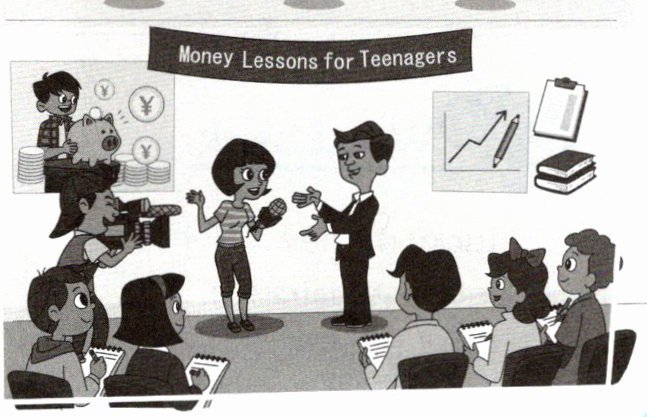
Reporter: Good morning, Mr Davis. Many students spend their pocket money quickly. How can they become smarter spenders?
Davis: The key is to think before you spend. Here are some simple tips. First, ask yourself two questions before buying: “Do I really need this?” and “Can I afford it?” If the answer to either question is no, don’t buy it. Second, make a wish list. Write down things you want, like a new game or a bike. Then rank them from the most important to the least important. This helps you focus on what matters most. Third, set a savings goal. If you want something expensive, decide how much to save each week. For example, save 10 yuan every week for a 100-yuan toy. In ten weeks, you’ll have enough! Fourth, compare prices before you buy. Check different shops or look online. Sometimes the same thing costs less in another place. Finally, for big purchases, wait 24 hours. After one day, ask yourself again, “Do I still want this?” Often, the feeling goes away, and you save your money.
Reporter: These tips sound easy to follow. Why are they important?
Davis: Because they help you make smart choices. When you plan your spending, you feel proud and in control. You also learn to value your parents’ hard work. These habits will stay with you for life.
Reporter: Thank you, Mr Davis!
Davis: Remember: Think before you spend, and spend with purpose!
Ⅰ. Read and tick or cross. 读一读,判断对(√)错(×)。
(
(
(
Ⅱ. Read and choose. 读一读,选出正确的答案。
(
A. How to make more pocket money.
B. How to spend money wisely.
C. How to save money in the bank.

(
A. They help students buy more things.
B. They help students make smart choices and build good habits.
C. They help students follow what their classmates do.
Ⅲ. Read and fill in the blanks. 读一读,填空。
| Tip | What to do |
| --- | --- |
| Ask two questions. | Ask “Do I really need it?” and “1.
| Make a 2.
| Set a savings goal. | Save a little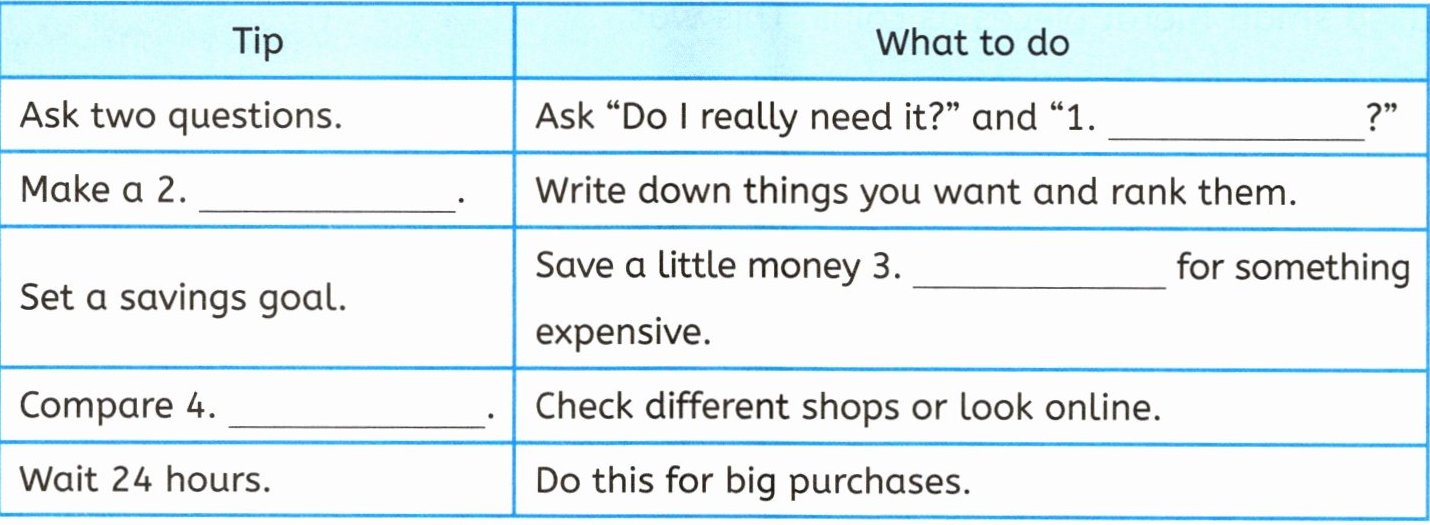 money 3.
| Compare 4.
| Wait 24 hours. | Do this for big purchases. |
Think Before You Spend
Read & answer: What tips does Mr Davis give to help students spend money wisely?
Reporter: Good morning, Mr Davis. Many students spend their pocket money quickly. How can they become smarter spenders?
Davis: The key is to think before you spend. Here are some simple tips. First, ask yourself two questions before buying: “Do I really need this?” and “Can I afford it?” If the answer to either question is no, don’t buy it. Second, make a wish list. Write down things you want, like a new game or a bike. Then rank them from the most important to the least important. This helps you focus on what matters most. Third, set a savings goal. If you want something expensive, decide how much to save each week. For example, save 10 yuan every week for a 100-yuan toy. In ten weeks, you’ll have enough! Fourth, compare prices before you buy. Check different shops or look online. Sometimes the same thing costs less in another place. Finally, for big purchases, wait 24 hours. After one day, ask yourself again, “Do I still want this?” Often, the feeling goes away, and you save your money.
Reporter: These tips sound easy to follow. Why are they important?
Davis: Because they help you make smart choices. When you plan your spending, you feel proud and in control. You also learn to value your parents’ hard work. These habits will stay with you for life.
Reporter: Thank you, Mr Davis!
Davis: Remember: Think before you spend, and spend with purpose!
Ⅰ. Read and tick or cross. 读一读,判断对(√)错(×)。
(
×
) 1. Mr Davis thinks students should spend their pocket money quickly.(
×
) 2. A wish list helps you remember what your friends have.(
√
) 3. For big purchases, Mr Davis suggests waiting 24 hours to think again.Ⅱ. Read and choose. 读一读,选出正确的答案。
(
B
) 1. What is the main topic of the dialogue?A. How to make more pocket money.
B. How to spend money wisely.
C. How to save money in the bank.
(
B
) 2. Why does Mr Davis think these tips are helpful for students?A. They help students buy more things.
B. They help students make smart choices and build good habits.
C. They help students follow what their classmates do.
Ⅲ. Read and fill in the blanks. 读一读,填空。
| Tip | What to do |
| --- | --- |
| Ask two questions. | Ask “Do I really need it?” and “1.
Can I afford it
?” || Make a 2.
wish list
. | Write down things you want and rank them. || Set a savings goal. | Save a little
money 3. each week
for something expensive. || Compare 4.
prices
. | Check different shops or look online. || Wait 24 hours. | Do this for big purchases. |
答案
1. × 2. × 3. √
1. B 2. B
1. Can I afford it 2. wish list 3. each week 4. prices
解析
【分析】
这是一道英语阅读理解题,包含判断正误、选择、填空三类题型。解题思路为:1. 解答判断正误题时,需将小题表述与原文对应内容逐一核对,判断是否一致;2. 解答选择题时,要结合对话主旨和原文细节,排除不符合原文的错误选项;3. 解答填空题时,需从原文中提取对应短语,注意拼写和形式匹配。
【解析】
Ⅰ. 判断正误:
1. 原文提到“Many students spend their pocket money quickly. How can they become smarter spenders?”,说明Davis不建议学生快速花零花钱,故该题错误;
2. 原文指出“make a wish list... This helps you focus on what matters most”,愿望清单是帮助聚焦重要物品,而非记住朋友的东西,故该题错误;
3. 原文明确“for big purchases, wait 24 hours. After one day, ask yourself again...”,故该题正确。
Ⅱ. 选择题:
1. 对话核心围绕“如何成为更明智的花钱者”,即如何明智花钱,对应选项B;
2. 原文Davis说明“这些技巧帮助做出明智选择,还能养成终身受益的习惯”,对应选项B。
Ⅲ. 填空题:
1. 原文提到购买前要问“Do I really need this?”和“Can I afford it?”,故填Can I afford it;
2. 原文第二条建议是“make a wish list”,故填wish list;
3. 原文提到“decide how much to save each week”,故填each week;
4. 原文第四条建议是“compare prices before you buy”,故填prices。
【答案】
1. × 2. × 3. √;1. B 2. B;1. Can I afford it 2. wish list 3. each week 4. prices
【知识点】
英语阅读理解、细节理解题、主旨大意题
【点评】
本题围绕学生理财话题,考查英语阅读的细节查找、主旨理解和信息提取能力,题型基础,贴近学生生活,易于掌握。
【难度系数】
0.8
