

 登录
五、阅读理解。
A) 阅读短文,根据上下文和首字母提示,补全单词完成短文。
Now in Shanghai, there are some rules about rubbish sorting(分类). People in Shanghai must sort their rubbish into f
A) 阅读短文,根据上下文和首字母提示,补全单词完成短文。
Now in Shanghai, there are some rules about rubbish sorting(分类). People in Shanghai must sort their rubbish into f
four
types: dry(干的) rubbish, wwet
rubbish(kitchen rubbish), recyclable rubbish and hazardous rubbish. Many students learn hhow
to sort rubbish and then they tteach
the old people to sort the rubbish. Rubbish sorting has become a nnew
"fashion" in Shanghai now. Some other ccities
like(像) Nanjing and Suzhou are also trying to do it.答案
four; wet; how; teach; new; cities
解析
【分析】
本题为英语首字母填空题,解题思路为:先通读短文,理解全文语境(围绕上海垃圾分类展开),再结合每个空的首字母提示,分析句子所需的词性、词义,匹配符合语境的正确单词。
【解析】
1. 由后文列举的四类垃圾(干垃圾、湿垃圾、可回收垃圾、有害垃圾),结合首字母f,可知此处填数词four;
2. 厨房垃圾属于湿垃圾,结合首字母w,可知此处填形容词wet;
3. 句意是学生学习如何进行垃圾分类,结合首字母h,可知此处填疑问词how;
4. 句意是学生教老人垃圾分类,结合首字母t,可知此处填动词teach;
5. 句意是垃圾分类成为上海的新时尚,结合首字母n,可知此处填形容词new;
6. 后文举例南京、苏州,属于其他城市,结合首字母c,且需用复数形式,可知此处填名词复数cities。
【答案】
four; wet; how; teach; new; cities
【知识点】
英语首字母填空、词汇运用、阅读理解
【点评】
本题结合上海垃圾分类的热点话题,考查学生对词汇的掌握及上下文语境的理解,难度适中,需结合生活常识辅助解题。
【难度系数】
0.5
B) 阅读短文,根据短文内容选择最佳答案。
What is recycling? It is to reuse anything that can be used again. Recycling may save our world. “Recycling” also means doing everything we can do to prevent(阻止) the need for recycling. How do we do this? Here are some suggestions:
• If you bring your own bags with you to the shop, you won’t need to use the bags of the shop. This will save bags before they need to be recycled.
• Don’t buy things that can be used only once(一次). For example, use cloth napkins(餐巾) instead of(代替) paper napkins.
• Put on warm clothes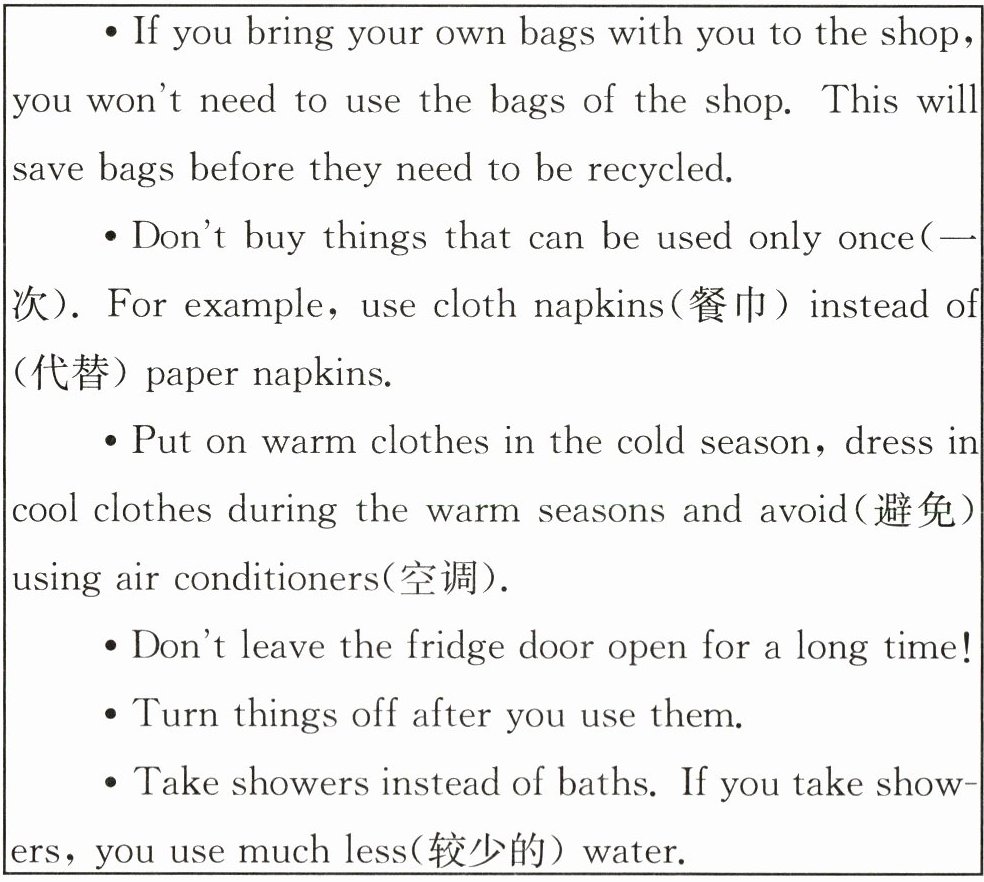 in the cold season, dress in cool clothes during the warm seasons and avoid(避免) using air conditioners(空调).
• Don’t leave the fridge door open for a long time!
• Turn things off after you use them.
• Take showers instead of baths. If you take showers, you use much less(较少的) water.
(
A. Reducing B. Recycling C. Reusing
(
A. Paper napkins B. Glass bottles C. Cloth napkins
(
A. jackets(羽绒服) B. T-shirts C. shorts
(
A. turn on the tap B. turn off the tap C. turn on the light
(
A. Turn off the things after you use them.
B. Take showers instead of baths.
C. Let the fridge open for a long time.
What is recycling? It is to reuse anything that can be used again. Recycling may save our world. “Recycling” also means doing everything we can do to prevent(阻止) the need for recycling. How do we do this? Here are some suggestions:
• If you bring your own bags with you to the shop, you won’t need to use the bags of the shop. This will save bags before they need to be recycled.
• Don’t buy things that can be used only once(一次). For example, use cloth napkins(餐巾) instead of(代替) paper napkins.
• Put on warm clothes
in the cold season, dress in cool clothes during the warm seasons and avoid(避免) using air conditioners(空调).• Don’t leave the fridge door open for a long time!
• Turn things off after you use them.
• Take showers instead of baths. If you take showers, you use much less(较少的) water.
(
B
)1. “” is to reuse something that can be used again.A. Reducing B. Recycling C. Reusing
(
A
)2. can be used only once.A. Paper napkins B. Glass bottles C. Cloth napkins
(
A
)3. In winter we should put on to avoid using air conditioners.A. jackets(羽绒服) B. T-shirts C. shorts
(
B
)4. We should after we wash our hands.A. turn on the tap B. turn off the tap C. turn on the light
(
C
)5. Which way(方式) can’t save energy?A. Turn off the things after you use them.
B. Take showers instead of baths.
C. Let the fridge open for a long time.
答案
1. B 2. A 3. A 4. B 5. C
解析
【分析】
本题为英语阅读理解细节题,需根据短文内容定位对应信息解答各小题。解题思路为:先通读短文了解大意,再针对每道题的问题,回到短文中查找相关语句,对比选项得出答案。具体各题思路:1题需找“重复使用可再用物品”对应的概念;2题找一次性物品的例子;3题找冷季穿的保暖衣物;4题找用完物品后的做法;5题找不能节能的行为。
【解析】
1. 根据短文第一段“What is recycling? It is to reuse anything that can be used again.”可知,recycling的定义就是重复使用可再用的东西,故选B。
2. 根据短文第二条“Don't buy things that can be used only once. For example, use cloth napkins instead of paper napkins.”可知,纸餐巾是一次性物品,故选A。
3. 根据短文第三条“Put on warm clothes in the cold season... avoid using air conditioners.”,冬天属于冷季,需穿保暖的衣服,选项中jackets(保暖衣物)符合要求,故选A。
4. 根据短文第五条“Turn things off after you use them.”,洗手后属于用完水龙头,应关掉水龙头,故选B。
5. 根据短文第四条“Don't leave the fridge door open for a long time!”可知,长时间开冰箱门不能节能,A、B选项都是节能方式,故选C。
【答案】
1. B 2. A 3. A 4. B 5. C
【知识点】
英语阅读理解、细节信息查找
【点评】
本题考查学生从短文中提取关键信息的能力,属于基础阅读理解题,只要仔细阅读原文,定位对应语句即可轻松解答。
【难度系数】
0.9
