

 登录
I 完形填空。
From a plane you can see the fields, cities, mountains or rivers below. If you go into space, you can see more of Earth. Many man-made satellites are sent into
Mars is our neighbour in space. It is a planet, and it is
Mars does not have its own light. It
In fact, Mars is very far from Earth. It is about 225 million
1. A. friend B. space C. water
2. A. smaller B. clearer C. shinier
3. A. they B. them C. their
4. A. big B. small C. suitable
5. A. shines B. goes C. takes
6. A. Because B. When C. Though
7. A. clearly B. quickly C. happily
8. A. kilometres B. telescopes C. metres
9. A. under B. by C. of
10. A. reach B. divide C. clear
From a plane you can see the fields, cities, mountains or rivers below. If you go into space, you can see more of Earth. Many man-made satellites are sent into
B
1 to look at Earth, the stars and other planets, and to learn more about the world around us.Mars is our neighbour in space. It is a planet, and it is
A
2 than the Earth. Plants cannot grow on Mars because there is not enough air or water for B
3 to live on. The environment on Mars is not C
4 to living things.Mars does not have its own light. It
A
5 back the light of Sun, just like the moon does. B
6 Sun shines on the side of Mars that faces us, it looks bright and clear in the sky. We cannot see Mars A
7 when Sun shines on the other side that faces away from us.In fact, Mars is very far from Earth. It is about 225 million
A
8 away. We can go to Mars B
9 spaceship. A spaceship flies rather fast, but it still takes many months to A
10 Mars because of the distance. Scientists study Mars carefully and hope to find more secrets about this red planet in the future.1. A. friend B. space C. water
2. A. smaller B. clearer C. shinier
3. A. they B. them C. their
4. A. big B. small C. suitable
5. A. shines B. goes C. takes
6. A. Because B. When C. Though
7. A. clearly B. quickly C. happily
8. A. kilometres B. telescopes C. metres
9. A. under B. by C. of
10. A. reach B. divide C. clear
答案
1.B 2.A 3.B 4.C 5.A 6.B 7.A 8.A 9.B 10.A
解析
【分析】
做完形填空需先通读全文把握科普类文章的主旨(介绍太空、火星相关知识),再结合语境、语法规则、固定搭配及常识逐一分析每个空,排除错误选项后确定答案。
【解析】
1. 句意:很多人造卫星被送入________。前文提到“进入太空”,结合常识,人造卫星送入太空,故选B(space)。
2. 句意:火星是行星,比地球________。根据天文常识,火星体积比地球小,故选A(smaller)。
3. 句意:火星上不能生长植物,因为没有足够的空气或水供________生存。介词for后接人称代词宾格,故选B(them)。
4. 句意:火星的环境不________生物生存。固定搭配be suitable for(适合),结合语境,火星环境不适合生物,故选C(suitable)。
5. 句意:火星没有自身的光,它________太阳光,像月亮一样。固定搭配shine back(反射),故选A(shines)。
6. 句意:______太阳照向我们看到的火星那面时,它在天空中明亮清晰。此处引导时间状语从句,表“当……时”,故选B(When)。
7. 句意:当太阳照向背向我们的火星那面时,我们不能________看到火星。修饰动词see用副词,结合语境是“清楚地”,故选A(clearly)。
8. 句意:火星距离地球约225百万________。描述天体距离用公里,故选A(kilometres)。
9. 句意:我们可以________宇宙飞船去火星。固定搭配by+交通工具(表方式),故选B(by)。
10. 句意:宇宙飞船速度快,但因距离远,仍需数月________火星。结合语境是“到达”,故选A(reach)。
【答案】
1.B 2.A 3.B 4.C 5.A 6.B 7.A 8.A 9.B 10.A
【知识点】
完形填空、形容词比较级、介词固定搭配
【点评】
本题为科普类完形填空,围绕太空与火星知识展开,考查词汇辨析、语法运用及语境理解,需结合常识与上下文逻辑解题,整体难度适中。
【难度系数】
0.6
Ⅱ. 阅读表格,选择最佳答案。
We are excited to announce(宣布)a school trip to the Space Exploration Exhibition at the Science and Technology Museum. This is a great opportunity for students to learn about space science.
Trip Details
Date: Saturday, November 28th, 2026
Meeting time and place: 7:40 a. m. at the school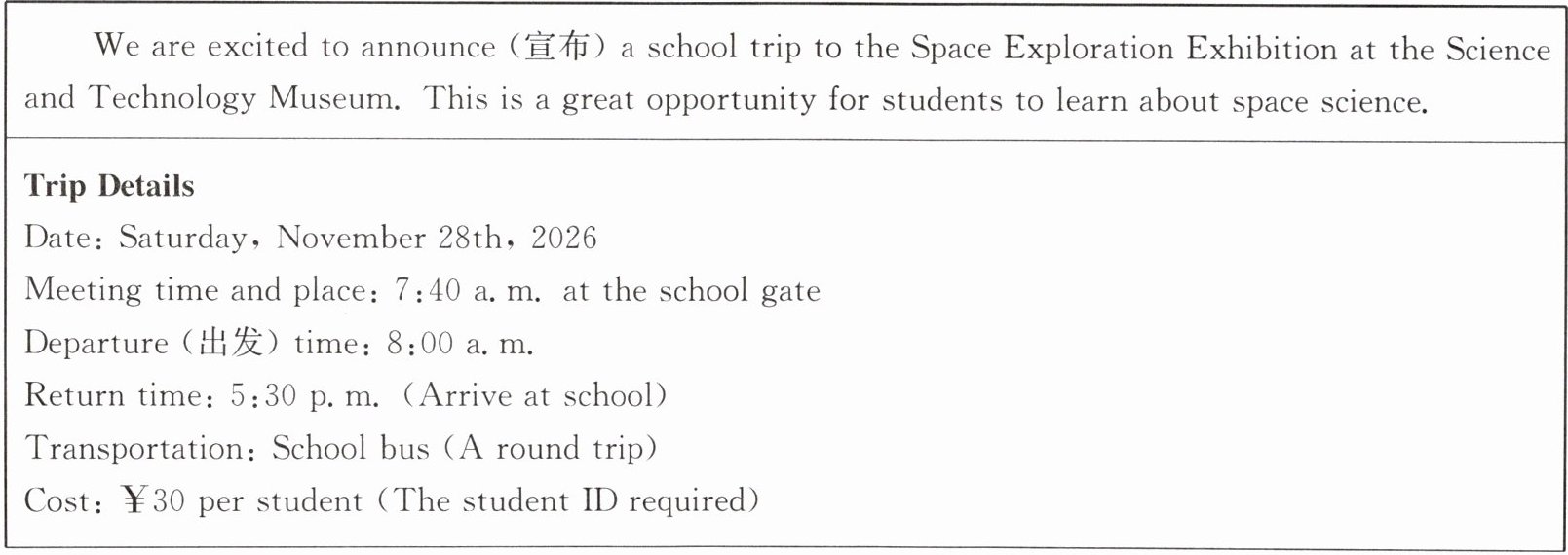
Departure(出发)time: 8:00 a. m.
Return time: 5:30 p. m. (Arrive at school)
Transportation: School bus (A round trip)
Cost: ¥30 per student (The student ID required)
What to Bring
The student ID(required for tickets)
Water bottles
Packed lunch or money for lunch
Comfortable shoes and clothing
Rules for Visitors
School groups must arrive and enter together.
No food or drinks in exhibition areas.
Photography is allowed without flash.
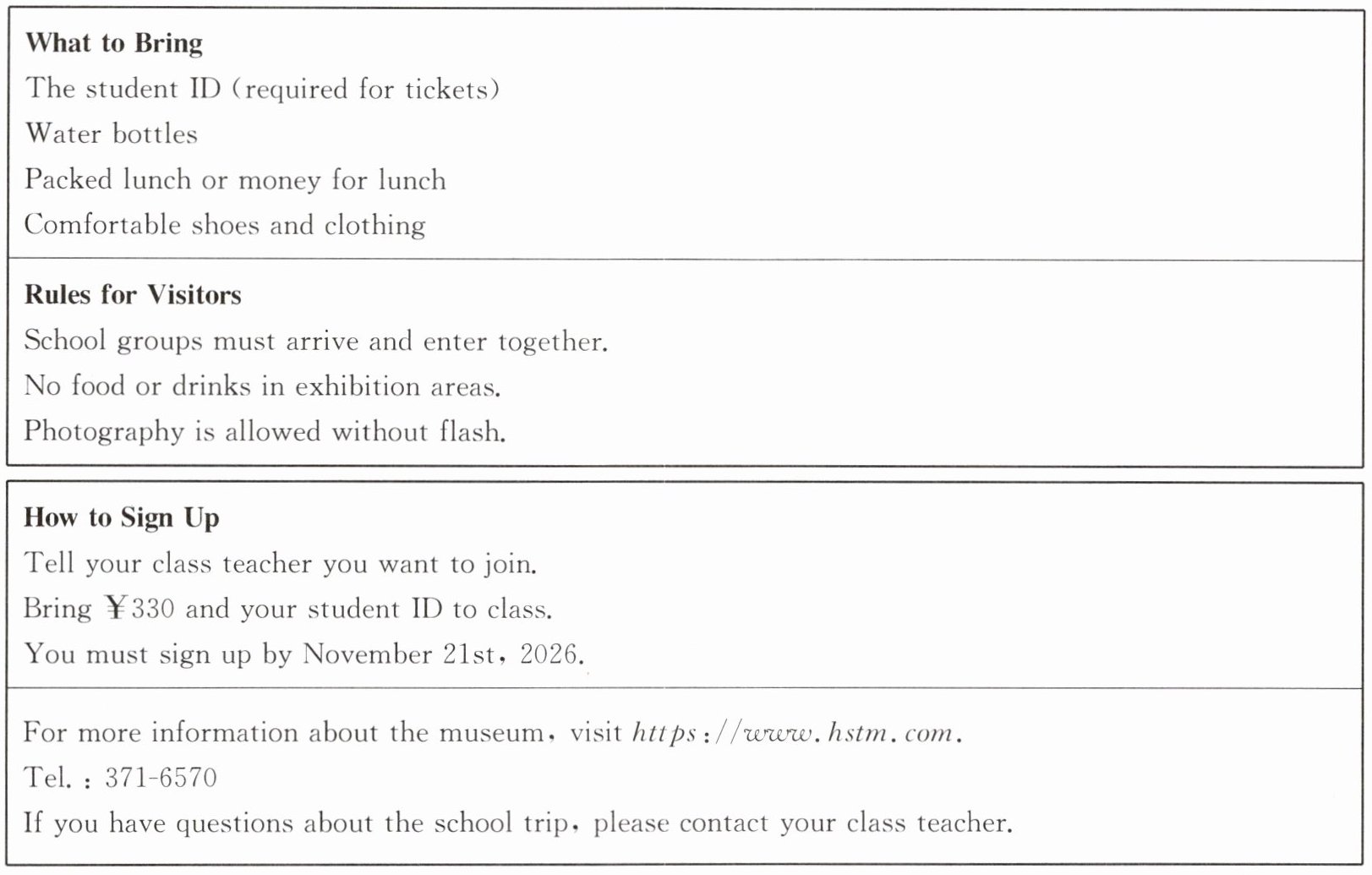
How to Sign Up
Tell your class teacher you want to join.
Bring ¥330 and your student ID to class.
You must sign up by November 21st, 2026.
For more information about the museum, visit https://www.hstm.com.
Tel.: 371-6570
If you have questions about the school trip, please contact your class teacher.
1. What is the main purpose of this school trip?
A. To learn about space science.
B. To have lunch with classmates.
C. To visit a science museum for fun.
D. To practice taking photos in a museum.
2. If Jim wants to take part in this trip, what time should he arrive at school?
A. Before 7:40 a. m.
B. After 7:40 a. m.
C. Before 8:00 a. m.
D. After 8:00 a. m.
3. How will the students go to the Science and Technology Museum?
A.
4. Which of the following is allowed in the exhibition areas?
①Taking photos without flash.
②Bringing a water bottle.
③Eating or drinking.
④Wearing comfortable shoes.
A. ①②③
B. ①③④
C. ②③④
D. ①②④
5. If Jack wants to take part in this trip, when should he sign up?
A. On November 20th.
B. On November 23rd.
C. On November 24th.
D. On November 28th.
We are excited to announce(宣布)a school trip to the Space Exploration Exhibition at the Science and Technology Museum. This is a great opportunity for students to learn about space science.
Trip Details
Date: Saturday, November 28th, 2026
Meeting time and place: 7:40 a. m. at the school
Departure(出发)time: 8:00 a. m.
Return time: 5:30 p. m. (Arrive at school)
Transportation: School bus (A round trip)
Cost: ¥30 per student (The student ID required)
What to Bring
The student ID(required for tickets)
Water bottles
Packed lunch or money for lunch
Comfortable shoes and clothing
Rules for Visitors
School groups must arrive and enter together.
No food or drinks in exhibition areas.
Photography is allowed without flash.
How to Sign Up
Tell your class teacher you want to join.
Bring ¥330 and your student ID to class.
You must sign up by November 21st, 2026.
For more information about the museum, visit https://www.hstm.com.
Tel.: 371-6570
If you have questions about the school trip, please contact your class teacher.
1. What is the main purpose of this school trip?
A. To learn about space science.
B. To have lunch with classmates.
C. To visit a science museum for fun.
D. To practice taking photos in a museum.
2. If Jim wants to take part in this trip, what time should he arrive at school?
A. Before 7:40 a. m.
B. After 7:40 a. m.
C. Before 8:00 a. m.
D. After 8:00 a. m.
3. How will the students go to the Science and Technology Museum?
A.
4. Which of the following is allowed in the exhibition areas?
①Taking photos without flash.
②Bringing a water bottle.
③Eating or drinking.
④Wearing comfortable shoes.
A. ①②③
B. ①③④
C. ②③④
D. ①②④
5. If Jack wants to take part in this trip, when should he sign up?
A. On November 20th.
B. On November 23rd.
C. On November 24th.
D. On November 28th.
答案
1.A 2.A 3.C 4.D 5.A
解析
【分析】做这类英语阅读理解的信息查找题,需先明确题干问题,再回到原文对应板块定位关键信息,逐一匹配选项,排除错误选项得出答案。本题5道小题均为细节题,分别对应原文中旅行目的、集合时间、交通方式、展区规则、报名截止时间的信息,需精准定位。
【解析】1. 题干询问学校旅行的主要目的,定位原文第一段最后一句“This is a great opportunity for students to learn about space science.”,可知目的是学习太空科学,选项B(与同学吃午餐)、C(为了乐趣参观科技馆)、D(练习拍照)均不符合,故选A。
2. 题干询问到达学校的时间,定位Trip Details中“Meeting time and place: 7:40 a. m. at the school”,说明需在7:40之前到达,选项B(7:40后)、C(8:00前)、D(8:00后)均不符合,故选A。
3. 题干询问学生的出行方式,定位Transportation: School bus (A round trip),对应选项C,故选C。
4. 题干询问展区允许的行为,定位Rules for Visitors及What to Bring:①无闪光灯拍照允许;②可带水瓶;③展区禁止吃喝;④需穿舒适鞋,因此允许的是①②④,选项A(含③)、B(含③)、C(含③)均错误,故选D。
5. 题干询问报名截止时间,定位How to Sign Up中“You must sign up by November 21st, 2026”,选项A(11月20日)在截止前,B(11月23日)、C(11月24日)、D(11月28日)均不符合,故选A。
【答案】1.A 2.A 3.C 4.D 5.A
【知识点】英语阅读理解、细节信息定位
【点评】本题为英语阅读理解的细节查找类题目,考查学生快速定位原文关键信息的能力,题目难度较低,只要仔细对应原文内容即可正确作答。
【难度系数】0.8
