

 登录
登录
一、根据句意及汉语提示写出单词。
1. We set the table with knives,
2. He
3. In China, it's bad
4. Students usually do eye exercises twice a day with both
5. One is not a true man
1. We set the table with knives,
forks
(叉子), and spoons before dinner.2. He
shook
(摇动) his head and said he didn't agree with our plan for the project.3. In China, it's bad
manners
(礼仪) to start eating before everyone sits down.4. Students usually do eye exercises twice a day with both
elbows
(手肘) on the desk.5. One is not a true man
unless
(除非) he climbs up the Great Wall.答案
1.forks
2.shook
3.manners
4.elbows
5.unless
2.shook
3.manners
4.elbows
5.unless
解析
【分析】
本题为根据句意及汉语提示填单词的基础题,解题思路:结合句子语境,依据语法规则(如名词单复数、动词时态、固定搭配等)确定单词的正确形式,同时注意单词的拼写。
【解析】
1. 句意:晚餐前我们摆放桌子,放上刀、叉和勺子。fork意为“叉子”,与knives、spoons并列,需用复数形式forks。
2. 句意:他摇着头说不同意我们的项目计划。shake意为“摇动”,由said(过去式)可知,此处用一般过去时,故填shook。
3. 句意:在中国,在大家坐下前就开始吃饭是不礼貌的。manners意为“礼仪”,固定搭配bad manners表示“不礼貌”,故填manners。
4. 句意:学生们通常一天做两次眼保健操,手肘放在桌子上。elbow意为“手肘”,由both可知需用复数形式elbows。
5. 句意:不到长城非好汉。unless意为“除非”,引导条件状语从句,符合句意。
【答案】
1.forks
2.shook
3.manners
4.elbows
5.unless
【知识点】
名词单复数;动词过去式;固定搭配
【点评】
本题考查英语基础词汇的运用,涉及名词单复数、动词时态及固定搭配,是英语学习的核心基础题型,需熟练掌握常见词汇的拼写与形式变化。
【难度系数】
0.6
本题为根据句意及汉语提示填单词的基础题,解题思路:结合句子语境,依据语法规则(如名词单复数、动词时态、固定搭配等)确定单词的正确形式,同时注意单词的拼写。
【解析】
1. 句意:晚餐前我们摆放桌子,放上刀、叉和勺子。fork意为“叉子”,与knives、spoons并列,需用复数形式forks。
2. 句意:他摇着头说不同意我们的项目计划。shake意为“摇动”,由said(过去式)可知,此处用一般过去时,故填shook。
3. 句意:在中国,在大家坐下前就开始吃饭是不礼貌的。manners意为“礼仪”,固定搭配bad manners表示“不礼貌”,故填manners。
4. 句意:学生们通常一天做两次眼保健操,手肘放在桌子上。elbow意为“手肘”,由both可知需用复数形式elbows。
5. 句意:不到长城非好汉。unless意为“除非”,引导条件状语从句,符合句意。
【答案】
1.forks
2.shook
3.manners
4.elbows
5.unless
【知识点】
名词单复数;动词过去式;固定搭配
【点评】
本题考查英语基础词汇的运用,涉及名词单复数、动词时态及固定搭配,是英语学习的核心基础题型,需熟练掌握常见词汇的拼写与形式变化。
【难度系数】
0.6
二、阅读还原。
Chopsticks are a pair of sticks to be used when eating.
Chinese people started to use chopsticks about 3,000 years ago during the Shang Dynasty. During the pre-Qin period,chopsticks were called “Jia”,and in the Qin and Han dynasties,they were called “Zhu”. Because “Zhu” sounds like “stop” in Chinese,which is an unlucky word,by the Ming Dynasty,people began to call them “Kuai”,meaning “fast” in Chinese.
Who invented(发明) chopsticks?
How should we behave when using chopsticks?
When eating with the elders,Chinese people usually let the elders take up chopsticks before anyone else.
根据材料内容,从下面五个选项中选出能填入文中空缺处的最佳选项,使文章意思通顺、内容完整。
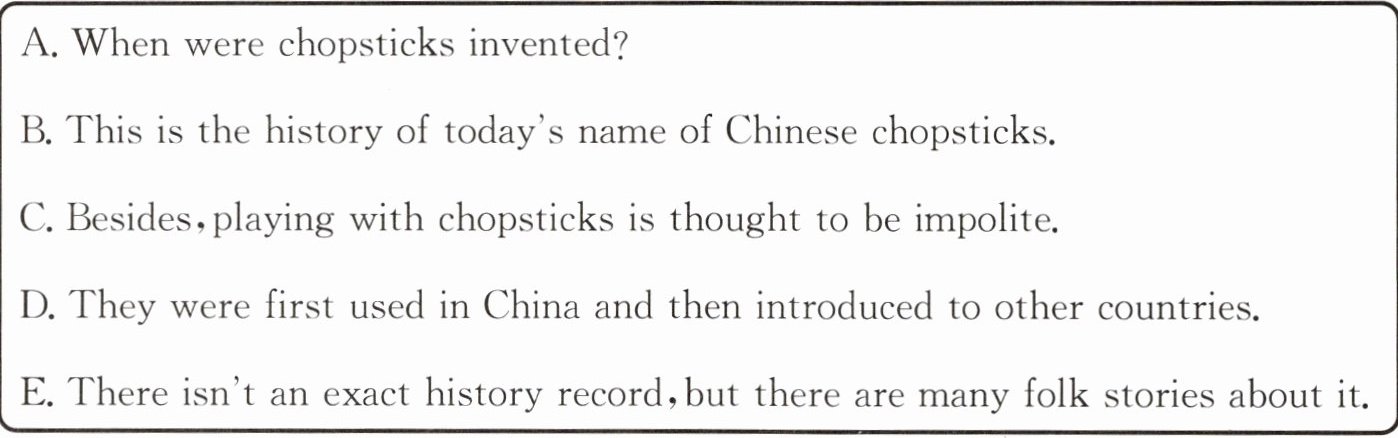
1.
Chopsticks are a pair of sticks to be used when eating.
D
1 Chopsticks are one of the symbols of Chinese food culture. Here are three things you should know about them.A
2Chinese people started to use chopsticks about 3,000 years ago during the Shang Dynasty. During the pre-Qin period,chopsticks were called “Jia”,and in the Qin and Han dynasties,they were called “Zhu”. Because “Zhu” sounds like “stop” in Chinese,which is an unlucky word,by the Ming Dynasty,people began to call them “Kuai”,meaning “fast” in Chinese.
B
3Who invented(发明) chopsticks?
E
4 One is that Jiang Ziya created chopsticks after getting an idea from a mythical(神秘的) bird. It is also said that Yu the Great,who founded the Xia Dynasty,used sticks to pick hot food in order to save time to control floods,so chopsticks came into being.How should we behave when using chopsticks?
When eating with the elders,Chinese people usually let the elders take up chopsticks before anyone else.
C
5 It’s also bad to tap(敲) chopsticks on the edge of your bowl,because in ancient China beggars(乞丐) often did it to attract attention.根据材料内容,从下面五个选项中选出能填入文中空缺处的最佳选项,使文章意思通顺、内容完整。
1.
D
2. A
3. B
4. E
5. C
答案
1—5 DABEC
解析
【分析】做阅读还原题时,需先通读全文和各选项,明确每段核心内容及空缺处的上下文逻辑关系,通过句子间的衔接性、话题一致性匹配选项。具体思路:第1空前文介绍筷子定义,后文提及筷子是中国饮食文化象征,需选衔接筷子起源与传播的选项;第2空后文讲筷子使用时间,需选引出“发明时间”话题的问句;第3空前文讲筷子名称演变,需选承接名称历史的选项;第4空前文问发明者,后文讲民间故事,需选引出故事的选项;第5空前文讲用筷礼仪,后文讲敲碗礼仪,需选属于礼仪范畴的选项。
【解析】1. 第1空:前文介绍筷子用途,后文说明筷子是中国饮食文化象征,选项D“它们最早在中国使用,然后传到其他国家”衔接筷子的起源与传播,符合逻辑,故选D。2. 第2空:后文讲述筷子使用时间(约3000年前),选项A“筷子是什么时候发明的?”引出下文关于发明时间的内容,故选A。3. 第3空:前文介绍筷子名称演变(先秦叫“Jia”,秦汉叫“Zhu”,明代叫“Kuai”),选项B“这是今天中国筷子名称的历史”承接上文的名称变化,故选B。4. 第4空:前文问“谁发明了筷子?”,后文讲两个民间故事,选项E“没有确切的历史记录,但有很多关于它的民间故事”承上启下,引出后续故事,故选E。5. 第5空:前文讲用筷子的礼仪(让长辈先拿),后文讲敲碗的礼仪,选项C“另外,玩筷子被认为不礼貌”属于用筷礼仪范畴,衔接上下文,故选C。
【答案】1.D 2.A 3.B 4.E 5.C
【知识点】英语阅读还原、语篇逻辑衔接、文化常识
【点评】本题为英语阅读还原题,重点考查学生对语篇逻辑、话题一致性的把握,需结合上下文语境和文化常识解题,难度适中,理清句子间逻辑关系即可正确作答。
【难度系数】0.5
【解析】1. 第1空:前文介绍筷子用途,后文说明筷子是中国饮食文化象征,选项D“它们最早在中国使用,然后传到其他国家”衔接筷子的起源与传播,符合逻辑,故选D。2. 第2空:后文讲述筷子使用时间(约3000年前),选项A“筷子是什么时候发明的?”引出下文关于发明时间的内容,故选A。3. 第3空:前文介绍筷子名称演变(先秦叫“Jia”,秦汉叫“Zhu”,明代叫“Kuai”),选项B“这是今天中国筷子名称的历史”承接上文的名称变化,故选B。4. 第4空:前文问“谁发明了筷子?”,后文讲两个民间故事,选项E“没有确切的历史记录,但有很多关于它的民间故事”承上启下,引出后续故事,故选E。5. 第5空:前文讲用筷子的礼仪(让长辈先拿),后文讲敲碗的礼仪,选项C“另外,玩筷子被认为不礼貌”属于用筷礼仪范畴,衔接上下文,故选C。
【答案】1.D 2.A 3.B 4.E 5.C
【知识点】英语阅读还原、语篇逻辑衔接、文化常识
【点评】本题为英语阅读还原题,重点考查学生对语篇逻辑、话题一致性的把握,需结合上下文语境和文化常识解题,难度适中,理清句子间逻辑关系即可正确作答。
【难度系数】0.5
