

 登录
登录
Ⅲ. 阅读理解
The universe is everything around us. It includes space, all the matter and energy in space, and even time. The stars like the Sun and planets like Earth are part of it. These planets go around the Sun, which is just one star among billions. The Moon is not a planet. It circles Earth and is also part of this huge system.
Scientists say the solar system is about 4.6 billion years old. They found this by studying rocks and small space stones. Earth seems permanent, but it's not. The Sun, much bigger than Earth, will change too, possibly growing large enough to take in nearby planets like Earth one day.
The universe is about 13.8 billion years old. Scientists found this by looking at old stars and how fast the universe is getting bigger.
Earth and humans are very young compared to the universe. Life on Earth has been around for 3.8 billion years, but humans have only been here for about 300,000 years. That's a tiny bit of time—like a second in a whole year! We've explored only our own solar system, and even then, we haven't seen all the planets and moons.
With new technology and curiosity, we keep learning about the universe. How did the universe begin? Are there other planets with life? Though space is big and full of secrets, each discovery helps us understand our place in it. The more we learn, the more we want to explore.
(
A. It is a planet that goes around the Sun.
B. It is a star like the Sun in the universe.
C. It circles around Earth.
D. It is a form of energy in space.
(
A. Long.
B. Endless.
C. Ancient.
D. Important.
(
A. Most stars far away from us are moving faster and faster.
B. Some stars near us are getting smaller and smaller.
C. All stars in the universe stay in one place.
D. Few stars can be seen with scientists' tools.
(
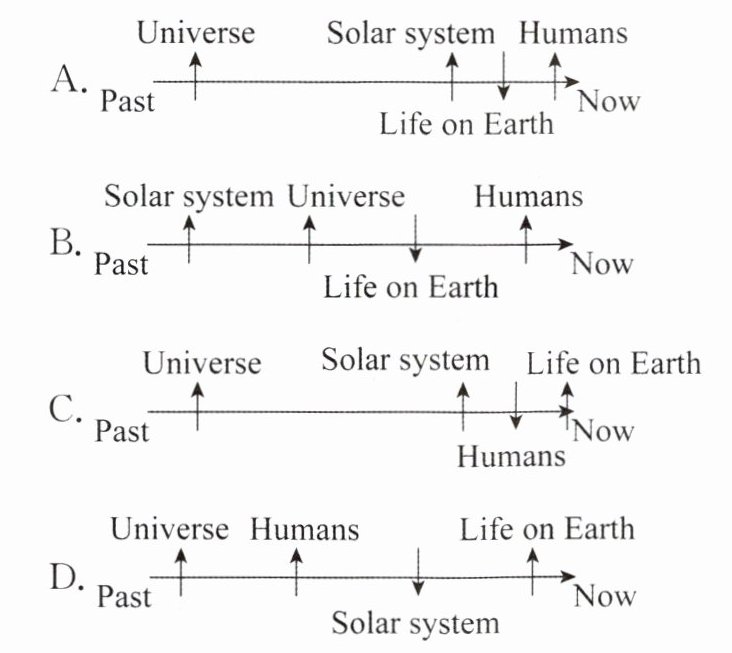
(
A. Earth's Long Life
B. The Secrets of the Universe
C. Scientists' Study of the Stars
D. The Universe and Our Place in It
The universe is everything around us. It includes space, all the matter and energy in space, and even time. The stars like the Sun and planets like Earth are part of it. These planets go around the Sun, which is just one star among billions. The Moon is not a planet. It circles Earth and is also part of this huge system.
Scientists say the solar system is about 4.6 billion years old. They found this by studying rocks and small space stones. Earth seems permanent, but it's not. The Sun, much bigger than Earth, will change too, possibly growing large enough to take in nearby planets like Earth one day.
The universe is about 13.8 billion years old. Scientists found this by looking at old stars and how fast the universe is getting bigger.
A
This surprises scientists, because they expected gravity to slow the stars down.Earth and humans are very young compared to the universe. Life on Earth has been around for 3.8 billion years, but humans have only been here for about 300,000 years. That's a tiny bit of time—like a second in a whole year! We've explored only our own solar system, and even then, we haven't seen all the planets and moons.
With new technology and curiosity, we keep learning about the universe. How did the universe begin? Are there other planets with life? Though space is big and full of secrets, each discovery helps us understand our place in it. The more we learn, the more we want to explore.
(
C
)1. Which is true about the Moon according to the passage?A. It is a planet that goes around the Sun.
B. It is a star like the Sun in the universe.
C. It circles around Earth.
D. It is a form of energy in space.
(
B
)2. What does the underlined word "permanent" mean in Paragraph 2?A. Long.
B. Endless.
C. Ancient.
D. Important.
(
A
)3. Which of the following can be put in " " in Paragraph 3?A. Most stars far away from us are moving faster and faster.
B. Some stars near us are getting smaller and smaller.
C. All stars in the universe stay in one place.
D. Few stars can be seen with scientists' tools.
(
A
)4. Which of the following most probably shows the right timeline?(
D
)5. What is the best title for the passage?A. Earth's Long Life
B. The Secrets of the Universe
C. Scientists' Study of the Stars
D. The Universe and Our Place in It
答案
1. C
2. B
3. A
4. A
5. D
2. B
3. A
4. A
5. D
解析
【分析】
本题为科普类阅读理解题,需结合原文细节、词义逻辑、句子衔接、时间顺序及主旨大意逐一解题:
1. 第1题定位原文关于月球的描述,判断选项正误;
2. 第2题结合上下文转折逻辑猜测划线词含义;
3. 第3题根据前后文关于宇宙膨胀、引力与恒星速度的逻辑衔接,选择合适句子;
4. 第4题梳理文中宇宙、太阳系、地球生命、人类的时间先后顺序,匹配对应图示;
5. 第5题总结全文核心内容,提炼最佳标题。
【解析】
1. 第1题:根据第一段最后一句“The Moon is not a planet. It circles Earth and is also part of this huge system.”可知,月球绕地球运行,对应选项C。
2. 第2题:划线词所在句“Earth seems permanent, but it's not”中,“but”表转折,后文提到太阳会变化,说明地球看似“永恒不变”,选项B(Endless,意为永恒的)符合词义。
3. 第3题:前文提到宇宙在膨胀,后文说科学家预期引力会让恒星减速,结合转折逻辑,空格处应说明实际情况与预期相反,即恒星运动速度越来越快,对应选项A。
4. 第4题:文中时间顺序为:宇宙(138亿年)→太阳系(46亿年)→地球生命(38亿年)→人类(30万年),对应选项A的时间线图示。
5. 第5题:全文围绕宇宙展开,最后一段点明“每次发现都帮助我们理解自身在宇宙中的位置”,核心是宇宙及人类在宇宙中的位置,对应选项D。
【答案】
1.C 2.B 3.A 4.A 5.D
【知识点】
阅读理解(细节理解、词义猜测、主旨大意)
【点评】
本题为科普类阅读理解,考查学生对文章细节信息、词义逻辑、句子衔接、时间顺序及主旨的理解能力,需学生精准定位原文关键内容,梳理文章逻辑关系。
【难度系数】
0.6
本题为科普类阅读理解题,需结合原文细节、词义逻辑、句子衔接、时间顺序及主旨大意逐一解题:
1. 第1题定位原文关于月球的描述,判断选项正误;
2. 第2题结合上下文转折逻辑猜测划线词含义;
3. 第3题根据前后文关于宇宙膨胀、引力与恒星速度的逻辑衔接,选择合适句子;
4. 第4题梳理文中宇宙、太阳系、地球生命、人类的时间先后顺序,匹配对应图示;
5. 第5题总结全文核心内容,提炼最佳标题。
【解析】
1. 第1题:根据第一段最后一句“The Moon is not a planet. It circles Earth and is also part of this huge system.”可知,月球绕地球运行,对应选项C。
2. 第2题:划线词所在句“Earth seems permanent, but it's not”中,“but”表转折,后文提到太阳会变化,说明地球看似“永恒不变”,选项B(Endless,意为永恒的)符合词义。
3. 第3题:前文提到宇宙在膨胀,后文说科学家预期引力会让恒星减速,结合转折逻辑,空格处应说明实际情况与预期相反,即恒星运动速度越来越快,对应选项A。
4. 第4题:文中时间顺序为:宇宙(138亿年)→太阳系(46亿年)→地球生命(38亿年)→人类(30万年),对应选项A的时间线图示。
5. 第5题:全文围绕宇宙展开,最后一段点明“每次发现都帮助我们理解自身在宇宙中的位置”,核心是宇宙及人类在宇宙中的位置,对应选项D。
【答案】
1.C 2.B 3.A 4.A 5.D
【知识点】
阅读理解(细节理解、词义猜测、主旨大意)
【点评】
本题为科普类阅读理解,考查学生对文章细节信息、词义逻辑、句子衔接、时间顺序及主旨的理解能力,需学生精准定位原文关键内容,梳理文章逻辑关系。
【难度系数】
0.6
