

 登录
登录
一、阅读理解。
阅读下面四篇语言材料,然后按文后要求做题。
A
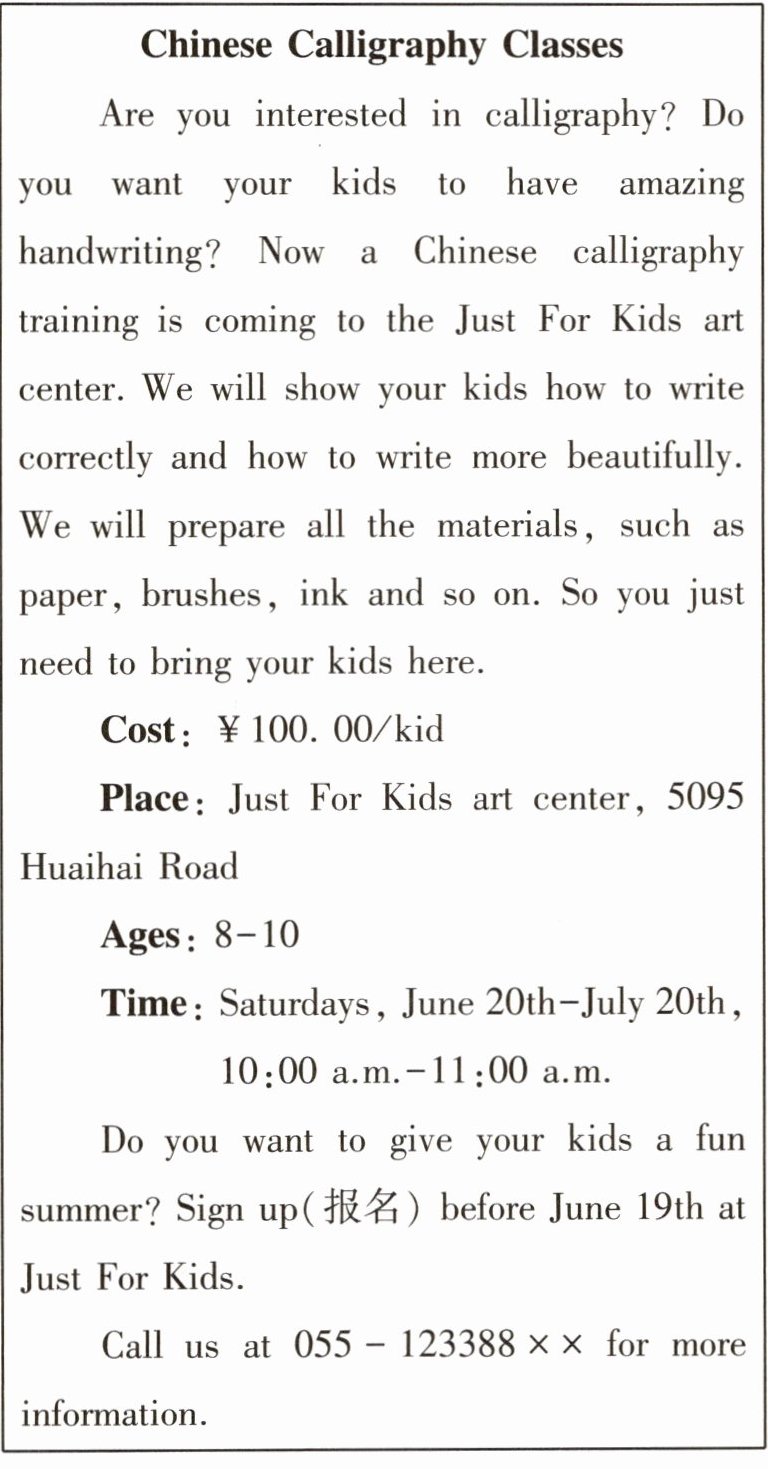
根据材料内容选择最佳答案。
(
A. Some paper.
B. A brush.
C. A bottle of ink.
D. Kids.
(
A. ¥100.00.
B. ¥200.00.
C. ¥300.00.
D. ¥400.00.
(
A. One week.
B. Two weeks.
C. One month.
D. Two months.
(
A. It’s just for kids.
B. It will start on May 20th.
C. It is held twice every summer.
D. It will show you what Chinese calligraphy is.
(
A. Students.
B. Teachers.
C. Writers.
D. Parents.
阅读下面四篇语言材料,然后按文后要求做题。
A
根据材料内容选择最佳答案。
(
D
)1. What should you bring to the art center when you go to the Chinese calligraphy classes?A. Some paper.
B. A brush.
C. A bottle of ink.
D. Kids.
(
B
)2. How much should Mr. Wang pay if he wants both his daughters to have the Chinese calligraphy classes?A. ¥100.00.
B. ¥200.00.
C. ¥300.00.
D. ¥400.00.
(
C
)3. How long will the Chinese calligraphy training last?A. One week.
B. Two weeks.
C. One month.
D. Two months.
(
A
)4. What can we know about the Chinese calligraphy classes?A. It’s just for kids.
B. It will start on May 20th.
C. It is held twice every summer.
D. It will show you what Chinese calligraphy is.
(
D
)5. Who is the ad for?A. Students.
B. Teachers.
C. Writers.
D. Parents.
答案
1. D 由表格中“We will prepare all the materials, such as paper, brushes, ink and so on. So you just need to bring your kids here.”可知,艺术中心准备了所有的材料,去上课只需要带上孩子。
2. B 由表格中“Cost: ¥100.00/kid”可知,学习费用是每个孩子100元,王先生有两个女儿,需200元。
3. C 由表格中“Time: Saturdays, June 20th-July 20th”可知,书法培训时间为6月20日到7月20日,有一个月的时间。
4. A 由该艺术中心的名字“Just For Kids”以及对学员年龄的要求“Ages: 8-10”可知,该书法课只针对孩子开设。
5. D 由表格中多次提到的your kids可知,该广告是针对父母写的。
2. B 由表格中“Cost: ¥100.00/kid”可知,学习费用是每个孩子100元,王先生有两个女儿,需200元。
3. C 由表格中“Time: Saturdays, June 20th-July 20th”可知,书法培训时间为6月20日到7月20日,有一个月的时间。
4. A 由该艺术中心的名字“Just For Kids”以及对学员年龄的要求“Ages: 8-10”可知,该书法课只针对孩子开设。
5. D 由表格中多次提到的your kids可知,该广告是针对父母写的。
解析
【分析】
本题为广告类阅读理解题,解题思路为:先明确每个问题的核心,再带着问题回到原文中定位相关信息,对比选项后选出正确答案。各小题均考查对原文细节信息的查找与理解,需精准对应原文内容。
【解析】
1. 细节理解题:根据原文“We will prepare all the materials, such as paper, brushes, ink and so on. So you just need to bring your kids here.”可知,艺术中心准备了所有书法材料,只需带孩子即可,故选D。
2. 细节理解题:根据原文“Cost: ¥100.00/kid”,每个孩子费用100元,王先生有两个女儿,总费用为100×2=200元,故选B。
3. 细节理解题:根据原文“Time: Saturdays, June 20th-July 20th”,培训时间从6月20日到7月20日,共1个月,故选C。
4. 细节理解题:根据原文“Just For Kids art center”及“Ages:8-10”,可知该书法课仅针对孩子开设,故选A。
5. 推理判断题:原文多次提到“your kids”,说明广告是写给父母的,故选D。
【答案】
1.D 2.B 3.C 4.A 5.D
【知识点】
广告类阅读理解;细节理解题;信息定位
【点评】
本题为广告类阅读理解,考查对原文细节信息的查找与简单推理,题目难度较低,学生通过定位原文对应内容即可轻松解答,属于基础题型。
【难度系数】
0.8
本题为广告类阅读理解题,解题思路为:先明确每个问题的核心,再带着问题回到原文中定位相关信息,对比选项后选出正确答案。各小题均考查对原文细节信息的查找与理解,需精准对应原文内容。
【解析】
1. 细节理解题:根据原文“We will prepare all the materials, such as paper, brushes, ink and so on. So you just need to bring your kids here.”可知,艺术中心准备了所有书法材料,只需带孩子即可,故选D。
2. 细节理解题:根据原文“Cost: ¥100.00/kid”,每个孩子费用100元,王先生有两个女儿,总费用为100×2=200元,故选B。
3. 细节理解题:根据原文“Time: Saturdays, June 20th-July 20th”,培训时间从6月20日到7月20日,共1个月,故选C。
4. 细节理解题:根据原文“Just For Kids art center”及“Ages:8-10”,可知该书法课仅针对孩子开设,故选A。
5. 推理判断题:原文多次提到“your kids”,说明广告是写给父母的,故选D。
【答案】
1.D 2.B 3.C 4.A 5.D
【知识点】
广告类阅读理解;细节理解题;信息定位
【点评】
本题为广告类阅读理解,考查对原文细节信息的查找与简单推理,题目难度较低,学生通过定位原文对应内容即可轻松解答,属于基础题型。
【难度系数】
0.8
B
Kunqu opera is one of the oldest traditional Chinese operas, and it is also a treasure(财富) of traditional Chinese Han culture and art.
Wang Fang, a woman from Suzhou, puts all her heart into Kunqu opera. At a young age, she started to learn this traditional art form. Because of her sweet voice, the Suzhou Kunqu Opera Troupe(剧团) chose her when she was in middle school.
It's never an easy thing to learn this traditional art. Wang started to learn how to sing words, and how to make proper movements. She didn't mind how hot it was in summer or how cold it was in winter. "No matter(不论) how difficult it is, I always get up early to practice," Wang said.
Wang said she wasn't sure at first whether(是否) she really liked Kunqu opera or not. But in her early twenties, when she watched the show by Zhang Jiqing, a master(大师) of Kunqu opera, it clicked(豁然开朗). "Her every movement was full of beauty. Each of her words and songs was perfect. I was touched by the beauty of Kunqu opera for the first time, and I decided to stay with it all my life," said Wang.
Wang once said in a talk, "First you must be a dreamer, then a doer(实干家), and only then can you be a master."
根据材料内容选择最佳答案。
(
A. By telling a story about Kunqu opera.
B. By listing some facts of Kunqu opera.
C. By introducing an artist of Kunqu opera.
D. By showing some ways to study Kunqu opera.
(
A. Because she had a sweet voice.
B. Because she studied hard in Kunqu opera.
C. Because she was very interested in Kunqu opera.
D. Because she was good at performing and sang well.
(
A. It's difficult for Wang to learn Kunqu opera.
B. Wang worked hard at learning Kunqu opera.
C. Wang learned Kunqu opera in different ways.
D. Wang learned Kunqu opera without any help.
(
A. The beauty of Kunqu opera.
B. Wang's love for Kunqu opera.
C. Zhang Jiqing made Wang change.
D. Zhang Jiqing was a master of Kunqu opera.
(
A. Practice makes perfect.
B. First think and then speak.
C. It's never too old to learn.
D. Where there is a will, there is a way.
Kunqu opera is one of the oldest traditional Chinese operas, and it is also a treasure(财富) of traditional Chinese Han culture and art.
Wang Fang, a woman from Suzhou, puts all her heart into Kunqu opera. At a young age, she started to learn this traditional art form. Because of her sweet voice, the Suzhou Kunqu Opera Troupe(剧团) chose her when she was in middle school.
It's never an easy thing to learn this traditional art. Wang started to learn how to sing words, and how to make proper movements. She didn't mind how hot it was in summer or how cold it was in winter. "No matter(不论) how difficult it is, I always get up early to practice," Wang said.
Wang said she wasn't sure at first whether(是否) she really liked Kunqu opera or not. But in her early twenties, when she watched the show by Zhang Jiqing, a master(大师) of Kunqu opera, it clicked(豁然开朗). "Her every movement was full of beauty. Each of her words and songs was perfect. I was touched by the beauty of Kunqu opera for the first time, and I decided to stay with it all my life," said Wang.
Wang once said in a talk, "First you must be a dreamer, then a doer(实干家), and only then can you be a master."
根据材料内容选择最佳答案。
(
B
)6. How does the writer start the passage?A. By telling a story about Kunqu opera.
B. By listing some facts of Kunqu opera.
C. By introducing an artist of Kunqu opera.
D. By showing some ways to study Kunqu opera.
(
A
)7. Why did the Suzhou Kunqu Opera Troupe choose Wang as a member of the troupe?A. Because she had a sweet voice.
B. Because she studied hard in Kunqu opera.
C. Because she was very interested in Kunqu opera.
D. Because she was good at performing and sang well.
(
B
)8. What is the main idea of Paragraph 3?A. It's difficult for Wang to learn Kunqu opera.
B. Wang worked hard at learning Kunqu opera.
C. Wang learned Kunqu opera in different ways.
D. Wang learned Kunqu opera without any help.
(
C
)9. What does the writer mainly want to tell us in Paragraph 4?A. The beauty of Kunqu opera.
B. Wang's love for Kunqu opera.
C. Zhang Jiqing made Wang change.
D. Zhang Jiqing was a master of Kunqu opera.
(
D
)10. Which of the following sayings can best summarize(总结) the passage?A. Practice makes perfect.
B. First think and then speak.
C. It's never too old to learn.
D. Where there is a will, there is a way.
答案
6. B 第一段介绍昆曲是中国最古老的传统剧种之一,也是汉族文化艺术中的财富。所以,作者是通过列举事实总领全文。
7. A 由第二段最后一句可知,苏州昆剧团选拔王芳作为昆剧团的一员,是因为她有甜美的嗓音。
8. B 由第三段可知,该段主要介绍王芳努力学习昆曲,如何练习昆剧唱词、动作,无论寒暑,坚持不懈。
9. C 由第四段可知,该段主要介绍昆曲大师张继青的精彩演出,使王芳对昆曲的认识发生了转变。王芳认识到了昆曲之美,并决定终生从事昆曲事业。
10. D 由文章最后一段可知,王芳在一次演讲中说,人首先得是一个梦想者,然后必须是一个行动者,只有这样才能成为大师。谚语“Where there is a will, there is a way.”意为“有志者事竟成”,符合文章主旨。
7. A 由第二段最后一句可知,苏州昆剧团选拔王芳作为昆剧团的一员,是因为她有甜美的嗓音。
8. B 由第三段可知,该段主要介绍王芳努力学习昆曲,如何练习昆剧唱词、动作,无论寒暑,坚持不懈。
9. C 由第四段可知,该段主要介绍昆曲大师张继青的精彩演出,使王芳对昆曲的认识发生了转变。王芳认识到了昆曲之美,并决定终生从事昆曲事业。
10. D 由文章最后一段可知,王芳在一次演讲中说,人首先得是一个梦想者,然后必须是一个行动者,只有这样才能成为大师。谚语“Where there is a will, there is a way.”意为“有志者事竟成”,符合文章主旨。
解析
【分析】先通读全文把握文章主旨,针对每道题定位原文对应段落,分析选项与原文的匹配度:第6题分析首段的开篇方式,第7题定位第二段找选拔原因,第8题梳理第三段核心内容,第9题解读第四段的核心事件,第10题结合末段名言匹配文章主旨。
【解析】6. 第一段介绍昆曲是中国最古老的传统戏曲之一,也是汉族文化艺术的财富,属于列举事实开篇,故选B。7. 由第二段最后一句“Because of her sweet voice, the Suzhou Kunqu Opera Troupe chose her when she was in middle school.”可知选拔原因是甜美的嗓音,故选A。8. 第三段讲述王芳学习昆曲时练习唱词、动作,无论寒暑坚持早起练习,核心体现她努力学习昆曲,故选B。9. 第四段主要讲王芳原本不确定是否喜欢昆曲,观看昆曲大师张继青的演出后豁然开朗,决定终生从事昆曲,核心是张继青让她发生转变,故选C。10. 文章末段王芳提到“先做梦想者再做实干家才能成为大师”,对应谚语“Where there is a will, there is a way.(有志者事竟成)”,符合文章主旨,故选D。
【答案】6.B 7.A 8.B 9.C 10.D
【知识点】英语阅读理解,细节理解,主旨大意
【点评】本题为英语阅读理解题,围绕昆曲艺术家王芳的经历设题,考查学生对文章细节、段落主旨及核心思想的把握,需学生精准定位原文信息,理解段落与全文逻辑。
【难度系数】0.6
【解析】6. 第一段介绍昆曲是中国最古老的传统戏曲之一,也是汉族文化艺术的财富,属于列举事实开篇,故选B。7. 由第二段最后一句“Because of her sweet voice, the Suzhou Kunqu Opera Troupe chose her when she was in middle school.”可知选拔原因是甜美的嗓音,故选A。8. 第三段讲述王芳学习昆曲时练习唱词、动作,无论寒暑坚持早起练习,核心体现她努力学习昆曲,故选B。9. 第四段主要讲王芳原本不确定是否喜欢昆曲,观看昆曲大师张继青的演出后豁然开朗,决定终生从事昆曲,核心是张继青让她发生转变,故选C。10. 文章末段王芳提到“先做梦想者再做实干家才能成为大师”,对应谚语“Where there is a will, there is a way.(有志者事竟成)”,符合文章主旨,故选D。
【答案】6.B 7.A 8.B 9.C 10.D
【知识点】英语阅读理解,细节理解,主旨大意
【点评】本题为英语阅读理解题,围绕昆曲艺术家王芳的经历设题,考查学生对文章细节、段落主旨及核心思想的把握,需学生精准定位原文信息,理解段落与全文逻辑。
【难度系数】0.6
