

 登录
9. 点$A$,$B$,$C$是半径为$5\ cm$的圆上三点,$\angle BAC = 90^{\circ}$,则弧$BC$的长为
5π
$cm$.答案
9.$5\pi$
解析
∵点$A$,$B$,$C$是圆上三点,$\angle BAC = 90^{\circ}$,
∴$BC$是圆的直径(直径所对的圆周角是直角)。
∵圆的半径为$5\space cm$,
∴直径$BC = 2×5 = 10\space cm$。
弧$BC$为半圆,其长为$\frac{1}{2}×2\pi×5 = 5\pi\space cm$。
$5\pi$
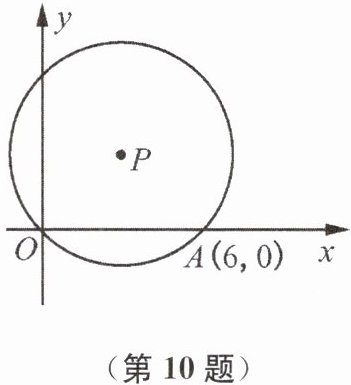
10. 如图,在平面直角坐标系中,点$O$为坐标原点,点$P$在第一象限,$\odot P$与$x$轴交于$O$,$A$两点,点$A$的坐标为$(6,0)$,$\odot P$的半径为$\sqrt{13}$,则点$P$的坐标为
]
(3,2)
.]
答案
10.$(3,2)$
解析
解:设点$P$的坐标为$(x,y)$。
因为$\odot P$与$x$轴交于$O(0,0)$,$A(6,0)$两点,所以$OA=6$,$P$在线段$OA$的垂直平分线上,故$x = \frac{0 + 6}{2}=3$。
又因为$\odot P$的半径为$\sqrt{13}$,所以$PO=\sqrt{13}$。
由两点间距离公式得:$\sqrt{(x - 0)^2+(y - 0)^2}=\sqrt{13}$,即$\sqrt{3^2 + y^2}=\sqrt{13}$。
两边平方得:$9 + y^2=13$,解得$y^2 = 4$,$y=\pm2$。
因为点$P$在第一象限,所以$y=2$。
则点$P$的坐标为$(3,2)$。
$(3,2)$
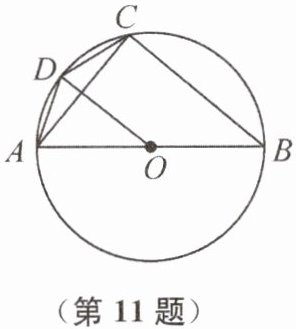
11. 如图,四边形$ABCD$内接于$\odot O$,$AB$是直径,$D$是$\overset{\frown}{AC}$的中点.
(1) 求证:$OD // BC$.
(2) 连接$AC$,若$AB = 5$,$CD = 2$,求$AC$的长.
]
(1) 求证:$OD // BC$.
(2) 连接$AC$,若$AB = 5$,$CD = 2$,求$AC$的长.
]
答案
11. 解:
(1) 连接AC, 交OD于E,
$\because$AB是⊙O的直径,
$\therefore AC\perp BC$,
$\because$点D是$\overset{\frown}{AC}$的中点,
$\therefore OD\perp AC$,
$\therefore OD// BC$;
(2) 连接OC,
由
(1)可得,$OD\perp AC$.
$\because AB = 5$,$\therefore OC = OD = 2.5$,
$\therefore$设$DE = x$,则$OE = 2.5 - x$。
在$Rt\triangle CDE$中,$CE^{2} = CD^{2} - DE^{2}$,
在$Rt\triangle OCE$中,$CE^{2} = OC^{2} - OE^{2}$,
$\therefore 4 - x^{2} = 2.5^{2} - (2.5 - x)^{2}$。
解得$x = \frac{4}{5}$。$\therefore CE = \frac{2\sqrt{21}}{5}$,
$\therefore AC = 2CE = \frac{4\sqrt{21}}{5}$。
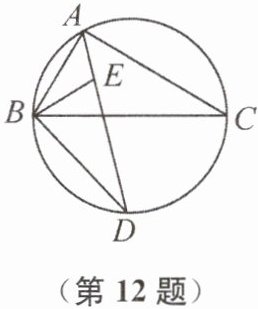
12. (2023 春·丰城市期末)如图,$\angle BAC$的平分线交$\triangle ABC$的外接圆于点$D$,$\angle ABC$的平分线交$AD$于点$E$.
(1) 求证:$DE = DB$;
(2) 若$\angle BAC = 90^{\circ}$,$BD = 4$,求$\triangle ABC$外接圆的半径.
]
(1) 求证:$DE = DB$;
(2) 若$\angle BAC = 90^{\circ}$,$BD = 4$,求$\triangle ABC$外接圆的半径.
]
答案
12.
(1) 证明:$\because AD$平分$\angle BAC,BE$平分$\angle ABC$,
$\therefore\angle BAD = \angle CAD,\angle ABE = \angle CBE$,
$\because\angle BED = \angle BAE + \angle ABE,\angle DBE = \angle EBC + \angle CBD,\angle CBD = \angle CAD$,
$\therefore\angle BED = \angle EBD$,
$\therefore DE = DB$;
(2) 解:连接CD,
$\because\angle BAC = 90^{\circ}$,$\therefore BC$是直径,
$\therefore\angle BDC = 90^{\circ}$,
$\because AD$平分$\angle BAC$,$\therefore\angle BAD = \angle CAD$,
$\therefore\overset{\frown}{BD} = \overset{\frown}{CD}$,$\therefore BD = CD$,
$\because BD = 4$,
$\therefore BC = \sqrt{4^{2} + 4^{2}} = 4\sqrt{2}$,
$\therefore \triangle ABC$外接圆的半径为$2\sqrt{2}$。
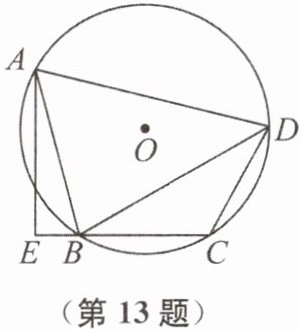
13. (2024 秋·温州期末)如图,四边形$ABCD$内接于$\odot O$,$AE \perp CB$交$CB$的延长线于点$E$,若$BA$平分$\angle DBE$,$AD = 6$,$CE = 4$,则$AE$的长为
]
2√5
.]
答案
13.$2\sqrt{5}$
解析
证明:连接AC,
∵BA平分∠DBE,
∴∠ABE=∠ABD,
∵四边形ABCD内接于⊙O,
∴∠ABD=∠ACD,∠ABE=∠ADC,
∴∠ACD=∠ADC,
∴AC=AD=6,
设BE=x,AE=y,
∵AE⊥CB,
∴AE²+BE²=AB²,AE²+CE²=AC²,
∵CE=4,AC=6,
∴y²+4²=6²,
解得y=2√5,
即AE=2√5.
2√5
∵BA平分∠DBE,
∴∠ABE=∠ABD,
∵四边形ABCD内接于⊙O,
∴∠ABD=∠ACD,∠ABE=∠ADC,
∴∠ACD=∠ADC,
∴AC=AD=6,
设BE=x,AE=y,
∵AE⊥CB,
∴AE²+BE²=AB²,AE²+CE²=AC²,
∵CE=4,AC=6,
∴y²+4²=6²,
解得y=2√5,
即AE=2√5.
2√5
14. 如图,四边形$ABCD$为正方形,$\odot O$过正方形的顶点$A$和对角线的交点$P$,分别交$AB$,$AD$于点$F$,$E$.
(1) 求证:$DE = AF$;
(2) 若$\odot O$的半径为$\frac{\sqrt{3}}{2}$,$AB = \sqrt{2} + 1$,求$\frac{AE}{DE}$的值.
]
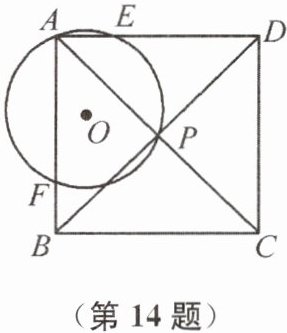
(1) 求证:$DE = AF$;
(2) 若$\odot O$的半径为$\frac{\sqrt{3}}{2}$,$AB = \sqrt{2} + 1$,求$\frac{AE}{DE}$的值.
]
答案
14.
(1) 略
(2) 解:连EF,
$\because\angle BAD = 90^{\circ}$,
$\therefore EF$为⊙O的直径,
而⊙O的半径为$\frac{\sqrt{3}}{2}$,
$\therefore EF = \sqrt{3}$,
$\therefore AF^{2} + AE^{2} = EF^{2} = (\sqrt{3})^{2} = 3$,
而$DE = AF$,
$\therefore DE^{2} + AE^{2} = 3$①.
又$\because AD = AE + DE = AB$,
$\therefore AE + DE = \sqrt{2} + 1$②.
由①②联立起来组成方程组,解之得$AE = 1,DE = \sqrt{2}$或$AE = \sqrt{2},DE = 1$,所以$\frac{AE}{DE} = \frac{\sqrt{2}}{2}$或$\frac{AE}{DE} = \sqrt{2}$。
