

 登录
登录
三、补全对话。
A)请阅读下面对话,根据对话内容从下面方框内的七个选项中选择五个填入空白处,使对话通顺、合理,意思完整。一空一句。
(Li Dan and Wei Hai are talking in the classroom. Li Dan=L, Wei Hai=W)
W: Good morning, Li Dan. 1.
L: A story named The Frog in the Well.
W: Oh, I heard about it. 2.
L: Yeah, but this is a new version(版本). And the frog changed a lot in this one.
W: Oh, really? 3.
L: He decided to jump out of the well to see the world outside. And he kept trying over and over again, even though it was really hard.
W: 4.
L: Of course. But that's not the end of the story.
W: What happened next?
L: The frog was surprised by the beautiful world. He started travelling around, visiting new places and exploring many wonderful things.
W: Wow! 5. If we step out of our comfort zone(舒适区), we can enjoy a wonderful world!
L: Exactly! The world is waiting for us to explore!
B)根据对话内容回答问题。
6. What story is Li Dan reading?
7. Why did the frog keep trying to jump out of the well again and again?
8. What can we learn from the story?
A. How did he change?
B. What a great story!
C. Did he succeed at last?
D. What are you reading?
E. It's quite an old story, right?
F. Was it easy for the frog to jump out?
G. I don't think the new version is interesting.
A)请阅读下面对话,根据对话内容从下面方框内的七个选项中选择五个填入空白处,使对话通顺、合理,意思完整。一空一句。
(Li Dan and Wei Hai are talking in the classroom. Li Dan=L, Wei Hai=W)
W: Good morning, Li Dan. 1.
L: A story named The Frog in the Well.
W: Oh, I heard about it. 2.
L: Yeah, but this is a new version(版本). And the frog changed a lot in this one.
W: Oh, really? 3.
L: He decided to jump out of the well to see the world outside. And he kept trying over and over again, even though it was really hard.
W: 4.
L: Of course. But that's not the end of the story.
W: What happened next?
L: The frog was surprised by the beautiful world. He started travelling around, visiting new places and exploring many wonderful things.
W: Wow! 5. If we step out of our comfort zone(舒适区), we can enjoy a wonderful world!
L: Exactly! The world is waiting for us to explore!
B)根据对话内容回答问题。
6. What story is Li Dan reading?
7. Why did the frog keep trying to jump out of the well again and again?
8. What can we learn from the story?
A. How did he change?
B. What a great story!
C. Did he succeed at last?
D. What are you reading?
E. It's quite an old story, right?
F. Was it easy for the frog to jump out?
G. I don't think the new version is interesting.
答案
1. D
2. E
3. A
4. C
5. B
6. She is reading a story named The Frog in the Well.
7. Because he wanted to jump out of the well to see the world outside.
8. If we step out of our comfort zone, we can enjoy a wonderful world.
2. E
3. A
4. C
5. B
6. She is reading a story named The Frog in the Well.
7. Because he wanted to jump out of the well to see the world outside.
8. If we step out of our comfort zone, we can enjoy a wonderful world.
解析
A部分解题思路:结合上下文语境匹配选项:
1. 根据后文答语“一个叫《井底之蛙》的故事”,可知空处是询问对方正在阅读的内容,对应匹配选项。
2. 根据后文答语“是的,但这是新版本”,可知空处是确认这个故事是不是老旧的经典版本,对应匹配选项。
3. 根据前文“这个版本里青蛙的变化很大”,后文紧接着介绍青蛙的具体改变,可知空处是询问青蛙发生了怎样的变化,对应匹配选项。
4. 根据后文答语“当然,但故事还没结束”,后续内容提到青蛙见到了外面的美丽世界,可知空处是询问青蛙最后有没有成功跳出井,对应匹配选项。
5. 后文是对故事主旨的感悟延伸,可知空处是对这个新故事发出赞叹,对应匹配选项。
B部分解题思路:直接从对话原文定位对应信息,整理成符合问题要求的答句即可。
1. 根据后文答语“一个叫《井底之蛙》的故事”,可知空处是询问对方正在阅读的内容,对应匹配选项。
2. 根据后文答语“是的,但这是新版本”,可知空处是确认这个故事是不是老旧的经典版本,对应匹配选项。
3. 根据前文“这个版本里青蛙的变化很大”,后文紧接着介绍青蛙的具体改变,可知空处是询问青蛙发生了怎样的变化,对应匹配选项。
4. 根据后文答语“当然,但故事还没结束”,后续内容提到青蛙见到了外面的美丽世界,可知空处是询问青蛙最后有没有成功跳出井,对应匹配选项。
5. 后文是对故事主旨的感悟延伸,可知空处是对这个新故事发出赞叹,对应匹配选项。
B部分解题思路:直接从对话原文定位对应信息,整理成符合问题要求的答句即可。
四、任务型阅读。
Long ago, there was a man travelling from the State of Wei(魏国) to the State of Chu(楚国). After taking a lot of money and food, he found a good coachman(马车夫) and a horse, and then he began his trip.
Chu was to the south of Wei, but this man couldn't tell the difference when the coachman rode away to the north. On the way, he met a traveller. When the traveller knew that he was going to Chu, the traveller said, “Chu is in the south. When can you arrive there if you go north?” The man didn't care because he thought his horse was the best and could run quickly. The traveller said, “Your horse is fast, but it will be farther and farther away from Chu in this direction(方向). You will never reach Chu.”
The man still didn't worry about that, because he had enough money and food. Then the traveller said, “But you're still going the wrong way.” The man said, “It doesn't matter. My coachman is very skilled!” After hearing that, the traveller didn't say anything and watched helplessly as the man went away.
任务一:根据短文内容选择正确的答案。
()1. Which direction did the man ride to?
A. The south. B. The north. C. The east. D. The west.
()2. Why didn't the man care about the traveller's words?
A. Because he thought he could run quickly.
B. Because he thought he could ride his horse well.
C. Because he thought he knew the best way to Chu very well.
D. Because he thought he had the best horse that could run quickly.
()3. How did the traveller feel after the man refused to change his way?
A. Helpless. B. Hopeful. C. Cheerful. D. Excited.
()4. What's the writer's purpose of writing the passage?
A. To tell us not to believe in strangers.
B. To teach us to travel with a true friend.
C. To tell us to accept others' correct advice.
D. To tell us to follow our own ideas without help.
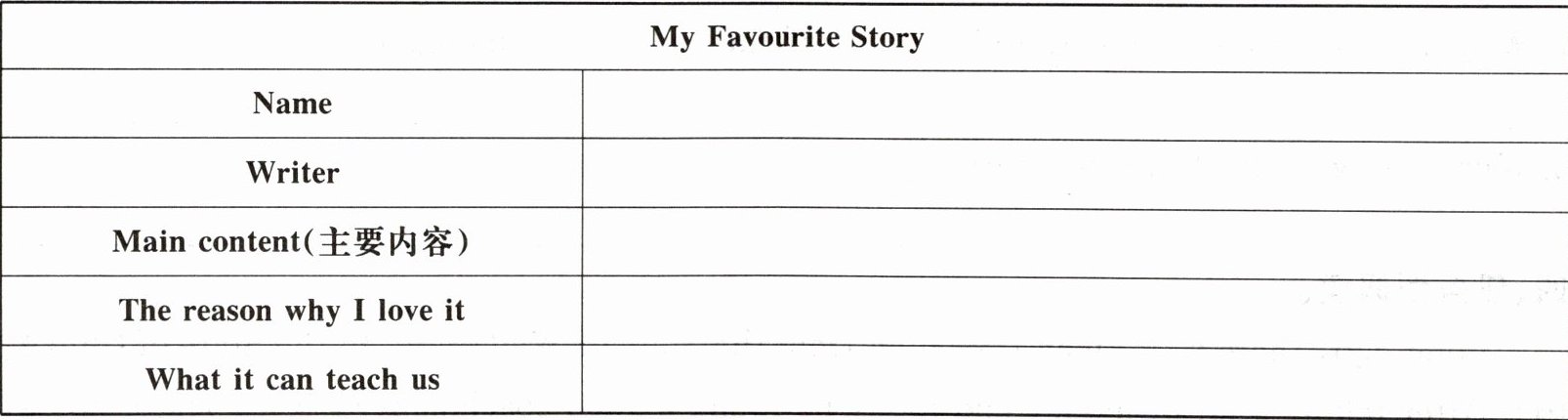
任务二:制作一张关于“My Favourite Story”的卡片。
Long ago, there was a man travelling from the State of Wei(魏国) to the State of Chu(楚国). After taking a lot of money and food, he found a good coachman(马车夫) and a horse, and then he began his trip.
Chu was to the south of Wei, but this man couldn't tell the difference when the coachman rode away to the north. On the way, he met a traveller. When the traveller knew that he was going to Chu, the traveller said, “Chu is in the south. When can you arrive there if you go north?” The man didn't care because he thought his horse was the best and could run quickly. The traveller said, “Your horse is fast, but it will be farther and farther away from Chu in this direction(方向). You will never reach Chu.”
The man still didn't worry about that, because he had enough money and food. Then the traveller said, “But you're still going the wrong way.” The man said, “It doesn't matter. My coachman is very skilled!” After hearing that, the traveller didn't say anything and watched helplessly as the man went away.
任务一:根据短文内容选择正确的答案。
()1. Which direction did the man ride to?
A. The south. B. The north. C. The east. D. The west.
()2. Why didn't the man care about the traveller's words?
A. Because he thought he could run quickly.
B. Because he thought he could ride his horse well.
C. Because he thought he knew the best way to Chu very well.
D. Because he thought he had the best horse that could run quickly.
()3. How did the traveller feel after the man refused to change his way?
A. Helpless. B. Hopeful. C. Cheerful. D. Excited.
()4. What's the writer's purpose of writing the passage?
A. To tell us not to believe in strangers.
B. To teach us to travel with a true friend.
C. To tell us to accept others' correct advice.
D. To tell us to follow our own ideas without help.
任务二:制作一张关于“My Favourite Story”的卡片。
答案
任务一:
1. B
2. D
3. A
4. C
任务二(参考填写内容):
Name: *Going South by Driving the Chariot North* (南辕北辙)
Writer: A famous ancient Chinese fable from *Strategies of the Warring States*
Main content: A man wanted to go to the State of Chu which is in the south of the State of Wei, but he rode his carriage to the north. He turned a deaf ear to the traveller's warning, and thought his good horse, enough supplies and skilled coachman could help him arrive at Chu smoothly.
The reason why I love it: The story is vivid and interesting, it makes a very deep impression on me.
What it can teach us: If we choose the wrong direction, our good conditions will not help us reach our target. We should take other people's correct advice in time.
1. B
2. D
3. A
4. C
任务二(参考填写内容):
Name: *Going South by Driving the Chariot North* (南辕北辙)
Writer: A famous ancient Chinese fable from *Strategies of the Warring States*
Main content: A man wanted to go to the State of Chu which is in the south of the State of Wei, but he rode his carriage to the north. He turned a deaf ear to the traveller's warning, and thought his good horse, enough supplies and skilled coachman could help him arrive at Chu smoothly.
The reason why I love it: The story is vivid and interesting, it makes a very deep impression on me.
What it can teach us: If we choose the wrong direction, our good conditions will not help us reach our target. We should take other people's correct advice in time.
解析
任务一:
1. 定位原文第二段"Chu was to the south of Wei, but this man couldn't tell the difference when the coachman rode away to the north.",可知男子驾车朝北方行驶,对应选项B。
2. 定位原文第二段"The man didn't care because he thought his horse was the best and could run quickly.",可知男子不在意路人的话是因为他认为自己有最好的快马,对应选项D。
3. 定位原文最后一段"the traveller didn't say anything and watched helplessly as the man went away.",可知路人在男子拒绝改道后感到很无奈,对应选项A。
4. 本文是经典寓言"南辕北辙",男子目标在南方却往北方走,不听旁人正确的劝告,只会离目的地越来越远,作者想借此告诉我们要接受他人的正确建议,对应选项C。
任务二:结合本篇寓言内容,符合七年级英语表达规范填写卡片即可。
1. 定位原文第二段"Chu was to the south of Wei, but this man couldn't tell the difference when the coachman rode away to the north.",可知男子驾车朝北方行驶,对应选项B。
2. 定位原文第二段"The man didn't care because he thought his horse was the best and could run quickly.",可知男子不在意路人的话是因为他认为自己有最好的快马,对应选项D。
3. 定位原文最后一段"the traveller didn't say anything and watched helplessly as the man went away.",可知路人在男子拒绝改道后感到很无奈,对应选项A。
4. 本文是经典寓言"南辕北辙",男子目标在南方却往北方走,不听旁人正确的劝告,只会离目的地越来越远,作者想借此告诉我们要接受他人的正确建议,对应选项C。
任务二:结合本篇寓言内容,符合七年级英语表达规范填写卡片即可。
