

 登录
登录
三、阅读理解(每小题 2 分,满分 40 分)
第一节 请认真阅读下面四篇短文,从每篇短文后各小题所给的 A、B、C、D 四个选项中选出最佳选项。
A
(
A. ¥10
B. ¥20
C. ¥30
D. ¥40
(
A. Kangaroos can jump high without the help of its big tail.
B. There are only one more bone in a big horse than in people.
C. There can't be any snowfalls or rainstorms in the Sahara Desert.
D. Eating some kinds of fruits or vegetables makes your skin orange.
(
A. a diary
B. a poster
C. a letter
D. a note
第一节 请认真阅读下面四篇短文,从每篇短文后各小题所给的 A、B、C、D 四个选项中选出最佳选项。
A
(
C
)26. If you want to listen to the talk with your parents, you will pay .A. ¥10
B. ¥20
C. ¥30
D. ¥40
(
D
)27. Which of the following is TRUE according to the material above?A. Kangaroos can jump high without the help of its big tail.
B. There are only one more bone in a big horse than in people.
C. There can't be any snowfalls or rainstorms in the Sahara Desert.
D. Eating some kinds of fruits or vegetables makes your skin orange.
(
B
)28. This is most probably .A. a diary
B. a poster
C. a letter
D. a note
答案
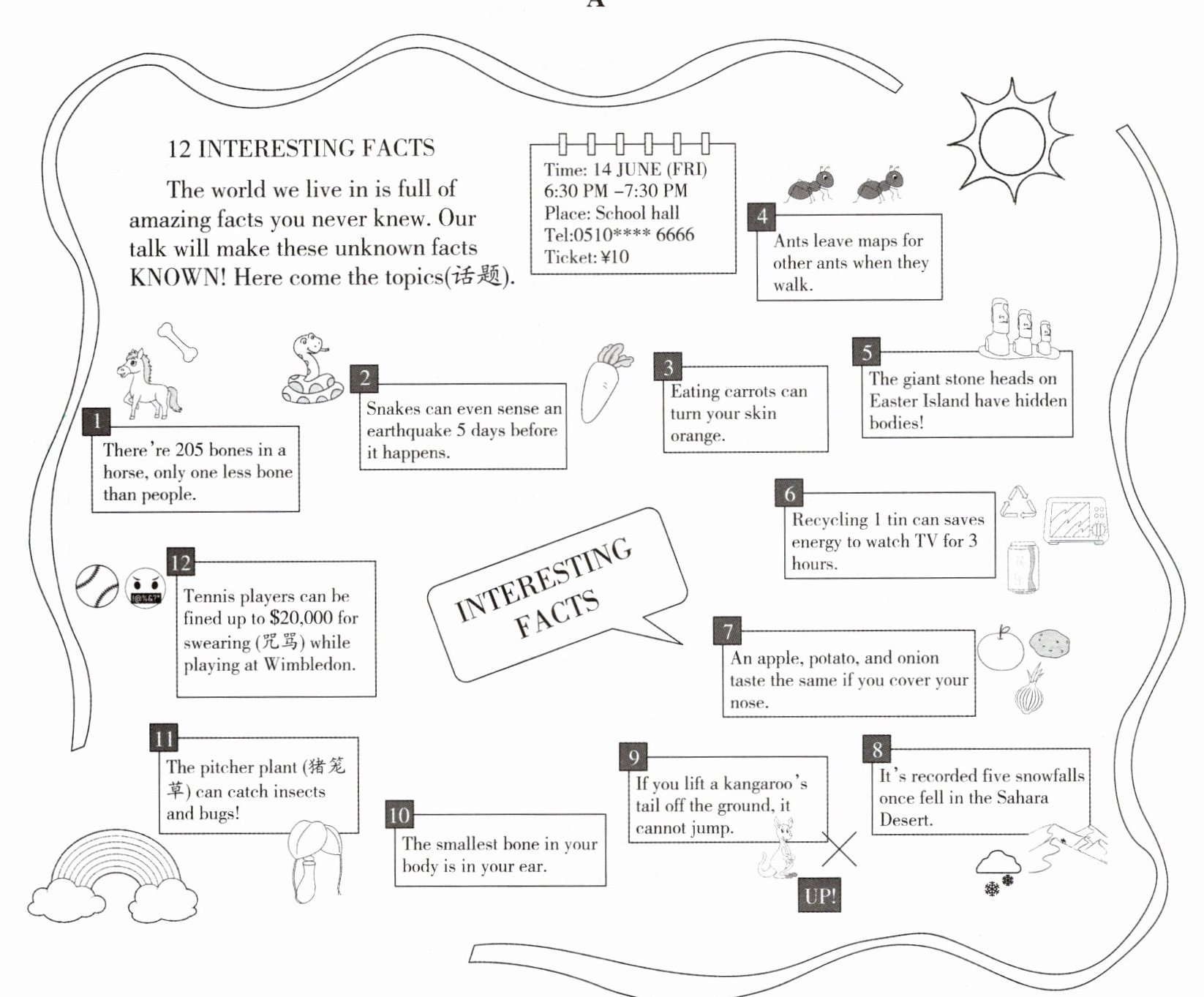
A【语篇解读】本文是一张海报,主要介绍学校礼堂举办的关于自然奇观的讲座信息,包含动物、植物和地理等方面的趣味知识。26~28 CDB
解析
【分析】
本题是基于一张介绍趣味事实讲座的海报的阅读理解题,需结合海报中的时间、地点、票价及12条趣味事实信息,解答三道选择题。第26题需计算三人的门票总费用,先定位票价再计算;第27题需逐一核对选项与海报内容的正误;第28题需根据文本特征判断体裁。
【解析】
26. 定位海报中“Ticket: ¥10”,可知单人票价为10元,和父母共3人,总费用为10×3=30元,故选C。
27. 逐一分析选项:
A项:海报第9条指出袋鼠抬起尾巴就不能跳,说明无尾巴无法跳,A错误;
B项:海报第1条说明马有205根骨头,比人少1根,B错误;
C项:海报第8条提到撒哈拉沙漠曾有过5次降雪,C错误;
D项:海报第3条说明吃胡萝卜(属于蔬菜)能让皮肤变橙,即部分果蔬会改变皮肤颜色,D正确,故选D。
28. 文本包含讲座的时间、地点、票价、话题等宣传信息,符合海报的体裁特征,故选B。
【答案】26.C 27.D 28.B
【知识点】阅读理解(细节理解)、应用文(海报)、信息提取判断
【点评】本题考查学生从海报中快速提取关键信息并分析判断的能力,需仔细核对每个选项与原文的对应关系,难度中等。
【难度系数】0.6
本题是基于一张介绍趣味事实讲座的海报的阅读理解题,需结合海报中的时间、地点、票价及12条趣味事实信息,解答三道选择题。第26题需计算三人的门票总费用,先定位票价再计算;第27题需逐一核对选项与海报内容的正误;第28题需根据文本特征判断体裁。
【解析】
26. 定位海报中“Ticket: ¥10”,可知单人票价为10元,和父母共3人,总费用为10×3=30元,故选C。
27. 逐一分析选项:
A项:海报第9条指出袋鼠抬起尾巴就不能跳,说明无尾巴无法跳,A错误;
B项:海报第1条说明马有205根骨头,比人少1根,B错误;
C项:海报第8条提到撒哈拉沙漠曾有过5次降雪,C错误;
D项:海报第3条说明吃胡萝卜(属于蔬菜)能让皮肤变橙,即部分果蔬会改变皮肤颜色,D正确,故选D。
28. 文本包含讲座的时间、地点、票价、话题等宣传信息,符合海报的体裁特征,故选B。
【答案】26.C 27.D 28.B
【知识点】阅读理解(细节理解)、应用文(海报)、信息提取判断
【点评】本题考查学生从海报中快速提取关键信息并分析判断的能力,需仔细核对每个选项与原文的对应关系,难度中等。
【难度系数】0.6
B
Do you know a “shore keeper”? In fact, it's not a job for people like zookeeper. It is a job for a special kind of forest—mangrove forest. In China, we call it *hongshulin* or “red forest”. Let's go into a mangrove forest to have a look.
They grow near the sea. They can grow up to 10 metres.
They keep the land from the sea. This way, they protect the land from strong winds and waves. The trees stand in neat rows, with shorter ones standing at the front and taller ones at the back. When typhoons(台风) come, they protect the towns nearby.
Like other trees, mangrove trees take in CO₂ to make oxygen. They are helping to keep the air clean and slow down weather change on Earth. Mangrove trees can grow up to 10 metres. Many wild birds live here. Many birds stop by for food during their trips.
Are the trees red? No, mangrove trees don't have red leaves or flowers. They are green. But they have special bark(树皮). Their bark can be used to make red dyes(染料). The bark gets air through small holes. The holes can close during high tide(涨潮). This way, the tree won't die.
Some parts of the roots(根) grow out of the water. They need more oxygen to live. They are also homes to snakes and lizards. The roots grow in salty water. They are not easy to get through. They make great homes for baby sea animals, like baby lobsters, baby turtles and baby fish. They can keep big animals away.
(
A. How mangrove trees help the Earth.
B. Where mangrove trees always grow.
C. What mangrove trees do during high tide.
D. How mangrove forests make the air fresh.
(
a. It protects us from bad weather.
b. It gives out oxygen.
c. It gives food to migratory birds.
d. It builds more houses.
A. abc
B. abd
C. acd
D. bcd
(
A. Because the trees have red leaves and flowers.
B. Because the trees live freely along the Red Sea.
C. Because red dyes can be made from the bark of the trees.
D. Because the trees' roots are red when they meet the water.
(
A. They only get air through roots, and they can keep the air clean.
B. They are one of the oldest trees and can grow up to 10 metres.
C. They may die during high tide because there are many large holes.
D. They grow in salty water and are homes to some baby sea animals.
Do you know a “shore keeper”? In fact, it's not a job for people like zookeeper. It is a job for a special kind of forest—mangrove forest. In China, we call it *hongshulin* or “red forest”. Let's go into a mangrove forest to have a look.
They grow near the sea. They can grow up to 10 metres.
They keep the land from the sea. This way, they protect the land from strong winds and waves. The trees stand in neat rows, with shorter ones standing at the front and taller ones at the back. When typhoons(台风) come, they protect the towns nearby.
Like other trees, mangrove trees take in CO₂ to make oxygen. They are helping to keep the air clean and slow down weather change on Earth. Mangrove trees can grow up to 10 metres. Many wild birds live here. Many birds stop by for food during their trips.
Are the trees red? No, mangrove trees don't have red leaves or flowers. They are green. But they have special bark(树皮). Their bark can be used to make red dyes(染料). The bark gets air through small holes. The holes can close during high tide(涨潮). This way, the tree won't die.
Some parts of the roots(根) grow out of the water. They need more oxygen to live. They are also homes to snakes and lizards. The roots grow in salty water. They are not easy to get through. They make great homes for baby sea animals, like baby lobsters, baby turtles and baby fish. They can keep big animals away.
(
A
)29. What does the third paragraph mainly tell us?A. How mangrove trees help the Earth.
B. Where mangrove trees always grow.
C. What mangrove trees do during high tide.
D. How mangrove forests make the air fresh.
(
A
)30. How does the mangrove forest help us?a. It protects us from bad weather.
b. It gives out oxygen.
c. It gives food to migratory birds.
d. It builds more houses.
A. abc
B. abd
C. acd
D. bcd
(
C
)31. Why is the mangrove forest called “red forest”?A. Because the trees have red leaves and flowers.
B. Because the trees live freely along the Red Sea.
C. Because red dyes can be made from the bark of the trees.
D. Because the trees' roots are red when they meet the water.
(
D
)32. What do we know about mangrove trees?A. They only get air through roots, and they can keep the air clean.
B. They are one of the oldest trees and can grow up to 10 metres.
C. They may die during high tide because there are many large holes.
D. They grow in salty water and are homes to some baby sea animals.
答案
B
【语篇解读】本文是一篇说明文。文章主要介绍了红树林的生长习性和它们的功能。
29~32 AACD
【语篇解读】本文是一篇说明文。文章主要介绍了红树林的生长习性和它们的功能。
29~32 AACD
解析
【分析】
解答这类阅读理解题,需先通读全文把握文章主旨,再针对每个小题的问题,定位到原文对应段落,分析段落内容或提取关键信息,逐一对比选项,排除错误选项后确定正确答案。
【解析】
29题:第三段主要介绍红树林能保护土地免受海浪、强风及台风的侵害,体现其对地球的保护作用,对应选项A。
30题:a项对应第三段红树林防台风(恶劣天气)的作用;b项对应第四段红树林释放氧气的作用;c项对应第四段为候鸟提供食物的作用;d项文中未提及,故正确组合为abc,选A。
31题:第五段明确说明红树林的树皮可用于制作红色染料,因此被称为“红森林”,对应选项C。
32题:A项“only get air through roots”与原文(树皮也有通气小孔)不符;B项“one of the oldest trees”文中未提及;C项“die during high tide”与原文(涨潮时小孔关闭防止死亡)不符;D项对应第六段“roots grow in salty water...make great homes for baby sea animals”,正确,选D。
【答案】
AACD
【知识点】
阅读理解(说明文)、细节理解题、主旨大意题
【点评】
本文是介绍红树林的说明文,重点考查学生对文章主旨和细节信息的理解与判断能力,需学生准确提取原文关键内容,排除干扰选项,整体难度适中。
【难度系数】
0.6
解答这类阅读理解题,需先通读全文把握文章主旨,再针对每个小题的问题,定位到原文对应段落,分析段落内容或提取关键信息,逐一对比选项,排除错误选项后确定正确答案。
【解析】
29题:第三段主要介绍红树林能保护土地免受海浪、强风及台风的侵害,体现其对地球的保护作用,对应选项A。
30题:a项对应第三段红树林防台风(恶劣天气)的作用;b项对应第四段红树林释放氧气的作用;c项对应第四段为候鸟提供食物的作用;d项文中未提及,故正确组合为abc,选A。
31题:第五段明确说明红树林的树皮可用于制作红色染料,因此被称为“红森林”,对应选项C。
32题:A项“only get air through roots”与原文(树皮也有通气小孔)不符;B项“one of the oldest trees”文中未提及;C项“die during high tide”与原文(涨潮时小孔关闭防止死亡)不符;D项对应第六段“roots grow in salty water...make great homes for baby sea animals”,正确,选D。
【答案】
AACD
【知识点】
阅读理解(说明文)、细节理解题、主旨大意题
【点评】
本文是介绍红树林的说明文,重点考查学生对文章主旨和细节信息的理解与判断能力,需学生准确提取原文关键内容,排除干扰选项,整体难度适中。
【难度系数】
0.6
