

 登录
登录
五、阅读理解
A
To me, life would be boring without music. I realize that it is not true for every-
body. Many people get along quite well with-
out going to the concerts, or listening to the
CDs. But music plays an important part in
everyone's life, whether he or she realizes it
or not. Try to imagine, for example, what
films or TV plays would be like without
music. Would the feeling, the moving story, and
the greatest interests be so exciting? I'm not
sure about it.
Now, we have been speaking of music in its
more common meaning—the kind of music we
hear in the concert hall. But if we look at some
parts of music more closely, we will discover
them in our everyday lives too—in the sound
of the sea, the singing of a bird in the woods
and so on. So music surely has meaning for
everyone. And, of course, it has special mean-
ing for those who have spent all their lives
working on playing or writing music.
It is well said, “Through music a child
enters a world of beauty, expresses himself
from his heart, feels the joy of doing things
alone, learns to take care of others, develops
his mind and makes his body strong.”
根据短文内容判断正误(正确的写“T”,错误
的写“F”)。
(
life.
(
portance of music.
(
everyday life.
(
cians.
(
development of music.
A
To me, life would be boring without music. I realize that it is not true for every-
body. Many people get along quite well with-
out going to the concerts, or listening to the
CDs. But music plays an important part in
everyone's life, whether he or she realizes it
or not. Try to imagine, for example, what
films or TV plays would be like without
music. Would the feeling, the moving story, and
the greatest interests be so exciting? I'm not
sure about it.
Now, we have been speaking of music in its
more common meaning—the kind of music we
hear in the concert hall. But if we look at some
parts of music more closely, we will discover
them in our everyday lives too—in the sound
of the sea, the singing of a bird in the woods
and so on. So music surely has meaning for
everyone. And, of course, it has special mean-
ing for those who have spent all their lives
working on playing or writing music.
It is well said, “Through music a child
enters a world of beauty, expresses himself
from his heart, feels the joy of doing things
alone, learns to take care of others, develops
his mind and makes his body strong.”
根据短文内容判断正误(正确的写“T”,错误
的写“F”)。
(
T
)1. Music is very important in the writer'slife.
(
T
)2. Some people don't realize the im-portance of music.
(
F
)3. Music can't be found everywhere ineveryday life.
(
T
)4. Music has special meaning for musi-cians.
(
F
)5. The writer talked mainly about thedevelopment of music.
答案
1.T 2.T 3.F 4.T 5.F
解析
【分析】做英语阅读理解判断正误题时,需先明确每道题的题干关键词,带着关键词回到原文定位对应内容,将题干表述与原文信息逐一对比,信息一致则判断为正确(T),不一致则为错误(F)。具体到本题:1. 题干关键词为“music important in writer's life”,定位原文第一句;2. 题干关键词为“some people don't realize music's importance”,定位原文第一段后半部分;3. 题干关键词为“music can't be found in daily life”,定位原文第二段;4. 题干关键词为“special meaning for musicians”,定位原文第二段后半部分;5. 题干关键词为“mainly about development of music”,定位全文主旨。
【解析】1. 原文第一句“To me, life would be boring without music”表明音乐对作者的生活至关重要,与题干表述一致,故判断为T;2. 原文第一段“whether he or she realizes it or not”说明有些人没有意识到音乐的重要性,与题干表述一致,故判断为T;3. 原文第二段提到日常生活中能发现音乐(如海的声音、鸟的鸣唱等),说明音乐在日常生活中随处可见,与题干“不能在日常生活中找到音乐”表述矛盾,故判断为F;4. 原文第二段“it has special meaning for those who have spent all their lives working on playing or writing music”,这些人即音乐家,与题干表述一致,故判断为T;5. 全文围绕音乐在生活中的重要性展开,并非讨论音乐的发展,与题干表述矛盾,故判断为F。
【答案】1.T 2.T 3.F 4.T 5.F
【知识点】英语阅读理解、细节理解题、主旨大意题
【点评】本题为英语阅读理解判断正误题型,侧重考查学生对短文细节信息的定位能力及对文章主旨的把握,解题关键是精准匹配题干与原文内容,整体难度适中,只要认真阅读原文即可正确作答。
【难度系数】0.6
【解析】1. 原文第一句“To me, life would be boring without music”表明音乐对作者的生活至关重要,与题干表述一致,故判断为T;2. 原文第一段“whether he or she realizes it or not”说明有些人没有意识到音乐的重要性,与题干表述一致,故判断为T;3. 原文第二段提到日常生活中能发现音乐(如海的声音、鸟的鸣唱等),说明音乐在日常生活中随处可见,与题干“不能在日常生活中找到音乐”表述矛盾,故判断为F;4. 原文第二段“it has special meaning for those who have spent all their lives working on playing or writing music”,这些人即音乐家,与题干表述一致,故判断为T;5. 全文围绕音乐在生活中的重要性展开,并非讨论音乐的发展,与题干表述矛盾,故判断为F。
【答案】1.T 2.T 3.F 4.T 5.F
【知识点】英语阅读理解、细节理解题、主旨大意题
【点评】本题为英语阅读理解判断正误题型,侧重考查学生对短文细节信息的定位能力及对文章主旨的把握,解题关键是精准匹配题干与原文内容,整体难度适中,只要认真阅读原文即可正确作答。
【难度系数】0.6
B
Recently, I asked a seeing friend who had just walked in the woods what she had no-
ticed. “Nothing special,” she replied.
How was it possible, I asked myself, to walk through the woods and see nothing worthy of note? I who cannot see find hundreds of things to interest me only through touch. If I can get so much pleasure from touch, how much more beauty must be found by sight(视力)? And I have imagined what I should most like to see if I were given the use of my eyes for just three days.
On the first day, I should want to see the people who have made my life worth living and the books which have been read to me. In
the afternoon, I should take a walk in the woods and admire the beauty of nature. That night, I should not be able to sleep.
On my second day, I should go to the museums to see man's progress. I should try to explore the spirit of man through his art. In the evening, I should spend at the movies.
The following day, I should spend in the world of common people going about the business of life. At midnight, permanent(永久的) night would close in on me again, and I should realize how much I had left unseen.
I who am blind can give one suggestion to those who see: Use your eyes as if tomor-
row you would be blind. The same is true of other senses. Hear the songs of birds, as if you would be deaf tomorrow. Smell the flow-
ers, as if tomorrow you could never smell again ... But of all the senses, I'm sure that sight must be the most pleasant.
(Adapted from Three Days to See by Helen Keller)
(
A. Walking in the woods.
B. Asking herself questions.
C. Seeing natural beauty.
D. Touching interesting things.
(
A. Read books to people on the first day.
B. Go to the movies on the second day.
C. Succeed in business on the third day.
D. Have a wonderful dream every day.
(
A. A description of different senses.
B. A method of living a pleasant life.
C. Encouragement to the blind people.
D. Advice to people without disabilities.
(
(
A. Time is what we want most, but what we use worst.
B. Never leave until tomorrow what you can do today.
C. Live every moment and be thankful for what you have.
D. The future belongs to those who are preparing for it now.
Recently, I asked a seeing friend who had just walked in the woods what she had no-
ticed. “Nothing special,” she replied.
How was it possible, I asked myself, to walk through the woods and see nothing worthy of note? I who cannot see find hundreds of things to interest me only through touch. If I can get so much pleasure from touch, how much more beauty must be found by sight(视力)? And I have imagined what I should most like to see if I were given the use of my eyes for just three days.
On the first day, I should want to see the people who have made my life worth living and the books which have been read to me. In
the afternoon, I should take a walk in the woods and admire the beauty of nature. That night, I should not be able to sleep.
On my second day, I should go to the museums to see man's progress. I should try to explore the spirit of man through his art. In the evening, I should spend at the movies.
The following day, I should spend in the world of common people going about the business of life. At midnight, permanent(永久的) night would close in on me again, and I should realize how much I had left unseen.
I who am blind can give one suggestion to those who see: Use your eyes as if tomor-
row you would be blind. The same is true of other senses. Hear the songs of birds, as if you would be deaf tomorrow. Smell the flow-
ers, as if tomorrow you could never smell again ... But of all the senses, I'm sure that sight must be the most pleasant.
(Adapted from Three Days to See by Helen Keller)
(
B
)6. What makes the writer start imagining the three days?A. Walking in the woods.
B. Asking herself questions.
C. Seeing natural beauty.
D. Touching interesting things.
(
B
)7. What does the writer want to do during the three days?A. Read books to people on the first day.
B. Go to the movies on the second day.
C. Succeed in business on the third day.
D. Have a wonderful dream every day.
(
D
)8. What does the last paragraph mainly talk about?A. A description of different senses.
B. A method of living a pleasant life.
C. Encouragement to the blind people.
D. Advice to people without disabilities.
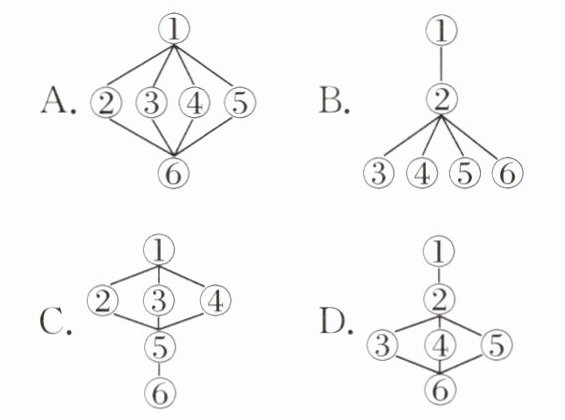
(
D
)9. Which is the best structure(结构) of the passage? (①=Paragraph 1, ②=Paragraph 2, ...)(
C
)10. Which of the following sayings may the writer agree with?A. Time is what we want most, but what we use worst.
B. Never leave until tomorrow what you can do today.
C. Live every moment and be thankful for what you have.
D. The future belongs to those who are preparing for it now.
答案
6.B 7.B 8.D 9.D 10.C
解析
【分析】
先通读全文理解文章主旨,再针对每个题目回到原文定位对应信息,结合题目要求分析选项:第6题需找到作者开始想象的触发点;第7题需定位三天中每天的活动;第8题需概括最后一段核心内容;第9题需梳理文章段落结构;第10题需匹配作者的观点态度。
【解析】
6. 根据原文第一段,作者询问朋友在树林中的发现后,通过自我提问(“How was it possible...?”)进而开始想象,对应选项B。
7. 原文第四段明确提到“On my second day...In the evening, I should spend at the movies.”,对应选项B。
8. 最后一段作者向有视力的人提出珍惜感官的建议,核心是给非残疾人士的忠告,对应选项D。
9. 文章段落结构:①引出话题(朋友的回答与作者的疑问);②过渡到想象;③第一天活动;④第二天活动;⑤第三天活动;⑥总结建议,对应选项D的结构。
10. 作者强调珍惜当下拥有的(如视力),与“Live every moment and be thankful for what you have”匹配,对应选项C。
【答案】
6.B 7.B 8.D 9.D 10.C
【知识点】
英语阅读理解、细节理解、主旨大意、推理判断
【点评】
本文节选自海伦·凯勒的作品,考查学生对文章细节、结构及作者观点的理解,需准确定位原文信息,难度适中。
【难度系数】
0.5
先通读全文理解文章主旨,再针对每个题目回到原文定位对应信息,结合题目要求分析选项:第6题需找到作者开始想象的触发点;第7题需定位三天中每天的活动;第8题需概括最后一段核心内容;第9题需梳理文章段落结构;第10题需匹配作者的观点态度。
【解析】
6. 根据原文第一段,作者询问朋友在树林中的发现后,通过自我提问(“How was it possible...?”)进而开始想象,对应选项B。
7. 原文第四段明确提到“On my second day...In the evening, I should spend at the movies.”,对应选项B。
8. 最后一段作者向有视力的人提出珍惜感官的建议,核心是给非残疾人士的忠告,对应选项D。
9. 文章段落结构:①引出话题(朋友的回答与作者的疑问);②过渡到想象;③第一天活动;④第二天活动;⑤第三天活动;⑥总结建议,对应选项D的结构。
10. 作者强调珍惜当下拥有的(如视力),与“Live every moment and be thankful for what you have”匹配,对应选项C。
【答案】
6.B 7.B 8.D 9.D 10.C
【知识点】
英语阅读理解、细节理解、主旨大意、推理判断
【点评】
本文节选自海伦·凯勒的作品,考查学生对文章细节、结构及作者观点的理解,需准确定位原文信息,难度适中。
【难度系数】
0.5
