

 登录
登录
七、阅读短文,判断正(T)误(F)。
Do you buy something just because it says “50% off” or “Last chance!”? Stores often use these words to make you buy quickly. This is called a “scarcity trick(稀缺把戏)”. When people think something is limited(有限的)or about to sell out, they feel worried and want to buy it at once.
However, a smart shopper knows this trick. You should ask yourself, “Do I really need this?” Sometimes, waiting for one day helps you make a better choice. Also, don't buy something just because your friend has one. That is called “peer pressure(同伴压力)”.
The best way to shop is to make a plan before you go shopping. Write down what you need. Stick to your list. Don't let tricks or friends change your mind. You are the boss of your money.
(
(
(
(
Do you buy something just because it says “50% off” or “Last chance!”? Stores often use these words to make you buy quickly. This is called a “scarcity trick(稀缺把戏)”. When people think something is limited(有限的)or about to sell out, they feel worried and want to buy it at once.
However, a smart shopper knows this trick. You should ask yourself, “Do I really need this?” Sometimes, waiting for one day helps you make a better choice. Also, don't buy something just because your friend has one. That is called “peer pressure(同伴压力)”.
The best way to shop is to make a plan before you go shopping. Write down what you need. Stick to your list. Don't let tricks or friends change your mind. You are the boss of your money.
(
T
)1. Stores use words like “Last chance!” to make people buy quickly.(
F
)2. A smart shopper should buy things at once when he/she sees “50% off”.(
T
)3. Waiting for one day can help you make a better shopping choice.(
T
)4. Peer pressure means buying something because your friend has one.答案
1. T 2. F 3. T 4. T
解析
【分析】
做此类判断正误题的思路是:先通读题目,再回到原文中定位与题目相关的句子,将题目表述与原文内容逐一对比,判断是否一致,注意不要被原文的“稀缺把戏”“同伴压力”等概念干扰,重点核对细节信息。
【解析】
1. 定位原文第一段第二句“Stores often use these words to make you buy quickly.”,题目表述与原文一致,故判断为T。
2. 定位原文第二段前两句“However, a smart shopper knows this trick. You should ask yourself, “Do I really need this?””,说明聪明的购物者不会看到“50% off”就立刻购买,题目表述与原文不符,故判断为F。
3. 定位原文第二段“Sometimes, waiting for one day helps you make a better choice.”,题目表述与原文一致,故判断为T。
4. 定位原文第二段“Also, don't buy something just because your friend has one. That is called “peer pressure”.”,题目表述与原文一致,故判断为T。
【答案】
1.T 2.F 3.T 4.T
【知识点】
英语阅读理解、细节信息判断
【点评】
本题为英语阅读理解的判断正误题,主要考查学生对短文细节内容的提取与理解能力,解题核心是准确定位原文对应语句,对比题目表述的一致性,整体难度较低,只要认真阅读原文即可完成判断。
【难度系数】
0.8
做此类判断正误题的思路是:先通读题目,再回到原文中定位与题目相关的句子,将题目表述与原文内容逐一对比,判断是否一致,注意不要被原文的“稀缺把戏”“同伴压力”等概念干扰,重点核对细节信息。
【解析】
1. 定位原文第一段第二句“Stores often use these words to make you buy quickly.”,题目表述与原文一致,故判断为T。
2. 定位原文第二段前两句“However, a smart shopper knows this trick. You should ask yourself, “Do I really need this?””,说明聪明的购物者不会看到“50% off”就立刻购买,题目表述与原文不符,故判断为F。
3. 定位原文第二段“Sometimes, waiting for one day helps you make a better choice.”,题目表述与原文一致,故判断为T。
4. 定位原文第二段“Also, don't buy something just because your friend has one. That is called “peer pressure”.”,题目表述与原文一致,故判断为T。
【答案】
1.T 2.F 3.T 4.T
【知识点】
英语阅读理解、细节信息判断
【点评】
本题为英语阅读理解的判断正误题,主要考查学生对短文细节内容的提取与理解能力,解题核心是准确定位原文对应语句,对比题目表述的一致性,整体难度较低,只要认真阅读原文即可完成判断。
【难度系数】
0.8
八、阅读短文,完成表格。
Do you often buy things you don't need? A shopping list can help you. Before you go to the shop, sit down and write down what you really need. For example, you need milk, bread and apples. When you are in the shop, only look at the things on your list. If you see a nice toy, ask yourself, “Is it on my list?” If the answer is no, do not buy it. A shopping list also helps you remember everything. You don't need to go back to the shop again. Many smart shoppers use a shopping list every time. They also check their pocket money before they go. They know how much they can spend. A list saves your money and your time.
| Smart shopping tips | What should you do? |
| --- | --- |
| Make a list. | Write down what you really 1.
| Only look at things on your 2.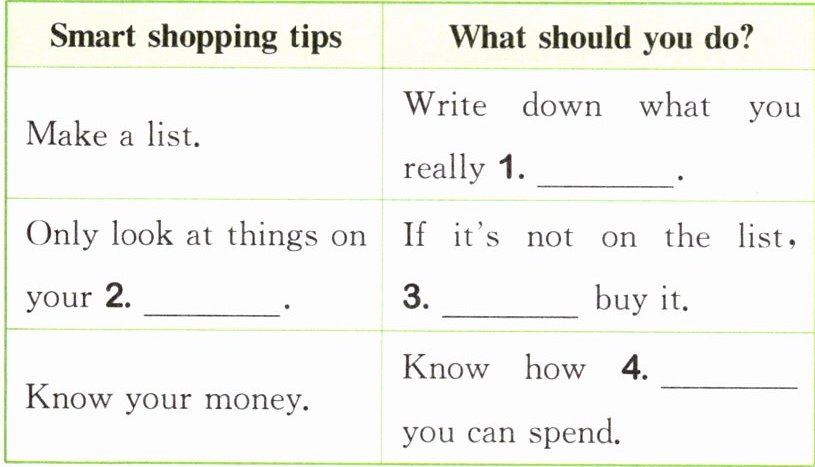 , 3.
, 3.
| Know your money. | Know how 4.
Do you often buy things you don't need? A shopping list can help you. Before you go to the shop, sit down and write down what you really need. For example, you need milk, bread and apples. When you are in the shop, only look at the things on your list. If you see a nice toy, ask yourself, “Is it on my list?” If the answer is no, do not buy it. A shopping list also helps you remember everything. You don't need to go back to the shop again. Many smart shoppers use a shopping list every time. They also check their pocket money before they go. They know how much they can spend. A list saves your money and your time.
| Smart shopping tips | What should you do? |
| --- | --- |
| Make a list. | Write down what you really 1.
need
. || Only look at things on your 2.
list
. | If it's not on the , 3. don't
buy it. || Know your money. | Know how 4.
much
you can spend. |答案
1. need 2. list 3. don't 4. much
解析
【分析】
这是一道根据短文内容完成表格的题目,解题思路是先通读短文,定位每个空格对应的原文句子,再提取符合语境的单词填入空格,核心是把握短文细节与表格内容的对应关系。
【解析】
1. 定位原文“Before you go to the shop, sit down and write down what you really need.”,可知此处应填need;
2. 定位原文“When you are in the shop, only look at the things on your list.”,可知此处应填list;
3. 定位原文“If the answer is no, do not buy it.”,可知此处应填don't;
4. 定位原文“They know how much they can spend.”,可知此处应填much。
【答案】
1. need 2. list 3. don't 4. much
【知识点】
阅读理解,词汇运用
【点评】
本题考查学生对英语短文细节的理解能力,属于基础题型,只要能准确匹配原文与表格内容即可完成,难度较低。
【难度系数】
0.2
这是一道根据短文内容完成表格的题目,解题思路是先通读短文,定位每个空格对应的原文句子,再提取符合语境的单词填入空格,核心是把握短文细节与表格内容的对应关系。
【解析】
1. 定位原文“Before you go to the shop, sit down and write down what you really need.”,可知此处应填need;
2. 定位原文“When you are in the shop, only look at the things on your list.”,可知此处应填list;
3. 定位原文“If the answer is no, do not buy it.”,可知此处应填don't;
4. 定位原文“They know how much they can spend.”,可知此处应填much。
【答案】
1. need 2. list 3. don't 4. much
【知识点】
阅读理解,词汇运用
【点评】
本题考查学生对英语短文细节的理解能力,属于基础题型,只要能准确匹配原文与表格内容即可完成,难度较低。
【难度系数】
0.2
