

 登录
登录
一、单词速查(根据汉语意思写出下列单词)
1.
2.
3.
4.
5.
6.
7.
8.
9.
10.
1.
risky
adj.有危险(或风险)的→risk
n.风险 v.冒……的风险(或危险)2.
southern
adj.南部的;向南的→south
n.南方 adj.南方的3.
located
adj.位于;坐落在→locate
v.位于;查找……的位置→location
n.位置;地点4.
freshwater
adj.淡水的;淡水中生长的5.
type
n.类型;种类6.
attract
v.吸引;招引→attraction
n.吸引力;景点→attractive
adj.有吸引力的;迷人的7.
curious
adj.好奇的;求知欲强的→curiosity
n.好奇心;求知欲→curiously
adv.好奇地8.
traveller
n.旅行者;游客→travel
v./n.旅行;出行9.
coast
n.海岸;海滨10.
coral
n.珊瑚;珊瑚虫答案
1.risky;risk 2.southern;south
3.located;locate;location 4.freshwater
5.type 6.attract; attraction; attractive
7.curious; curiosity; curiously
8.traveller; travel 9.coast 10.coral
3.located;locate;location 4.freshwater
5.type 6.attract; attraction; attractive
7.curious; curiosity; curiously
8.traveller; travel 9.coast 10.coral
解析
【分析】本题为英语基础词汇识记题,考查根据汉语意思匹配对应单词,重点涉及同根词的词性转换(形容词、名词、动词等的派生形式),解题时需先明确每个汉语释义的核心词义,再结合题干要求的词性,匹配积累的正确词汇,准确对应词义与词性即可。
【解析】1. 表“有危险的”形容词为risky,对应表“风险;冒风险”的名词/动词为risk;2. 表“南部的;向南的”形容词为southern,对应表“南方;南方的”名词/形容词为south;3. 表“位于;坐落在”的形容词为located,对应表“位于;查找位置”的动词为locate,对应表“位置;地点”的名词为location;4. 表“淡水的;淡水中生长的”形容词为freshwater;5. 表“类型;种类”的名词为type;6. 表“吸引”的动词为attract,对应表“吸引力;景点”的名词为attraction,对应表“有吸引力的”形容词为attractive;7. 表“好奇的”形容词为curious,对应表“好奇心”的名词为curiosity,对应表“好奇地”的副词为curiously;8. 表“旅行者;游客”的名词为traveller,对应表“旅行”的动词/名词为travel;9. 表“海岸;海滨”的名词为coast;10. 表“珊瑚;珊瑚虫”的名词为coral。
【答案】1.risky;risk 2.southern;south 3.located;locate;location 4.freshwater 5.type 6.attract; attraction; attractive 7.curious; curiosity; curiously 8.traveller; travel 9.coast 10.coral
【知识点】英语同根词转换、常用英语单词识记
【点评】本题为英语基础词汇考查题,聚焦核心词汇的词义与词性对应,是英语学习的基础内容,主要检验学生对基础词汇的积累情况。
【难度系数】0.8
【解析】1. 表“有危险的”形容词为risky,对应表“风险;冒风险”的名词/动词为risk;2. 表“南部的;向南的”形容词为southern,对应表“南方;南方的”名词/形容词为south;3. 表“位于;坐落在”的形容词为located,对应表“位于;查找位置”的动词为locate,对应表“位置;地点”的名词为location;4. 表“淡水的;淡水中生长的”形容词为freshwater;5. 表“类型;种类”的名词为type;6. 表“吸引”的动词为attract,对应表“吸引力;景点”的名词为attraction,对应表“有吸引力的”形容词为attractive;7. 表“好奇的”形容词为curious,对应表“好奇心”的名词为curiosity,对应表“好奇地”的副词为curiously;8. 表“旅行者;游客”的名词为traveller,对应表“旅行”的动词/名词为travel;9. 表“海岸;海滨”的名词为coast;10. 表“珊瑚;珊瑚虫”的名词为coral。
【答案】1.risky;risk 2.southern;south 3.located;locate;location 4.freshwater 5.type 6.attract; attraction; attractive 7.curious; curiosity; curiously 8.traveller; travel 9.coast 10.coral
【知识点】英语同根词转换、常用英语单词识记
【点评】本题为英语基础词汇考查题,聚焦核心词汇的词义与词性对应,是英语学习的基础内容,主要检验学生对基础词汇的积累情况。
【难度系数】0.8
二、情境创生(林翔与马丽在学习词汇的用法,他们在互相提问,咱们来听听他们问什么吧!)
1.林翔想知道英语中有多少种词类,他可以这样问:
2.马丽想知道动词是否很重要,她可以这样问:
1.林翔想知道英语中有多少种词类,他可以这样问:
2.马丽想知道动词是否很重要,她可以这样问:
答案
1. How many parts of speech are there in English?
2. Are verbs very important?
2. Are verbs very important?
解析
【分析】
本题结合英语交流情境,考查根据提问核心内容选择正确疑问句类型的能力:第1题需询问数量,用how many引导的特殊疑问句;第2题需询问是否重要,用be动词开头的一般疑问句,结合英语固定表达完成句子。
【解析】
1. 询问“英语中有多少种词类”,“多少种”对应how many,“词类”的固定表达是parts of speech,“在英语中”为in English,特殊疑问句结构为“How many + 可数名词复数 + are there + 介词短语?”,组合后为How many parts of speech are there in English?
2. 询问“动词是否很重要”,属于一般疑问句,主语“动词”是verbs,be动词用are,“很重要”是very important,一般疑问句需将be动词提前,组合后为Are verbs very important?
【答案】
1. How many parts of speech are there in English?
2. Are verbs very important?
【知识点】
英语特殊疑问句、英语一般疑问句
【点评】
本题结合情境创生考查英语日常提问的基础句型运用,贴近实际交流场景,侧重核心句型的掌握,难度适中。
【难度系数】
0.3
本题结合英语交流情境,考查根据提问核心内容选择正确疑问句类型的能力:第1题需询问数量,用how many引导的特殊疑问句;第2题需询问是否重要,用be动词开头的一般疑问句,结合英语固定表达完成句子。
【解析】
1. 询问“英语中有多少种词类”,“多少种”对应how many,“词类”的固定表达是parts of speech,“在英语中”为in English,特殊疑问句结构为“How many + 可数名词复数 + are there + 介词短语?”,组合后为How many parts of speech are there in English?
2. 询问“动词是否很重要”,属于一般疑问句,主语“动词”是verbs,be动词用are,“很重要”是very important,一般疑问句需将be动词提前,组合后为Are verbs very important?
【答案】
1. How many parts of speech are there in English?
2. Are verbs very important?
【知识点】
英语特殊疑问句、英语一般疑问句
【点评】
本题结合情境创生考查英语日常提问的基础句型运用,贴近实际交流场景,侧重核心句型的掌握,难度适中。
【难度系数】
0.3
任务驱动1 词汇闯关大挑战
1.从2a左栏中任选3个单词,写出它们的反义词,然后造句。
例如:below→above: The fish swims below the surface, but the birds fly above it.
(1)→:
(2)→:
(3)→:
2.从2b方框中选择3个词,构成"how+形容词/副词"结构,然后编写3个问题。
例如:how deep:How deep is Lake Baikal?
(1):
(2):
(3):
3.小组合作。和同桌搭档,围绕"旅行中的疑问"主题,用"how+形容词/副词"结构编一段简短对话。对话中需包含至少2个"how+形容词/副词"句型。
1.从2a左栏中任选3个单词,写出它们的反义词,然后造句。
例如:below→above: The fish swims below the surface, but the birds fly above it.
(1)→:
(2)→:
(3)→:
2.从2b方框中选择3个词,构成"how+形容词/副词"结构,然后编写3个问题。
例如:how deep:How deep is Lake Baikal?
(1):
(2):
(3):
3.小组合作。和同桌搭档,围绕"旅行中的疑问"主题,用"how+形容词/副词"结构编一段简短对话。对话中需包含至少2个"how+形容词/副词"句型。
答案
1. 单词反义词+造句
(1)`wide` → `narrow` : The river is wide at its mouth, but it becomes narrow as it flows to the source.
(2)`long` → `short` : This highway is over 500 kilometers long, but the small path beside the village is only 2 kilometers short.
(3) `big` → `small` : The elephant in the zoo is very big, but the ant next to its foot is extremely small.
2. 编写how+形容词/副词的问题
(1) `how high` : How high is the Qomolangma?
(2) `how long` : How long is the Great Wall?
(3) `how far` : How far is it from our school to the nearest train station?
3. 主题对话
A: We are going to travel to Zhangjiajie next week, do you have any idea about this trip?
B: Yeah, I'm really looking forward to it! By the way, how high is the famous Tianmen Mountain there?
A: It is over 1500 meters above sea level, we can take the cable car to get to the top.
B: Sounds great! And how far is the scenic spot from the railway station we will arrive at?
A: It is just about 30 minutes' drive, the local guide will pick us up when we get off the train.
B: Perfect, I can't wait for the trip now!
(1)`wide` → `narrow` : The river is wide at its mouth, but it becomes narrow as it flows to the source.
(2)`long` → `short` : This highway is over 500 kilometers long, but the small path beside the village is only 2 kilometers short.
(3) `big` → `small` : The elephant in the zoo is very big, but the ant next to its foot is extremely small.
2. 编写how+形容词/副词的问题
(1) `how high` : How high is the Qomolangma?
(2) `how long` : How long is the Great Wall?
(3) `how far` : How far is it from our school to the nearest train station?
3. 主题对话
A: We are going to travel to Zhangjiajie next week, do you have any idea about this trip?
B: Yeah, I'm really looking forward to it! By the way, how high is the famous Tianmen Mountain there?
A: It is over 1500 meters above sea level, we can take the cable car to get to the top.
B: Sounds great! And how far is the scenic spot from the railway station we will arrive at?
A: It is just about 30 minutes' drive, the local guide will pick us up when we get off the train.
B: Perfect, I can't wait for the trip now!
解析
【分析】
本题包含三个任务:任务1需从指定词汇中选3个单词,写出其反义词并造句,核心是掌握词汇的反义词及运用;任务2需从方框选词构成“how+形容词/副词”结构并编问题,考查该句型的构造;任务3是小组合作编对话,围绕旅行主题运用“how+形容词/副词”句型,侧重实际运用能力。
【解析】
任务1示例(结合常见基础词汇):(1) big→small: The elephant is big, and the rabbit is small. (2) fast→slow: The car is fast, but the bicycle is slow. (3) happy→sad: He is happy on weekends, but sad on school days.
任务2示例(结合常见形容词):(1) how tall: How tall is your classroom door? (2) how long: How long is the pencil? (3) how old: How old is your pet cat?
任务3示例:A: I want to travel to Hangzhou. B: Sounds great! How will you go there? A: By high-speed train. B: How long will you stay there? A: For five days.
【答案】
答案略
【知识点】
词汇反义词运用;how引导特殊疑问句;情景对话编写
【点评】
本题聚焦基础词汇与句型的实践运用,题型贴近日常学习,能有效考查学生对词汇、句型的掌握程度及实际运用能力。
【难度系数】
0.6
本题包含三个任务:任务1需从指定词汇中选3个单词,写出其反义词并造句,核心是掌握词汇的反义词及运用;任务2需从方框选词构成“how+形容词/副词”结构并编问题,考查该句型的构造;任务3是小组合作编对话,围绕旅行主题运用“how+形容词/副词”句型,侧重实际运用能力。
【解析】
任务1示例(结合常见基础词汇):(1) big→small: The elephant is big, and the rabbit is small. (2) fast→slow: The car is fast, but the bicycle is slow. (3) happy→sad: He is happy on weekends, but sad on school days.
任务2示例(结合常见形容词):(1) how tall: How tall is your classroom door? (2) how long: How long is the pencil? (3) how old: How old is your pet cat?
任务3示例:A: I want to travel to Hangzhou. B: Sounds great! How will you go there? A: By high-speed train. B: How long will you stay there? A: For five days.
【答案】
答案略
【知识点】
词汇反义词运用;how引导特殊疑问句;情景对话编写
【点评】
本题聚焦基础词汇与句型的实践运用,题型贴近日常学习,能有效考查学生对词汇、句型的掌握程度及实际运用能力。
【难度系数】
0.6
任务驱动2 语篇理解与创作
1.阅读2c的短文,用彩色笔画出短文中描述贝加尔湖特点的句子,然后完成下面的思维导图。
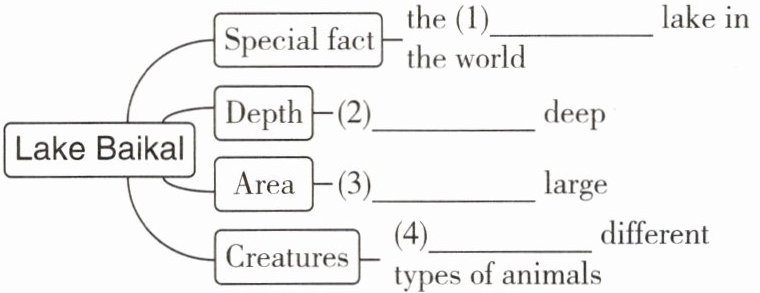
2.阅读3a的短文,完成下面的表格。
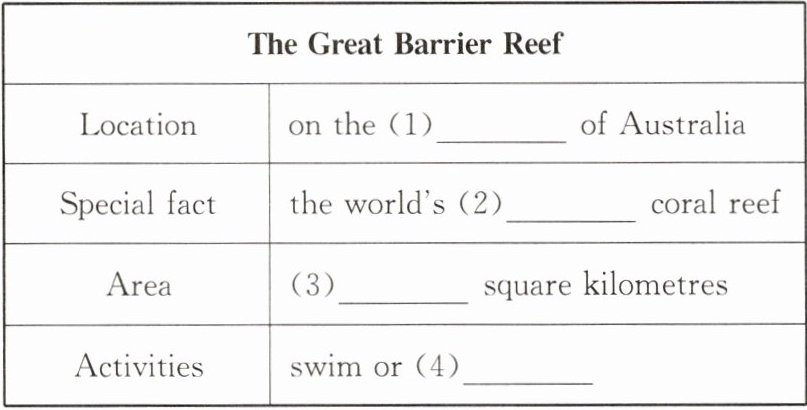
1.阅读2c的短文,用彩色笔画出短文中描述贝加尔湖特点的句子,然后完成下面的思维导图。
2.阅读3a的短文,完成下面的表格。
答案
1.(1)deepest freshwater (2)1,620
metres (3)31,500 square kilometres
(4)over 1,200
2.(1)northeastern coast (2)biggest
(3)345,000 (4)dive
metres (3)31,500 square kilometres
(4)over 1,200
2.(1)northeastern coast (2)biggest
(3)345,000 (4)dive
解析
【分析】本题为英语语篇理解类题目,第1题需先阅读2c短文,定位描述贝加尔湖特点的语句,提取对应关键信息完成思维导图;第2题需阅读3a短文,根据表格提示定位原文细节,填写对应内容。
【解析】第1题从2c短文中提取贝加尔湖的核心特点:最深的淡水湖、长度1620米、面积31500平方公里、周边河流超1200条;第2题从3a短文中提取对应信息:地点为东北海岸、某事物是最大的、数量为345000、活动为潜水。
【答案】1.(1)deepest freshwater (2)1,620 metres (3)31,500 square kilometres (4)over 1,200;2.(1)northeastern coast (2)biggest (3)345,000 (4)dive
【知识点】语篇理解、细节提取
【点评】本题考查学生对英语短文细节信息的定位与提取能力,需仔细阅读原文,准确匹配问题与原文内容,难度适中。
【难度系数】0.5
【解析】第1题从2c短文中提取贝加尔湖的核心特点:最深的淡水湖、长度1620米、面积31500平方公里、周边河流超1200条;第2题从3a短文中提取对应信息:地点为东北海岸、某事物是最大的、数量为345000、活动为潜水。
【答案】1.(1)deepest freshwater (2)1,620 metres (3)31,500 square kilometres (4)over 1,200;2.(1)northeastern coast (2)biggest (3)345,000 (4)dive
【知识点】语篇理解、细节提取
【点评】本题考查学生对英语短文细节信息的定位与提取能力,需仔细阅读原文,准确匹配问题与原文内容,难度适中。
【难度系数】0.5
