

 登录
Ⅰ. 用方框中所给单词的适当形式填空
admire researcher century wisdom
brave
1. True
2. They
3. The young
4. This old castle has stood on the hill for
5. Her courage and kindness in helping others are truly
admire researcher century wisdom
brave
1. True
wisdom
comes from learning and experiencing life.2. They
braved
the heavy rain to go to the hospital to see their friend yesterday.3. The young
researcher
works hard in the lab to find new solutions to the problem.4. This old castle has stood on the hill for
centuries
.5. Her courage and kindness in helping others are truly
admirable
.答案
1. wisdom 2. braved
3. researcher 4. centuries
5. admirable
Ⅱ. 完成句子
1. 勤洗手有助于阻止疾病的传播。
Washing hands often helps stop
2. 因为家庭贫困,她15岁时就辍学了。
She
3. 这位科学家一生辛勤工作,取得了重要发现。
The scientist worked hard all his life and
4. 护士们尽全力照顾好这些受伤的士兵。
The nurses tried their best to take good care of the
5. 我们通常钦佩那些为社会做出贡献的人。
We usually
1. 勤洗手有助于阻止疾病的传播。
Washing hands often helps stop
the
spread
of
diseases
.2. 因为家庭贫困,她15岁时就辍学了。
She
dropped
out
of
school
when she was 15 because of her poor family.3. 这位科学家一生辛勤工作,取得了重要发现。
The scientist worked hard all his life and
made
important
discoveries
.4. 护士们尽全力照顾好这些受伤的士兵。
The nurses tried their best to take good care of the
wounded
soldiers
.5. 我们通常钦佩那些为社会做出贡献的人。
We usually
look
up
to
those who make contributions to society.答案
1. the spread of diseases
2. dropped out of school
3. made important discoveries
4. wounded soldiers 5. look up to
Ⅲ. 口语应用
阅读下面对话,从方框内7个选项中选择5
个恰当的句子完成此对话。
M: Excuse me, can I ask you some questions?
W: Certainly. 1.
M: No problem. We'll finish soon. 2.
W: Well, I think Lei Feng should be remembered as the national hero because he always helped those in need.
M: 3.
W: You've got a point there.
M: I also think scientists like Qian Xuesen, Hua Luogeng and Yuan Longping should be considered as national heroes.
W: 4.
M: I see. That's all. Thank you. 5.
W: Thank you.
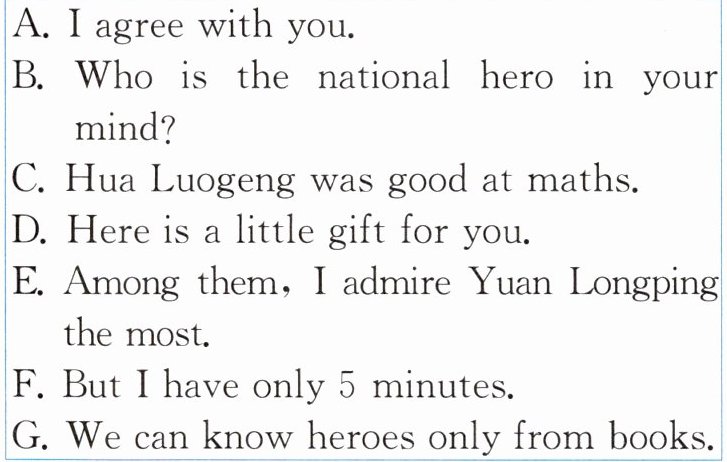
阅读下面对话,从方框内7个选项中选择5
个恰当的句子完成此对话。
M: Excuse me, can I ask you some questions?
W: Certainly. 1.
F
M: No problem. We'll finish soon. 2.
B
W: Well, I think Lei Feng should be remembered as the national hero because he always helped those in need.
M: 3.
A
Because of these people, we live in a peaceful country now.W: You've got a point there.
M: I also think scientists like Qian Xuesen, Hua Luogeng and Yuan Longping should be considered as national heroes.
W: 4.
E
He was China's leading agricultural scientist. He spent his lifetime fighting with hunger.M: I see. That's all. Thank you. 5.
D
W: Thank you.
答案
1-5 FBAED
Ⅳ. 阅读理解
Yang Zhenning, one of the most famous physicists of the 20th century, died on 18 October, 2025, in Beijing at the age of 103. Born in Hefei, Anhui Province in 1922, he grew up in a scholarly family and had a strong interest
in science during his early years. He studied at Southwest Associated University and later went abroad for further study at the University of Chicago in the United States.
In 1957, Yang and his colleague Li Zhengdao made history by winning the Nobel Prize in Physics. They received this prize for their groundbreaking work on the “parity non-conservation”(宇称不守恒)theory—a discovery that changed how scientists understand the basic laws of the universe. Beyond this, Yang’s “Yang-Mills gauge theory”(杨-米尔斯规范场论)is also considered as a cornerstone of modern physics, as important as Einstein’s theory of relativity(爱因斯坦相对论).
Though he lived abroad for more than 20 years, Yang never forgot his motherland. In 1971, he became the first Chinese scholar to visit China after a long period of separation, helping China’s science development. He advised the Chinese government on how to make basic science research stronger and paid for nearly 100 Chinese students to study in the US. In 1999, he returned to work at Tsinghua University. He spent his later years training young scientists and improving the development of physics in China.
Yang’s life was a mix of scientific curiosity and deep love for his country. His famous motto(座右铭), “Be honest instead of clever,” continues to encourage young people to pursue(追求)truth in science and life.
1. Why is Southwest Associated University mentioned in the passage?
A. It is where Yang was born.
B. It is where Yang first studied science.
C. It is where Yang won the Nobel Prize.
D. It is where Yang worked in his old age.
2. What made Yang and Li Zhengdao win the Nobel Prize?
A. The “Yang-Mills gauge theory”.
B. The theory of relativity.
C. The “parity non-conservation” theory.
D. Their work on basic science education.
3. What does the underlined word “groundbreaking” mean?
A. Very important and new.
B. Difficult and boring.
C. Easy and common.
D. Old and useless.
4. How did Yang help China’s science development?
A. By building a new university in Hefei.
B. By giving advice on basic science research and paying for students.
C. By bringing Einstein’s theory to China.
D. By working as a government leader.
5. What can we learn from Yang’s motto?
A. It’s better to be smart than honest.
B. Being honest is more important than being clever in science.
C. Clever people don’t need to be honest.
D. Honesty helps people make more money.
答案
本文主要讲述了20世纪最具影响力的物理学家之一杨振宁的生平事迹、科学成就以及对祖国的贡献。
1. B 推理判断题。根据第一段中的“…he grew up in a scholarly family and had a strong interest in science during his early years. He studied at Southwest Associated University …”可推知,西南联合大学是杨振宁最初学习科学的地方。故选 B。
2. C 细节理解题。根据第二段中的“They received this prize for their groundbreaking work on the ‘parity non-conservation’ theory …”可知,杨振宁和李政道因“宇称不守恒”理论获得诺贝尔奖。故选 C。
3. A 词义猜测题。根据第二段中的“…Yang and his colleague Li Zhengdao made history by winning the Nobel Prize in Physics. They received this prize for their groundbreaking work on the ‘parity non-conservation’ theory”可知,杨振宁和李政道因“宇称不守恒”理论获得了诺贝尔奖,创造了历史。由此推知,groundbreaking 是一个褒义词,结合选项可知,groundbreaking 意为“非常重要且新颖的”。故选 A。
4. B 细节理解题。根据第三段中的“He advised the Chinese government on how to make basic science research stronger and paid for nearly 100 Chinese students to study in the US.”可知,杨振宁通过提供建议和资助学生帮助中国科学发展。故选 B。
5. B 推理判断题。根据最后一段中的“His famous motto, ‘Be honest instead of clever,’ continues to encourage young people to pursue truth in science and life.”可知,杨振宁的格言鼓励年轻人在科学和生活中追求真理。由此推知,杨振宁认为在科学中诚实比聪明更重要。故选 B。
