

 登录
According to Ken Croswell, the Sun and the Moon are different. We often think that the Sun rules the day and the Moon rules the night. That's kind of right, but not totally.
The Sun shines all the time. It shines during the day when we see it, and even at night when we don't.
As Earth turns, sometimes we face the Sun. That's when we get day. When Earth's spin(自转) turns us away from the Sun and we are in Earth's shadow, we get night. When people on the opposite side of Earth face the Sun, those people have day while we have night.
The Moon is a different story. Unlike the Sun, it doesn't make its own light. Moonlight is actually the Sun's light reflecting(反射) the Moon back to us.
The Sun lights up only the side of the Moon that faces the Sun. At Full Moon, the Moon is on the opposite side of the Earth from the Sun. Then the side of the Moon facing Earth is all lit up. During Full Moon, the Moon rises around sunset, shines all night, and sets around sunrise. Since the moonlight is so bright, you can sometimes see it during the day, too. A few days before Full Moon, if you look east in the afternoon, you may see the Moon in the sky. After Full Moon, you may find it if you look west in the morning.
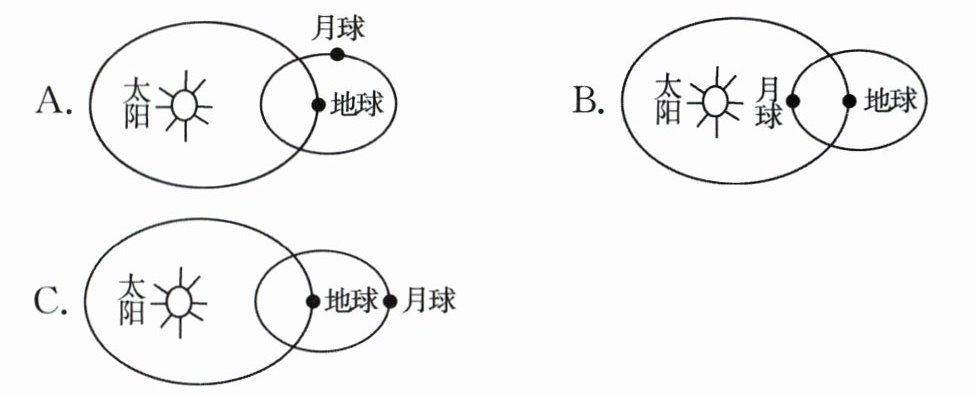
The Moon is most difficult to see at New Moon, when its orbit(轨道) puts it between Earth and the Sun. Then, the side of the Moon facing Earth is dark and we can't see the Moon at all.
(
A. The Sun rules the Moon.
B. The Sun shines during both day and night.
C. The Sun lights up all the sides of the Moon.
(
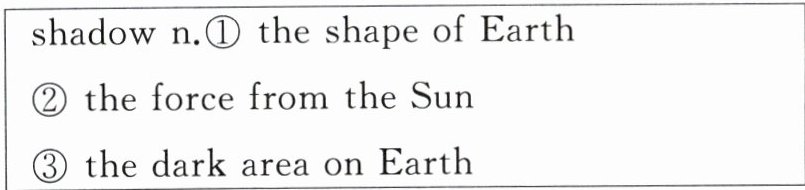
A. ① B. ② C. ③
(
A. The side of the Moon facing Earth is fully lit.
B. The Moon is between Earth and the Sun.
C. You can sometimes see it in the east in the afternoon.
(
The Sun shines all the time. It shines during the day when we see it, and even at night when we don't.
As Earth turns, sometimes we face the Sun. That's when we get day. When Earth's spin(自转) turns us away from the Sun and we are in Earth's shadow, we get night. When people on the opposite side of Earth face the Sun, those people have day while we have night.
The Moon is a different story. Unlike the Sun, it doesn't make its own light. Moonlight is actually the Sun's light reflecting(反射) the Moon back to us.
The Sun lights up only the side of the Moon that faces the Sun. At Full Moon, the Moon is on the opposite side of the Earth from the Sun. Then the side of the Moon facing Earth is all lit up. During Full Moon, the Moon rises around sunset, shines all night, and sets around sunrise. Since the moonlight is so bright, you can sometimes see it during the day, too. A few days before Full Moon, if you look east in the afternoon, you may see the Moon in the sky. After Full Moon, you may find it if you look west in the morning.
The Moon is most difficult to see at New Moon, when its orbit(轨道) puts it between Earth and the Sun. Then, the side of the Moon facing Earth is dark and we can't see the Moon at all.
(
B
)32. What can we know about the Sun according to the passage?A. The Sun rules the Moon.
B. The Sun shines during both day and night.
C. The Sun lights up all the sides of the Moon.
(
C
)33. Which of the following in the dictionary best explains the underlined word "shadow" in paragraph 3?A. ① B. ② C. ③
(
A
)34. Which of the following is TRUE about a Full Moon?A. The side of the Moon facing Earth is fully lit.
B. The Moon is between Earth and the Sun.
C. You can sometimes see it in the east in the afternoon.
(
B
)35. Which following picture shows us New Moon?答案
32. B 33. C 34. A 35. B
