

 登录
三、阅读理解。
In the solar system, Mars is more similar to Earth than the other planets.
The temperature on Mars is similar to that on Earth. Scientists find that there is water on Mars, too. But most of it is ice. Scientists also think that under Mars' north pole(极点), there might be areas warm enough for liquid water.
Mars is about 228 million kilometers away from the Sun while the distance from Earth to the Sun is about 150 million kilometers. That means Mars is about 78 million kilometers farther from the Sun than Earth. But in universe that is not that far. In universe, we use astronomical units(天文单位) to talk about distance. Earth is 1 astronomical unit from the Sun, and Mars is 1.5. That difference doesn't sound so big when we look at it this way.
▲ The days on both planets are nearly the same. Earth's day is 24 hours long, and Mars' is only about 40 minutes longer. Besides, they both have seasonal changes. Earth has four seasons, and Mars also has its own different seasons.
Since Mars is quite similar to Earth, is there life on Mars? Scientists are still looking for that.
根据短文内容,从题中所给的A、B、C、D四个选项中选出最佳选项。
(
A. 储存的 B. 消失的
C. 固体的 D. 液体的
(
A. We use astronomical units to talk about distance in universe.
B. The distance from Mars to the Sun is about 228 million kilometers.
C. Mars is similar to Earth in distance from the Sun.
D. The distance from Earth to the Sun is about 150 million kilometers.
(
A. There are some other similar points.
B. There are also some differences.
C. How about the days on both planets?
D. How about the seasons on both planets?
(
A. 4. B. 5.
C. 6. D. 7.
(
In the solar system, Mars is more similar to Earth than the other planets.
The temperature on Mars is similar to that on Earth. Scientists find that there is water on Mars, too. But most of it is ice. Scientists also think that under Mars' north pole(极点), there might be areas warm enough for liquid water.
Mars is about 228 million kilometers away from the Sun while the distance from Earth to the Sun is about 150 million kilometers. That means Mars is about 78 million kilometers farther from the Sun than Earth. But in universe that is not that far. In universe, we use astronomical units(天文单位) to talk about distance. Earth is 1 astronomical unit from the Sun, and Mars is 1.5. That difference doesn't sound so big when we look at it this way.
▲ The days on both planets are nearly the same. Earth's day is 24 hours long, and Mars' is only about 40 minutes longer. Besides, they both have seasonal changes. Earth has four seasons, and Mars also has its own different seasons.
Since Mars is quite similar to Earth, is there life on Mars? Scientists are still looking for that.
根据短文内容,从题中所给的A、B、C、D四个选项中选出最佳选项。
(
D
)1. What does the underlined word "liquid" mean in Chinese?A. 储存的 B. 消失的
C. 固体的 D. 液体的
(
C
)2. What is the main idea of paragraph 3?A. We use astronomical units to talk about distance in universe.
B. The distance from Mars to the Sun is about 228 million kilometers.
C. Mars is similar to Earth in distance from the Sun.
D. The distance from Earth to the Sun is about 150 million kilometers.
(
A
)3. Which of the following can be put in "▲"?A. There are some other similar points.
B. There are also some differences.
C. How about the days on both planets?
D. How about the seasons on both planets?
(
B
)4. How many ways are Mars similar to Earth according to the text?A. 4. B. 5.
C. 6. D. 7.
(
D
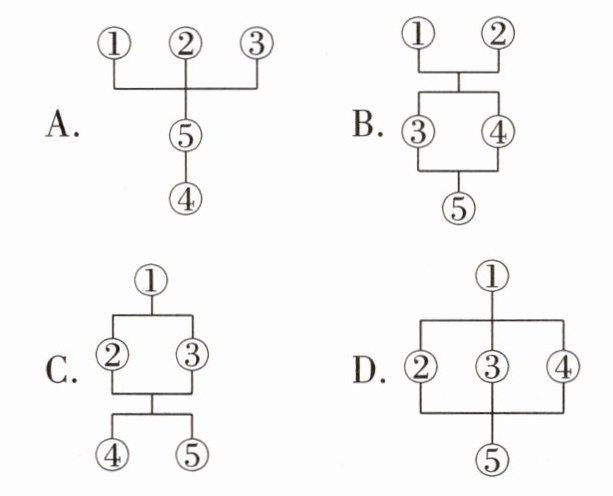
)5. What is the structure of this text?答案
1. D 第二段主要讲火星上的水。上文讲火星上的水大都是冰的形态,此句前半部分讲火星的北极也许会有足够温暖的地区,因此可能有液态的水。liquid 意为“液态的”。故选 D。
2. C 第三段主要讲火星和地球在与太阳距离上的相似性。故选 C。
3. A 第四段讲了火星与地球在一天的长度和季节变化方面有相似性,故本段的主题是火星与地球在其他方面的相似点。故选 A。
4. B 本文主要讲了火星与地球的五个相似点,即温度、水、与太阳的距离、一天的长度和季节变化。故选 B。
5. D 本文第一段总起,第二至第四段分别讲了火星与地球的五个相似点,最后一段总结,整体结构是总—分—总。故选 D。
