

 登录
望,并提出并非每个家庭都能养宠物,为下文引入在校养宠物的现象做铺垫。
第二段、第三段(分述):介绍在许多国家,中小学班级如何饲养自己的班级宠物。
第四段(总述):总结照顾班级宠物的乐趣和对学生的益处。
请根据文章内容填写表格。
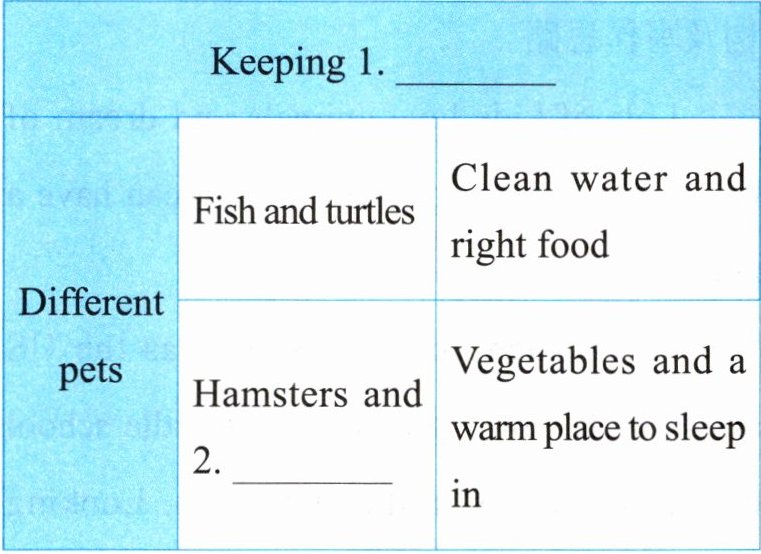
Keeping 1.
Different pets
Fish and turtles
Clean water and right food
Hamsters and 2.
Vegetables and a warm place to sleep in
续表
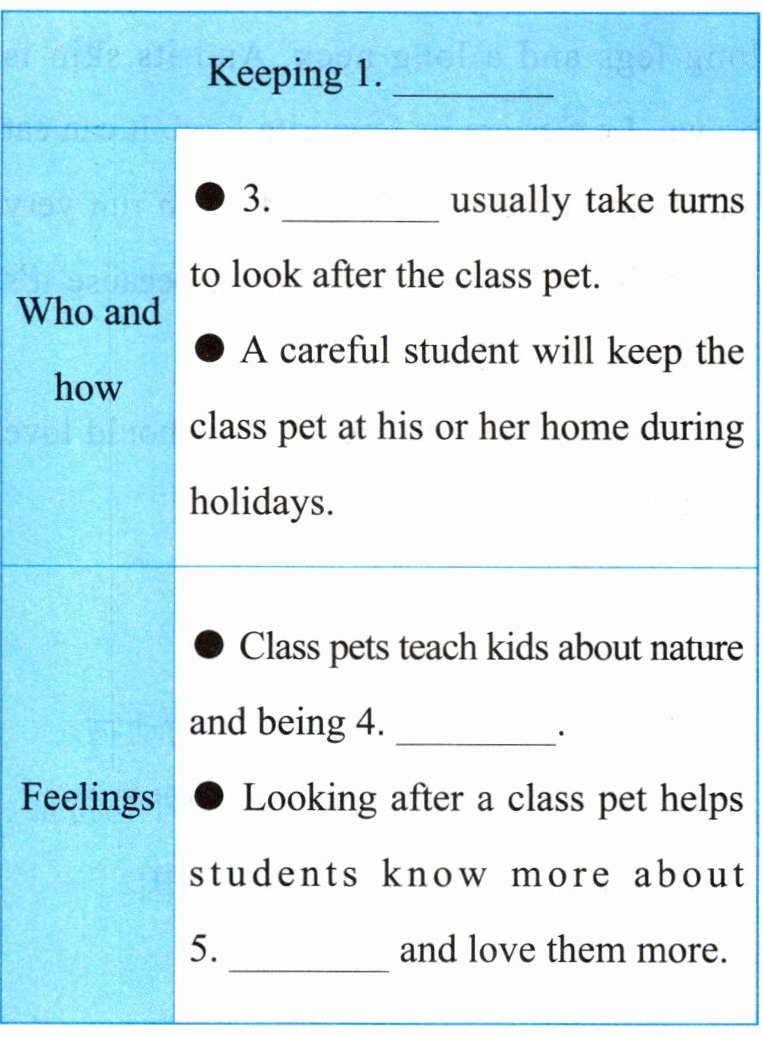
Keeping 1.
Who and how
● 3.
● A careful student will keep the class pet at his or her home during holidays.
Feelings
● Class pets teach kids about nature and being 4.
● Looking after a class pet helps students know more about 5.
第二段、第三段(分述):介绍在许多国家,中小学班级如何饲养自己的班级宠物。
第四段(总述):总结照顾班级宠物的乐趣和对学生的益处。
请根据文章内容填写表格。
Keeping 1.
(class) pets
Different pets
Fish and turtles
Clean water and right food
Hamsters and 2.
rabbits
Vegetables and a warm place to sleep in
续表
Keeping 1.
(class) pets
Who and how
● 3.
Students
usually take turns to look after the class pet.● A careful student will keep the class pet at his or her home during holidays.
Feelings
● Class pets teach kids about nature and being 4.
careful
.● Looking after a class pet helps students know more about 5.
animals
and love them more.答案
1. (class) pets
2. rabbits
3. Students
4. careful
5. animals
解析
【分析】
需结合文章内容与表格结构,提取对应信息填写空格:1. 文章围绕班级养宠物展开,对应插图1的养宠物主题,故填class pets;2. 与仓鼠并列的常见班级宠物为兔子,符合语境;3. 插图2询问照顾班级宠物的主体,文章提到学生轮流照顾,故填Students;4. 照顾宠物能培养学生细心的品质,故填careful;5. 照顾班级宠物可让学生更了解动物,故填animals。
【解析】
1. 文章核心介绍班级养宠物的相关内容,插图1对应养宠物的类型,因此Keeping后填class pets;
2. 与仓鼠并列的常见班级宠物为兔子,故填rabbits;
3. 班级宠物由学生轮流照顾,因此填Students;
4. 照顾宠物能培养学生的细心品质,故填careful;
5. 照顾班级宠物可让学生更了解动物,因此填animals。
【答案】
1. (class) pets
2. rabbits
3. Students
4. careful
5. animals
【知识点】
阅读理解细节填空
【点评】
本题考查学生对文章细节内容的理解与提取能力,需结合文章结构和语境填写表格,难度适中。
【难度系数】
0.6
Ⅰ. 短文填空
阅读下面短文,在空白处填入一个适当的单词或用括号内单词的正确形式填空。
Animals on a farm
What animals do farms have? Farms have lots of animals, like hens, pigs, sheep, cows, goats(山羊), horses and so on, 1 no rhinos. They are too wild.
Where do farm animals live? Look at the map of 2 farm. Red hens 3 (have) nests in the barn. In front 4 the barn, some pigs have pens(围栏)in the barnyard. Sheep and cows stay out where grass 5 (grow).
How do we go to the farm on the map? You can 6 (take) a bus to the farm. Or you can drive your own car to the farm.
What is the size of animal farms? The size of animal farms is different. Some farms are large. Some are small. Some have medium size.
What do farm animals eat? 7 (feed) animals has many ways. Hens use their 8 (foot) to scratch in dirt. They look for seeds and bugs to eat. They use their beak(喙)to peck. Mother hens show 9 (they) chicks how to find food. The baby chicks peck seeds, too. They love eating! 10 pigs, farmers need to feed 11 (they) corn and other grains. To horses in the fields, they eat grass and other 12 (plant). Almost all the above animals need lots of food.
How do farm animals help? We get food from some of the animals. For example, hens lay eggs. We eat eggs. Plus, we get milk from some cows and sheep. We drink milk. People make 13 (cheese) and other food from the milk, too. Sheep have hair that is called wool. Farmers cut wool off animals. Does it hurt the animals? No, it doesn't. It is just like 14 (get) a haircut. People can make warm sweaters and even socks of wool. Animals are 15 (real) helpful!
1.
4.
7.
10.
13.
阅读下面短文,在空白处填入一个适当的单词或用括号内单词的正确形式填空。
Animals on a farm
What animals do farms have? Farms have lots of animals, like hens, pigs, sheep, cows, goats(山羊), horses and so on, 1 no rhinos. They are too wild.
Where do farm animals live? Look at the map of 2 farm. Red hens 3 (have) nests in the barn. In front 4 the barn, some pigs have pens(围栏)in the barnyard. Sheep and cows stay out where grass 5 (grow).
How do we go to the farm on the map? You can 6 (take) a bus to the farm. Or you can drive your own car to the farm.
What is the size of animal farms? The size of animal farms is different. Some farms are large. Some are small. Some have medium size.
What do farm animals eat? 7 (feed) animals has many ways. Hens use their 8 (foot) to scratch in dirt. They look for seeds and bugs to eat. They use their beak(喙)to peck. Mother hens show 9 (they) chicks how to find food. The baby chicks peck seeds, too. They love eating! 10 pigs, farmers need to feed 11 (they) corn and other grains. To horses in the fields, they eat grass and other 12 (plant). Almost all the above animals need lots of food.
How do farm animals help? We get food from some of the animals. For example, hens lay eggs. We eat eggs. Plus, we get milk from some cows and sheep. We drink milk. People make 13 (cheese) and other food from the milk, too. Sheep have hair that is called wool. Farmers cut wool off animals. Does it hurt the animals? No, it doesn't. It is just like 14 (get) a haircut. People can make warm sweaters and even socks of wool. Animals are 15 (real) helpful!
1.
but
2. a
3. have
4.
of
5. grows
6. take
7.
Feeding
8. feet
9. their
10.
To
11. them
12. plants
13.
cheese
14. getting
15. really
答案
1. but
2. a
3. have
4. of
5. grows
6. take
7. Feeding
8. feet
9. their
10. To
11. them
12. plants
13. cheese
14. getting
15. really
解析
【分析】首先通读全文,把握短文关于农场动物的主题,再结合每个空的上下文语境、语法规则(如时态、词性、固定搭配、代词、冠词等)逐一推导答案:1. 前后句为转折关系,需用转折连词;2. 泛指“一张农场的地图”,用不定冠词;3. 主语为复数,一般现在时谓语用原形;4. 对应固定搭配;5. 不可数名词作主语,一般现在时谓语用三单形式;6. 情态动词后接动词原形;7. 动名词作主语;8. 名词复数变化;9. 形容词性物主代词修饰名词;10. 表“对于……”的介词;11. 动词后接宾格代词;12. other后接可数名词复数;13. 不可数名词用法;14. 介词后接动名词;15. 副词修饰形容词。
【解析】1. 前文说明农场有多种动物,后文提到没有犀牛,为转折关系,故填but;2. 此处指“一张农场的地图”,表泛指,用不定冠词a;3. 主语Red hens是复数,一般现在时谓语用原形have;4. 固定搭配in front of(在……前面),故填of;5. grass是不可数名词,一般现在时谓语用第三人称单数形式grows;6. 情态动词can后接动词原形,故填take;7. 此处作句子主语,需用动名词形式,故填Feeding;8. foot的复数形式为feet,符合语境;9. 修饰名词chicks需用形容词性物主代词their;10. 此处表示“对于猪来说”,用介词To;11. 动词feed后接人称代词宾格,故填them;12. other后接可数名词复数,plant的复数是plants;13. cheese是不可数名词,用原形;14. like是介词,后接动名词,故填getting;15. 修饰形容词helpful需用副词really。
【答案】1. but 2. a 3. have 4. of 5. grows 6. take 7. Feeding 8. feet 9. their 10. To 11. them 12. plants 13. cheese 14. getting 15. really
【知识点】冠词的用法、动词的正确形式、固定搭配
【点评】本题为短文填空,综合考查学生对词汇、语法及固定搭配的运用能力,需结合上下文语境分析判断,属于基础综合类题型。
【难度系数】0.5
