

 登录
4. 凡凡在物理课上学习了“发声物体的振动实验”后,对其作了进一步的探究,如图1,在一个支架的横杆点O处用一根细绳悬挂一个小球A,小球A可以自由摆动,OA表示小球静止时的位置,如图2,用发声物体靠近小球,当小球从OA摆到OB位置时,小球到OA的水平距离BD = 8.8 cm,当小球摆到OC位置时,CE ⊥ OA于点E,此时OC与OB恰好垂直,小球在两次摆动中点B和点C的高度差DE = 7 cm,求小球摆动到OC位置时,小球到OA的水平距离CE的长。(图中所有的点在同一平面上)
答案
由题意知,$BO = OC$,$∠ BOC = 90°$,$BD⊥ OA$,
$\therefore ∠ ODB = 90°$.
$\because CE⊥ OA$,
$\therefore ∠ CEO = 90°$,
$\therefore ∠ BOD + ∠ COE = ∠ COE + ∠ OCE = 90°$,
$\therefore ∠ BOD = ∠ OCE$.
在$△ BOD$和$△ OCE$中,
$\begin{cases}∠ ODB = ∠ CEO,\\∠ BOD = ∠ OCE,\\BO = OC,\end{cases}$
$\therefore △ BOD≌△ OCE(\mathrm{AAS})$,
$\therefore BD = OE = 8.8\ \mathrm{cm}$,$OD = CE$.
$\because DE = 7\ \mathrm{cm}$,
$\therefore OD = OE + DE = 8.8 + 7 = 15.8(\mathrm{cm})$,
$\therefore CE = 15.8\ \mathrm{cm}$.
5. 如图,在$△ ABC$和$△ CDE$中,点$D$在$AB$上,$AC$与$DE$交于点$F$,$AB// CE$.
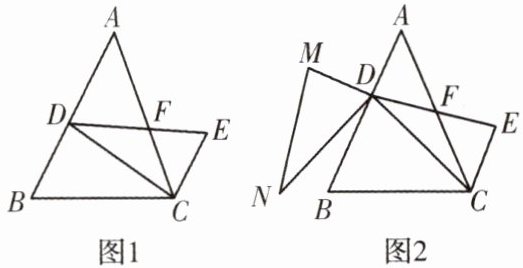
(1)如图1,若$∠ A=47°,∠ DCE=82°$,CD平分$∠ ACB$,求$∠ B$的度数.
(2)如图2,若$F$为$AC$的中点,过点$D$作$DM⊥ DA,DN⊥ DC$,且$DM=DA$,$DN=DC$,连接$MN$.求证:$MN=2EF$.
(1)如图1,若$∠ A=47°,∠ DCE=82°$,CD平分$∠ ACB$,求$∠ B$的度数.
(2)如图2,若$F$为$AC$的中点,过点$D$作$DM⊥ DA,DN⊥ DC$,且$DM=DA$,$DN=DC$,连接$MN$.求证:$MN=2EF$.
答案
(1)
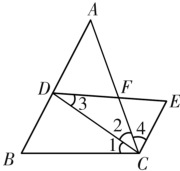
$\because AB// CE$,
$\therefore ∠ 4 = ∠ A = 47°$.
$\because CD$平分$∠ ACB$,
$\therefore ∠ 1 = ∠ 2$.
$\because ∠ DCE = 82°$,
$\therefore ∠ 1 = ∠ 2 = 35°$,
$\therefore ∠ B = 180° - 47° - 35° - 35° = 63°$.
(2)
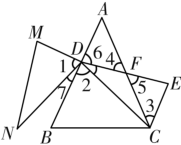
$\because F$为$AC$的中点,
$\therefore AF = CF$.
$\because AB// CE$,
$\therefore ∠ 6 = ∠ E$.
$\because ∠ 4 = ∠ 5$,
$\therefore △ ADF≌△ CEF$,
$\therefore DF = EF$,$ED = 2EF$.
$\because DM⊥ DA$,$DN⊥ DC$,
$\therefore ∠ 1 + ∠ 7 = 90°$,$∠ 2 + ∠ 7 = 90°$,
$\therefore ∠ 1 = ∠ 2$.
$\because AB// CE$,$\therefore ∠ DCE = ∠ 2 = ∠ 1$.
$\because DM = DA = CE$,$DN = CD$,
$\therefore △ MND≌△ EDC$,
$\therefore MN = ED = 2EF$.
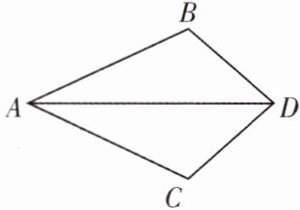
例1 如图,已知AB=AC,要用“SSS”证明△ABD≌△ACD,需增加的一个条件是
变式训练 阅读并完成下面的推理过程,补充括号内的理由:
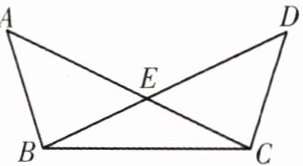
已知AE = DE,EB = EC,AB = DC.求证:△ABC≌△DCB.
证明:因为AE = DE,EC = EB(已知),
所以AE + EC =
在△ABC和△DCB中,
$\{\begin{array}{l}AB = \_\_\_\_\_\_(\mathrm{已知}),\\\_\_\_\_\_\_ = BD(\mathrm{已证}),\\BC = \_\_\_\_\_\_,(\mathrm{公共边})\end{array} $
所以△
BD=CD
.变式训练 阅读并完成下面的推理过程,补充括号内的理由:
已知AE = DE,EB = EC,AB = DC.求证:△ABC≌△DCB.
证明:因为AE = DE,EC = EB(已知),
所以AE + EC =
DE
+ EB
(等式的性质),即CA = BD.在△ABC和△DCB中,
$\{\begin{array}{l}AB = \_\_\_\_\_\_(\mathrm{已知}),\\\_\_\_\_\_\_ = BD(\mathrm{已证}),\\BC = \_\_\_\_\_\_,(\mathrm{公共边})\end{array} $
所以△
ABC
≌△DCB
(SSS
).答案
例1 需增加条件:BD=CD
变式训练完整推理:
因为AE = DE,EC = EB(已知),
所以AE + EC = DE + EB(等式的性质),即CA = BD.
在△ABC和△DCB中,
$\{\begin{array}{l}AB = DC(\mathrm{已知}),\\CA = BD(\mathrm{已证}),\\BC = CB,(\mathrm{公共边})\end{array} $
所以△ABC≌△DCB(SSS).
变式训练完整推理:
因为AE = DE,EC = EB(已知),
所以AE + EC = DE + EB(等式的性质),即CA = BD.
在△ABC和△DCB中,
$\{\begin{array}{l}AB = DC(\mathrm{已知}),\\CA = BD(\mathrm{已证}),\\BC = CB,(\mathrm{公共边})\end{array} $
所以△ABC≌△DCB(SSS).
