

 登录
Ⅴ. Read the conversation and complete it with proper sentences.
阅读下面对话,在空白处填入适当的句子,使对话完整,合乎情境。
(A school reporter is asking Rick about his school day routine. )
A: Good morning! I'm a school reporter. May I ask you some questions? B: Sure!
A: 1
B: I usually get up at six. I brush my teeth and take a shower at a quarter past six.
A: 2
B: Around ten to seven. After breakfast, I go to school at about seven o'clock. My school finishes at 4:00 in the afternoon.
A: 3
B: After school? Sometimes I play sport or go to my music club.
A: And what time do you go home?
B: 4
A: And what time do you usually go to bed? B: I usually go to bed at nine o'clock.
A: Why do you go to bed so early?
B: 5
A: Thank you.
阅读下面对话,在空白处填入适当的句子,使对话完整,合乎情境。
(A school reporter is asking Rick about his school day routine. )
A: Good morning! I'm a school reporter. May I ask you some questions? B: Sure!
A: 1
What time/When do you usually get up?
?B: I usually get up at six. I brush my teeth and take a shower at a quarter past six.
A: 2
What time/When do you have breakfast?
?B: Around ten to seven. After breakfast, I go to school at about seven o'clock. My school finishes at 4:00 in the afternoon.
A: 3
And what do you do after school?
?B: After school? Sometimes I play sport or go to my music club.
A: And what time do you go home?
B: 4
I usually go home at five thirty/around 6:00.(合理即可)
.A: And what time do you usually go to bed? B: I usually go to bed at nine o'clock.
A: Why do you go to bed so early?
B: 5
Early to bed, early to rise./Because it’s good for my health.(合理即可)
.A: Thank you.
答案
1. What time/When do you usually get up? 2. What time/When do you have breakfast? 3. And what do you do after school? 4. I usually go home at five thirty/around 6:00.(合理即可) 5. Early to bed, early to rise./Because it’s good for my health.(合理即可)
解析
翻译:
Ⅴ. 阅读对话,用恰当的句子补全对话。
(一名校园记者正在询问里克他的日常校园生活情况。)
A: 早上好!我是一名校园记者。我可以问你一些问题吗?
B: 当然可以!
A: 1 你通常几点起床?
B: 我通常六点起床。我在六点十五分刷牙、洗澡。
A: 2 你什么时候吃早饭?
B: 大约六点五十分。早饭后,我大约七点钟去上学。我的学校下午四点放学。
A: 3 放学后你做什么?
B: 放学后?有时候我做运动或者去我的音乐俱乐部。
A: 你什么时候回家?
B: 4 我通常五点半/大约六点回家。(合理即可)
A: 你通常几点上床睡觉?
B: 我通常九点钟上床睡觉。
A: 你为什么这么早上床睡觉?
B: 5 早睡早起。/因为这对我的健康有好处。(合理即可)
A: 谢谢你。
Grammar Focus
Ⅰ. Write some conversations after the model.
仿写对话。
Model:
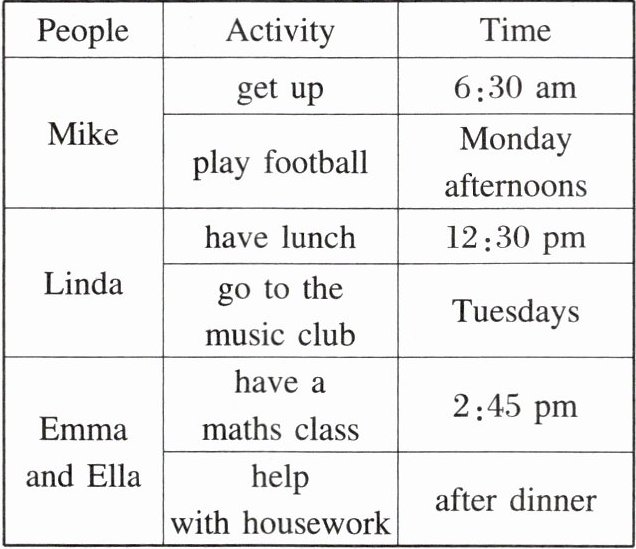
A: What time does Mike get up?
B: He gets up at half past six/6:30 am.
A: When does he play football?
B: He plays football on Monday afternoons.
1. A: What time does Linda have lunch?
B: She
A: When does she go to the music club?
B: She
2. A:
B:
A:
B:
Ⅰ. Write some conversations after the model.
仿写对话。
Model:
A: What time does Mike get up?
B: He gets up at half past six/6:30 am.
A: When does he play football?
B: He plays football on Monday afternoons.
1. A: What time does Linda have lunch?
B: She
has lunch at half past twelve.
A: When does she go to the music club?
B: She
goes to the music club on Tuesdays.
2. A:
What time do Emma and Ella have a math class?
B:
They have a maths class at a quarter to three.
A:
When do they help with housework?
B:
They help with housework after dinner.
答案
1. B: She has lunch at half past twelve. B: She goes to the music club on Tuesdays. 2. A: What time do Emma and Ella have a math class? B: They have a maths class at a quarter to three. A: When do they help with housework? B: They help with housework after dinner.
解析
翻译:
### 语法聚焦
Ⅰ. 仿照示例编写一些对话。
示例:
A: 迈克几点起床?
B: 他早上六点半起床。
A: 他什么时候踢足球?
B: 他星期一下午踢足球。
1. A: 琳达几点吃午饭?
B: 她十二点半吃午饭。
A: 她什么时候去音乐俱乐部?
B: 她星期二去音乐俱乐部。
2. A: 艾玛和艾拉几点上数学课?
B: 她们两点四十五上数学课。
A: 她们什么时候帮忙做家务?
B: 她们晚饭后帮忙做家务。
Ⅱ. Language learning. Read, think and practice.
A) Complete the table with ×, √, √√, √√√, and √√√√.

B) Complete the sentences with adverbs of frequency.
用频度副词完成句子。
1. Frank always plays basketball after school. √√√√
2. Mr Brown
3. Helen is
4. Peter doesn't
5. We
C) Write sentences. Put the adverb in the correct position.
写句子,并把副词放在正确的位置。
1. We go to the cinema. (sometimes) We sometimes go to the cinema.
2. They're early. (often)
3. I don't go to the park. (usually)
4. Linda and Jane go to the gym. (never)
5. I sing the song. (always)
6. You don't visit the farm. (often)
7. Our house isn't warm. (always)
8. Bill doesn't go hiking at weekends. (always)
小结:表示经常性或习惯性的行为时常使用频度副词,常用的频度副词有:
频度副词的位置:一般在行为动词的
A) Complete the table with ×, √, √√, √√√, and √√√√.
B) Complete the sentences with adverbs of frequency.
用频度副词完成句子。
1. Frank always plays basketball after school. √√√√
2. Mr Brown
usually
listens to the news on his way to work. √√√3. Helen is
never
late for school. ×4. Peter doesn't
often
go to the library. √√5. We
sometimes
eat ice cream after dinner. √C) Write sentences. Put the adverb in the correct position.
写句子,并把副词放在正确的位置。
1. We go to the cinema. (sometimes) We sometimes go to the cinema.
2. They're early. (often)
They're often early.
3. I don't go to the park. (usually)
I don't usually go to the park.
4. Linda and Jane go to the gym. (never)
Linda and Jane never go to the gym.
5. I sing the song. (always)
I always sing the song.
6. You don't visit the farm. (often)
You don't often visit the farm.
7. Our house isn't warm. (always)
Our house isn't always warm.
8. Bill doesn't go hiking at weekends. (always)
Bill doesn't always go hiking at weekends.
小结:表示经常性或习惯性的行为时常使用频度副词,常用的频度副词有:
always
(总是),usually
(通常),often
(经常),sometimes
(有时),never
(从不)。频度副词的位置:一般在行为动词的
前面
,系动词和助动词的后面
。答案
A) 1 never × 4 usually ✔✔✔ 2 always ✔✔✔ 5 often ✔✔ 3 sometimes ✔ B) 2. usually 3. never 4. often 5. sometimes C) 2. They're often early. 3. I don't usually go to the park. 4. Linda and Jane never go to the gym. 5. I always sing the song. 6. You don't often visit the farm. 7. Our house isn't always warm. 8. Bill doesn't always go hiking at weekends. 小结:always, usually, often, sometimes, never; 前面, 后面
解析
翻译:
Ⅱ. 语言学习。阅读、思考并练习。
A) 用×、√、√√、√√√和√√√√完成表格。
B) 用频度副词完成句子。
1. 弗兰克放学后总是打篮球。√√√√
2. 布朗先生通常在上班路上听新闻。√√√
3. 海伦上学从不迟到。×
4. 彼得不常去图书馆。√√
5. 我们有时晚饭后吃冰淇淋。√
C) 写句子。把副词放在正确的位置。
1. 我们去看电影。(有时)我们有时去看电影。
2. 他们很早。(经常)他们经常很早。
3. 我不去公园。(通常)我通常不去公园。
4. 琳达和简去健身房。(从不)琳达和简从不去健身房。
5. 我唱这首歌。(总是)我总是唱这首歌。
6. 你不参观农场。(经常)你不常参观农场。
7. 我们的房子不暖和。(总是)我们的房子不总是暖和的。
8. 比尔周末不徒步旅行。(总是)比尔周末不总是徒步旅行。
小结:表示经常性或习惯性的行为时常使用频度副词,常用的频度副词有:总是(always)、通常(usually)、经常(often)、有时(sometimes)、从不(never)。
频度副词的位置:一般在行为动词的前面,系动词和助动词的后面。
