

 登录
五、信息还原(共4小题;每小题1.5分,满分6分)
阅读下面短文,从短文后所给的选项中选出可以填入空白处的最佳选项(选项中有两项为多余选项)。
Colours affect our emotions in different ways. In different cultures around the world, colours have different meanings. What's your favourite colour? Maybe your favourite colour reflects(反映) your personality!
Red Blood is red, so people associate(联系) this colour with danger. 1 Red is also associated with energy. Drivers of sports cars often choose red cars, and players of video games often wear red clothes to appear more dominant(优势的).
2 In Europe, it is associated with love. That is why people give red roses on Valentine's Day. In China, red symbolizes(象征) happiness, On special days, adults give money to their children in red envelopes.
Blue Because the sea is blue, this colour is often associated with peace and calm. Blue is also associated with sad things. A type of music called blues originated(起源) in the USA in the 1870s. 3
Green We associate green with growth, health, youth and freshness. 4 Many environmental groups use green in their logos to show their support for nature. Green also symbolizes permission, as it means "go" on traffic lights.
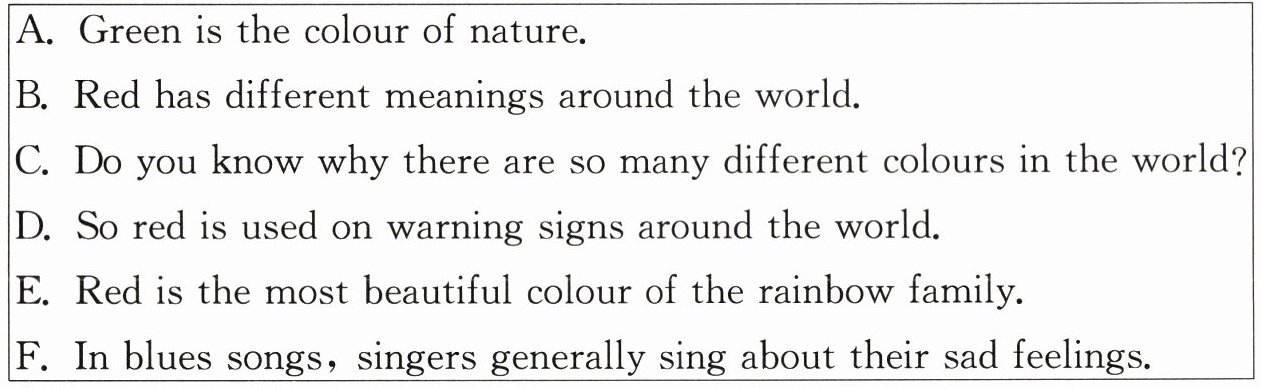
阅读下面短文,从短文后所给的选项中选出可以填入空白处的最佳选项(选项中有两项为多余选项)。
Colours affect our emotions in different ways. In different cultures around the world, colours have different meanings. What's your favourite colour? Maybe your favourite colour reflects(反映) your personality!
Red Blood is red, so people associate(联系) this colour with danger. 1 Red is also associated with energy. Drivers of sports cars often choose red cars, and players of video games often wear red clothes to appear more dominant(优势的).
2 In Europe, it is associated with love. That is why people give red roses on Valentine's Day. In China, red symbolizes(象征) happiness, On special days, adults give money to their children in red envelopes.
Blue Because the sea is blue, this colour is often associated with peace and calm. Blue is also associated with sad things. A type of music called blues originated(起源) in the USA in the 1870s. 3
Green We associate green with growth, health, youth and freshness. 4 Many environmental groups use green in their logos to show their support for nature. Green also symbolizes permission, as it means "go" on traffic lights.
答案
1. D 2. B 3. F 4. A
解析
【分析】
本题为信息还原题,解题时需先通读全文把握核心主题(颜色在不同文化中的含义及对人的影响),再针对每个空白处,结合其前后文的逻辑关系(如主题承接、因果关联、指代呼应等),逐一匹配选项,同时排除多余选项,确保所选内容符合语篇的连贯性。
【解析】
1. 第1空:前文提到红色与“danger(危险)”相关,选项D“So red is used on warning signs around the world.”承接这一内容,说明红色因关联危险而被用于警告标志,逻辑连贯,故选择D。
2. 第2空:后文分别介绍了欧洲、中国对红色的不同含义解读,选项B“Red has different meanings around the world.”是本段的总起句,引出下文不同文化中红色的含义,符合段落结构,故选择B。
3. 第3空:前文提到“blues(蓝调音乐)”,选项F“In blues songs, singers generally sing about their sad feelings.”承接“blues”这一话题,说明蓝调歌曲的内容特点,衔接自然,故选择F。
4. 第4空:本段围绕绿色与自然的关联展开,选项A“Green is the colour of nature.”直接点明绿色与自然的联系,承接前文对绿色的描述,符合语境,故选择A。
【答案】
1. D 2. B 3. F 4. A
【知识点】
英语语篇逻辑、信息还原题
【点评】
本题考查学生的语篇理解与逻辑推理能力,要求学生结合上下文的主题、逻辑关系匹配选项,是英语考试中常见的语篇类题型,需学生掌握基本的语篇衔接技巧。
【难度系数】
0.6
六、阅读表达(共4小题;前3小题每题1.5分,第4小题2.5分,满分7分)
阅读下面短文,回答短文后的问题,前3题每题答案不超过10词,第4题字数不限。
If your kids aren't interested in a dish, you might want to try changing the look of the bowl or plate. The relationship between the colour of a bowl and the taste of the food was examined(检测) in a study in the UK. The findings were published in a magazine.
47 volunteers took part in the study. They were divided into two groups, non-picky(不挑食的) eaters and picky eaters.
According to this study, food was put in coloured bowls and white bowls. As a result, the colour made no difference in taste for the non-picky eaters, but the picky eaters reported changes in their sense of taste. Snacks in red and blue bowls were thought to have more salt than those in white bowls, while snacks in red bowls were not as pleasant as those in the other bowls.
“This knowledge can be useful to those who want to try more kinds of foods,” says Lorenzo Stafford, a psychologist(心理学家) from a University in the UK. “For example, if you want a picky eater to try some bitter(苦的) vegetables, you can try to put them on a pink plate or in a yellow bowl, because this can give him or her a sweet feeling.”
It may seem strange that the colour of a bowl can influence people's feelings about food, but previous(以前的) researches have shown how light and music can influence eating habits. All of our senses are connected, including taste.
“This new study can help in treating food neophobia(新食物恐惧症),” a researcher says. “Through further studies, maybe we can choose ways to help actively influence a person's diet, and as a result, their health in mind and body,” says Stafford.
1. What was examined in the UK study?
2. How many groups were volunteers divided into?
3. What can influence picky eaters' taste?
4. How can we use these findings in daily life for better diets?
阅读下面短文,回答短文后的问题,前3题每题答案不超过10词,第4题字数不限。
If your kids aren't interested in a dish, you might want to try changing the look of the bowl or plate. The relationship between the colour of a bowl and the taste of the food was examined(检测) in a study in the UK. The findings were published in a magazine.
47 volunteers took part in the study. They were divided into two groups, non-picky(不挑食的) eaters and picky eaters.
According to this study, food was put in coloured bowls and white bowls. As a result, the colour made no difference in taste for the non-picky eaters, but the picky eaters reported changes in their sense of taste. Snacks in red and blue bowls were thought to have more salt than those in white bowls, while snacks in red bowls were not as pleasant as those in the other bowls.
“This knowledge can be useful to those who want to try more kinds of foods,” says Lorenzo Stafford, a psychologist(心理学家) from a University in the UK. “For example, if you want a picky eater to try some bitter(苦的) vegetables, you can try to put them on a pink plate or in a yellow bowl, because this can give him or her a sweet feeling.”
It may seem strange that the colour of a bowl can influence people's feelings about food, but previous(以前的) researches have shown how light and music can influence eating habits. All of our senses are connected, including taste.
“This new study can help in treating food neophobia(新食物恐惧症),” a researcher says. “Through further studies, maybe we can choose ways to help actively influence a person's diet, and as a result, their health in mind and body,” says Stafford.
1. What was examined in the UK study?
Bowl colour and food taste relationship.
2. How many groups were volunteers divided into?
Two groups.
3. What can influence picky eaters' taste?
Bowl colour.
4. How can we use these findings in daily life for better diets?
We can use colorful bowls to make healthy but disliked foods (like bitter veggies) more appealing. For example, serve whole - grain foods in bright - colored bowls to make picky eaters more willing to try, helping them accept healthy foods and form a balanced diet.(答案合理即可)
答案
1. Bowl colour and food taste relationship.
2. Two groups.
3. Bowl colour.
4. We can use colorful bowls to make healthy but disliked foods (like bitter veggies) more appealing. For example, serve whole - grain foods in bright - colored bowls to make picky eaters more willing to try, helping them accept healthy foods and form a balanced diet.(答案合理即可)
解析
【分析】
做本题时,需先通读短文把握核心内容:英国研究了碗的颜色与食物味道的关系,针对挑食者和不挑食者有不同影响。然后针对每个问题定位原文对应段落的关键信息:第1题找英国研究的检测对象,第2题找志愿者的分组数量,第3题找影响挑食者味觉的因素,第4题结合研究结论合理阐述应用方式,注意前3题答案不超10词,第4题合理即可。
【解析】
1. 定位原文第一段第二句“The relationship between the colour of a bowl and the taste of the food was examined in a study in the UK.”,提取核心内容得出答案;
2. 定位原文第二段第二句“They were divided into two groups, non-picky eaters and picky eaters.”,明确分组数为两组;
3. 定位原文第三段,可知碗的颜色会影响挑食者的味觉感受,得出答案;
4. 结合研究结论,可通过用彩色碗(如粉色、黄色)盛放挑食者不爱吃的健康食物(如苦蔬菜),让其产生愉悦感,帮助挑食者接受健康食物,进而形成均衡饮食,符合要求即可。
【答案】
1. Bowl colour and food taste relationship.
2. Two groups.
3. Bowl colour.
4. We can use colorful bowls to make healthy but disliked foods (like bitter veggies) more appealing. For example, serve whole-grain foods in bright-colored bowls to make picky eaters more willing to try, helping them accept healthy foods and form a balanced diet.
【知识点】
英语阅读理解(细节理解)、英语阅读表达(信息运用)
【点评】
本题为英语阅读表达题,前3小题为基础细节题,考查学生快速定位原文信息的能力,难度较低;第4小题为开放题,考查学生结合研究结论合理运用知识的能力,整体符合英语阅读的考查要求。
【难度系数】
0.7
