

 登录
登录
Ⅰ. 用方框内单词及短语补全Lingling关于Rich Dad Poor Dad的书评。
ideas save wisely manage money management achieve my dream
Recently, I had the pleasure of reading Rich Dad Poor Dad.
It teaches me many useful lessons about 1.
Before reading the book, I used to believe that hard work alone could easily bring money. But the book opened my eyes: working for money all the time won't make our life better. I never realized that it's not about how much money we have, but how we 2.
The book shows us different 3.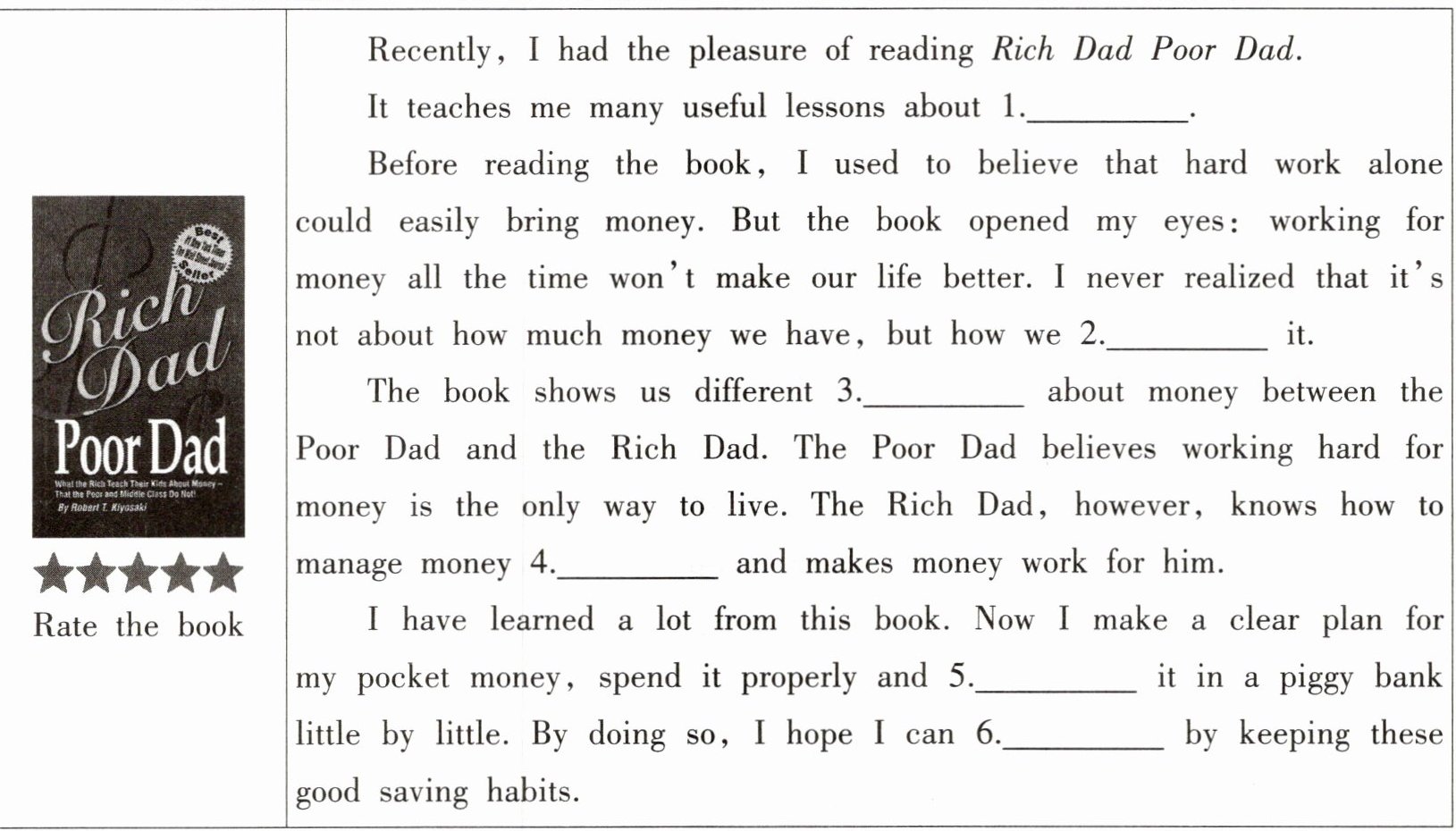 Poor Dad and the Rich Dad. The Poor Dad believes working hard for money is the only way to live. The Rich Dad, however, knows how to manage money 4.
I have learned a lot from this book. Now I make a clear plan for my pocket money, spend it properly and 5.
ideas save wisely manage money management achieve my dream
Recently, I had the pleasure of reading Rich Dad Poor Dad.
It teaches me many useful lessons about 1.
money management
.Before reading the book, I used to believe that hard work alone could easily bring money. But the book opened my eyes: working for money all the time won't make our life better. I never realized that it's not about how much money we have, but how we 2.
manage
it.The book shows us different 3.
ideas
about money between the Poor Dad and the Rich Dad. The Poor Dad believes working hard for money is the only way to live. The Rich Dad, however, knows how to manage money 4.wisely
and makes money work for him.I have learned a lot from this book. Now I make a clear plan for my pocket money, spend it properly and 5.
save
it in a piggy bank little by little. By doing so, I hope I can 6.achieve my dream
by keeping these good saving habits.答案
1. money management
2. manage
3. ideas
4. wisely
5. save
6. achieve my dream
2. manage
3. ideas
4. wisely
5. save
6. achieve my dream
解析
【分析】这是一道选词填空题,需结合文章主旨、句子结构及词性,从给定的单词短语中匹配合适内容填入空格。解题时先通读全文理解语境,再逐个分析每个空格的语法要求和语义需求,对应选择词汇。
【解析】1. 空格前为介词about,结合书名《Rich Dad Poor Dad》及全文围绕金钱的主题,此处指关于金钱管理的课程,故填money management;2. 句子结构为“how we + 动词原形”,it指代money,结合前文提到的manage money,此处表示“如何管理钱”,故填manage;3. different后接可数名词复数,结合语境指两位爸爸关于金钱的不同想法,故填ideas;4. 此处修饰动词短语manage money,需用副词,结合语境指明智地管理钱,故填wisely;5. 结合“in a piggy bank”(存钱罐),此处表示“存钱”,故填save;6. 结合语境,希望通过好习惯实现梦想,故填achieve my dream。
【答案】1. money management 2. manage 3. ideas 4. wisely 5. save 6. achieve my dream
【知识点】英语选词填空、词汇运用、语境理解
【点评】本题围绕书籍感悟展开,考查学生对文章语境的理解及词汇的正确运用,难度适中,需结合上下文逻辑和词性分析作答。
【难度系数】0.6
【解析】1. 空格前为介词about,结合书名《Rich Dad Poor Dad》及全文围绕金钱的主题,此处指关于金钱管理的课程,故填money management;2. 句子结构为“how we + 动词原形”,it指代money,结合前文提到的manage money,此处表示“如何管理钱”,故填manage;3. different后接可数名词复数,结合语境指两位爸爸关于金钱的不同想法,故填ideas;4. 此处修饰动词短语manage money,需用副词,结合语境指明智地管理钱,故填wisely;5. 结合“in a piggy bank”(存钱罐),此处表示“存钱”,故填save;6. 结合语境,希望通过好习惯实现梦想,故填achieve my dream。
【答案】1. money management 2. manage 3. ideas 4. wisely 5. save 6. achieve my dream
【知识点】英语选词填空、词汇运用、语境理解
【点评】本题围绕书籍感悟展开,考查学生对文章语境的理解及词汇的正确运用,难度适中,需结合上下文逻辑和词性分析作答。
【难度系数】0.6
Ⅱ. 阅读短文,根据短文内容按要求完成以下任务。
Many teenagers have dreams or wishes, like traveling abroad or buying a new laptop. But how can we make these dreams come true? The key is to manage our pocket money wisely. It's not hard to do, and small daily efforts can help us get closer to our dreams.
Lily, a 15-year-old student, is a good example. She dreams of taking part in a summer camp in Canada and it costs ¥8,000. Instead of asking her parents to pay for it, she decides to save the money all by herself. She starts the "365-Day Savings Challenge". She puts ¥3 into her piggy bank every single day and she always keeps a record of every coin she saves. To reach her goal, Lily makes "dream tins". She writes one tin "Canada Summer Camp" and another "New Books". She also learns to budget her pocket money well: she uses part of it for snacks and small gifts for friends, and puts the rest into her tins. When she wants to buy expensive toys or snacks, she reminds herself where her dreams are.
After about 14 months, Lily finally saves enough money for the camp. She learns that managing money isn't about never having fun—it's about making smart choices, developing good saving habits and helping her achieve her dream slowly.
任务一:回答问题。
1. What dream does Lily have and how much does it cost?
2. How does Lily save money every day?
3. Do you think the "365-Day Savings Challenge" is a good idea for teenagers? Why or why not?
任务二:用when / where引导状语从句完成关于Lily的故事的句子。
1. Lily puts money into her dream tin every day
2. She saves her pocket money
3.
4. She always keeps her budget list
Many teenagers have dreams or wishes, like traveling abroad or buying a new laptop. But how can we make these dreams come true? The key is to manage our pocket money wisely. It's not hard to do, and small daily efforts can help us get closer to our dreams.
Lily, a 15-year-old student, is a good example. She dreams of taking part in a summer camp in Canada and it costs ¥8,000. Instead of asking her parents to pay for it, she decides to save the money all by herself. She starts the "365-Day Savings Challenge". She puts ¥3 into her piggy bank every single day and she always keeps a record of every coin she saves. To reach her goal, Lily makes "dream tins". She writes one tin "Canada Summer Camp" and another "New Books". She also learns to budget her pocket money well: she uses part of it for snacks and small gifts for friends, and puts the rest into her tins. When she wants to buy expensive toys or snacks, she reminds herself where her dreams are.
After about 14 months, Lily finally saves enough money for the camp. She learns that managing money isn't about never having fun—it's about making smart choices, developing good saving habits and helping her achieve her dream slowly.
任务一:回答问题。
1. What dream does Lily have and how much does it cost?
She dreams of taking part in a summer camp in Canada. It costs ¥8,000.
2. How does Lily save money every day?
She puts ¥3 into her piggy bank every day and keeps a record of her savings.
3. Do you think the "365-Day Savings Challenge" is a good idea for teenagers? Why or why not?
Yes, it is. Because it helps teenagers learn to manage pocket money wisely and make their dreams come true slowly.
/No, I don't think so. Because managing money isn't about never having fun. Too much saving will make teenagers lose the fun of daily life.(答案合理即可)
任务二:用when / where引导状语从句完成关于Lily的故事的句子。
1. Lily puts money into her dream tin every day
when
she gets her pocket money.2. She saves her pocket money
where
her dream lies.3.
When
Lily wants to buy expensive toys, she reminds herself of her dreams.4. She always keeps her budget list
where
she can see it easily—on her desk.答案
任务一:
1. She dreams of taking part in a summer camp in Canada. It costs ¥8,000.
2. She puts ¥3 into her piggy bank every day and keeps a record of her savings.
3. Yes, it is. Because it helps teenagers learn to manage pocket money wisely and make their dreams come true slowly. /No, I don't think so. Because managing money isn't about never having fun. Too much saving will make teenagers lose the fun of daily life.(答案合理即可)
任务二:
1. when
2. where
3. When
4. where
1. She dreams of taking part in a summer camp in Canada. It costs ¥8,000.
2. She puts ¥3 into her piggy bank every day and keeps a record of her savings.
3. Yes, it is. Because it helps teenagers learn to manage pocket money wisely and make their dreams come true slowly. /No, I don't think so. Because managing money isn't about never having fun. Too much saving will make teenagers lose the fun of daily life.(答案合理即可)
任务二:
1. when
2. where
3. When
4. where
解析
【分析】
本题为英语阅读理解任务,分为任务一(细节查找类问答+开放观点类问答)和任务二(状语从句连接词填空)。任务一需从原文定位提取对应信息,开放问答结合主旨给出合理观点即可;任务二需掌握when(引导时间状语从句,表“当……时”)和where(引导地点状语从句,表“在……地方”)的用法,结合句子语境选择合适连接词。
【解析】
任务一:1. 定位原文第二段关于Lily的描述,提取她的梦想及费用;2. 定位原文中Lily每日存钱的具体做法;3. 为开放性问题,结合文章“明智管理零花钱实现梦想”的主旨,给出合理观点(同意或不同意均可,理由充分即可)。任务二:1. 句子表“拿到零花钱时存钱”的时间场景,用when;2. 句子表“存钱到梦想所在处”的地点场景,用where;3. 句子表“想买贵玩具时”的时间场景,句首大写用When;4. 句子表“放清单到易见处”的地点场景,用where。
【答案】
任务一:
1. She dreams of taking part in a summer camp in Canada. It costs ¥8,000.
2. She puts ¥3 into her piggy bank every day and keeps a record of her savings.
3. Yes, it is. Because it helps teenagers learn to manage pocket money wisely and make their dreams come true slowly. /No, I don't think so. Because managing money isn't about never having fun. Too much saving will make teenagers lose the fun of daily life.(答案合理即可)
任务二:
1. when
2. where
3. When
4. where
【知识点】
阅读理解、状语从句
【点评】
本题结合阅读理解与语法运用,既考查学生从原文定位提取信息的能力,又考查when/where引导状语从句的用法,开放题需结合主旨表达观点,整体难度适中,适合初中英语学习者巩固相关知识点。
【难度系数】
0.6
本题为英语阅读理解任务,分为任务一(细节查找类问答+开放观点类问答)和任务二(状语从句连接词填空)。任务一需从原文定位提取对应信息,开放问答结合主旨给出合理观点即可;任务二需掌握when(引导时间状语从句,表“当……时”)和where(引导地点状语从句,表“在……地方”)的用法,结合句子语境选择合适连接词。
【解析】
任务一:1. 定位原文第二段关于Lily的描述,提取她的梦想及费用;2. 定位原文中Lily每日存钱的具体做法;3. 为开放性问题,结合文章“明智管理零花钱实现梦想”的主旨,给出合理观点(同意或不同意均可,理由充分即可)。任务二:1. 句子表“拿到零花钱时存钱”的时间场景,用when;2. 句子表“存钱到梦想所在处”的地点场景,用where;3. 句子表“想买贵玩具时”的时间场景,句首大写用When;4. 句子表“放清单到易见处”的地点场景,用where。
【答案】
任务一:
1. She dreams of taking part in a summer camp in Canada. It costs ¥8,000.
2. She puts ¥3 into her piggy bank every day and keeps a record of her savings.
3. Yes, it is. Because it helps teenagers learn to manage pocket money wisely and make their dreams come true slowly. /No, I don't think so. Because managing money isn't about never having fun. Too much saving will make teenagers lose the fun of daily life.(答案合理即可)
任务二:
1. when
2. where
3. When
4. where
【知识点】
阅读理解、状语从句
【点评】
本题结合阅读理解与语法运用,既考查学生从原文定位提取信息的能力,又考查when/where引导状语从句的用法,开放题需结合主旨表达观点,整体难度适中,适合初中英语学习者巩固相关知识点。
【难度系数】
0.6
