

 登录
六、阅读理解。
A
It's cold in winter. Many plants stop to grow. It's hard to find food for animals. Lots of animals sleep for a long time—like frogs, bears, ants and snakes.
In autumn, the bears eat a lot of fruit and fish. They make beds with leaves and twigs from the trees. They don't eat or drink until(直到) spring. When they get up, they are hungry. They eat anything they can find. They eat meat, green grass and fish.
阅读短文,选择正确的答案。
(
B.
(
B.
(
B.
(
A. the bears don't eat or drink until summer
B. all the animals sleep for a long time in winter
C. the bears eat a lot of things after winter sleep
A
It's cold in winter. Many plants stop to grow. It's hard to find food for animals. Lots of animals sleep for a long time—like frogs, bears, ants and snakes.
In autumn, the bears eat a lot of fruit and fish. They make beds with leaves and twigs from the trees. They don't eat or drink until(直到) spring. When they get up, they are hungry. They eat anything they can find. They eat meat, green grass and fish.
阅读短文,选择正确的答案。
(
B
)1. don't sleep for a long time in winter.B.
(
A
)2. Bears make their beds with .B.
(
B
)3. The underlined word "twigs" means .B.
(
C
)4. From the passage, we know .A. the bears don't eat or drink until summer
B. all the animals sleep for a long time in winter
C. the bears eat a lot of things after winter sleep
答案
1. B 2. A 3. B 4. C
解析
【分析】
做本题时,首先通读短文,了解短文主要内容:短文介绍了冬天很多动物会冬眠,以及熊冬眠前后的情况。然后逐个分析题目,带着问题回到原文定位关键信息:第1题找冬天不冬眠的动物,第2题找熊做床的材料,第3题猜测划线单词的含义,第4题逐一核对选项与原文是否一致。
【解析】
1. 根据短文第一段“Lots of animals sleep for a long time—like frogs, bears, ants and snakes.”可知,青蛙、熊、蚂蚁、蛇都会冬眠,因此不冬眠的对应选项B,故选B。
2. 根据短文第二段第二句“They make beds with leaves and twigs from the trees.”可知,熊用树叶和树枝做床,对应选项A,故选A。
3. 划线单词“twigs”来自“from the trees”,结合语境可知其意为“细枝”,对应选项B,故选B。
4. 选项A:原文提到熊“don't eat or drink until spring”,而非summer,错误;选项B:原文是“Lots of animals”冬眠,而非all,错误;选项C:原文提到熊醒来后“eat anything they can find”,即吃很多东西,正确,故选C。
【答案】
1.B 2.A 3.B 4.C
【知识点】
英语阅读理解、细节理解、词义猜测
【点评】
本题是基础英语阅读理解题,侧重考查学生提取短文信息和词义推断的能力,内容贴近生活,难度适中,适合低年级学生巩固相关知识。
【难度系数】
0.7
B
The season has the longest(最长的) days. It is hot. It rains a lot. Everything is green. Most flowers are blooming.
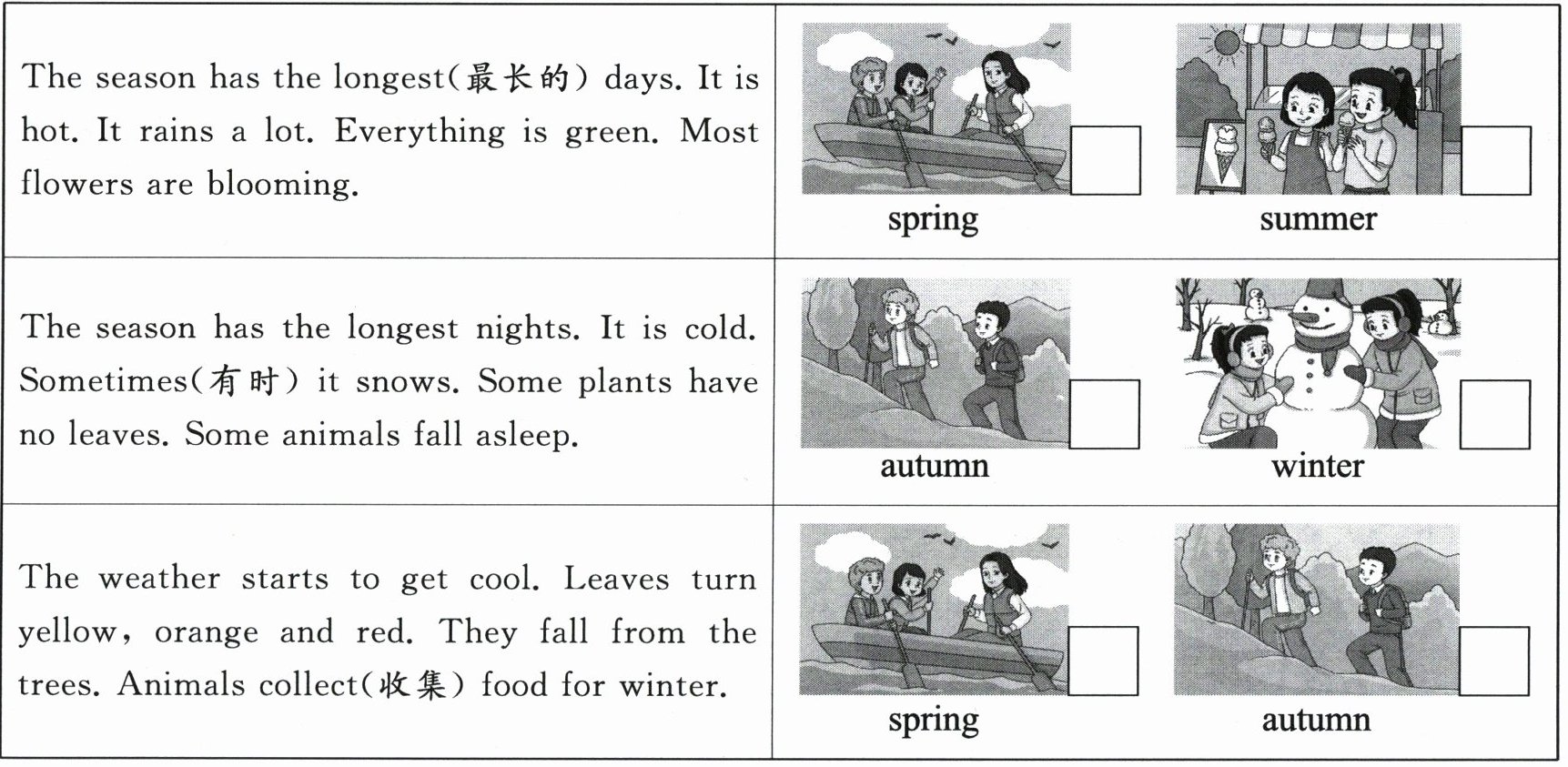
spring
summer
The season has the longest nights. It is cold. Sometimes(有时) it snows. Some plants have no leaves. Some animals fall asleep.
autumn
winter
The weather starts to get cool. Leaves turn yellow, orange and red. They fall from the trees. Animals collect(收集) food for winter.
spring
autumn
(一)阅读表格,勾选出对应的季节图片。
(二)阅读表格,判断正(T)误(F)。
(
(
(
The season has the longest(最长的) days. It is hot. It rains a lot. Everything is green. Most flowers are blooming.
spring
summer
The season has the longest nights. It is cold. Sometimes(有时) it snows. Some plants have no leaves. Some animals fall asleep.
autumn
winter
The weather starts to get cool. Leaves turn yellow, orange and red. They fall from the trees. Animals collect(收集) food for winter.
spring
autumn
(一)阅读表格,勾选出对应的季节图片。
(二)阅读表格,判断正(T)误(F)。
(
F
) 1. It rains a lot in spring.(
T
) 2. Some plants have no leaves when it snows.(
F
) 3. The days are the longest in summer and winter.答案
(一) summer, winter, autumn (二) 1. F 2. T 3. F
解析
【分析】
本题分为两部分:一是根据季节特征匹配对应的季节图片,二是根据原文描述判断句子正误。解题时需先提取每个季节描述的关键特征,再与给出的季节选项对应;判断正误题需找到原文依据,对比句子描述是否一致。
【解析】
(一)匹配季节:
1. 第一个描述:有最长的白天、炎热、多雨、万物翠绿、多数花盛开,符合夏天(summer)的特征,对应summer的图片;
2. 第二个描述:有最长的夜晚、寒冷、有时下雪、部分植物无叶、部分动物冬眠,符合冬天(winter)的特征,对应winter的图片;
3. 第三个描述:天气开始变凉、叶子变黄/橙/红、从树上掉落、动物收集食物过冬,符合秋天(autumn)的特征,对应autumn的图片。
(二)判断正误:
1. 句子说“春天多雨”,但原文第一个描述是夏天多雨,与原文不符,故为F;
2. 句子说“下雪时有些植物无叶”,原文第二个描述提到冬天有时下雪,部分植物无叶,与原文相符,故为T;
3. 句子说“夏天和冬天白天最长”,原文第一个描述是夏天白天最长,第二个描述是冬天夜晚最长,与原文不符,故为F。
【答案】
(一)summer、winter、autumn (二)1.F 2.T 3.F
【知识点】
季节特征、英语阅读理解、判断正误
【点评】
本题考查学生对季节特征的掌握及英语阅读理解能力,需准确提取原文关键信息,难度适中,适合基础阶段学生练习。
【难度系数】
0.5
