

 登录
登录
四、书面表达
假设你是李平,请你对意大利交换生 Armino 的邮件进行回复。
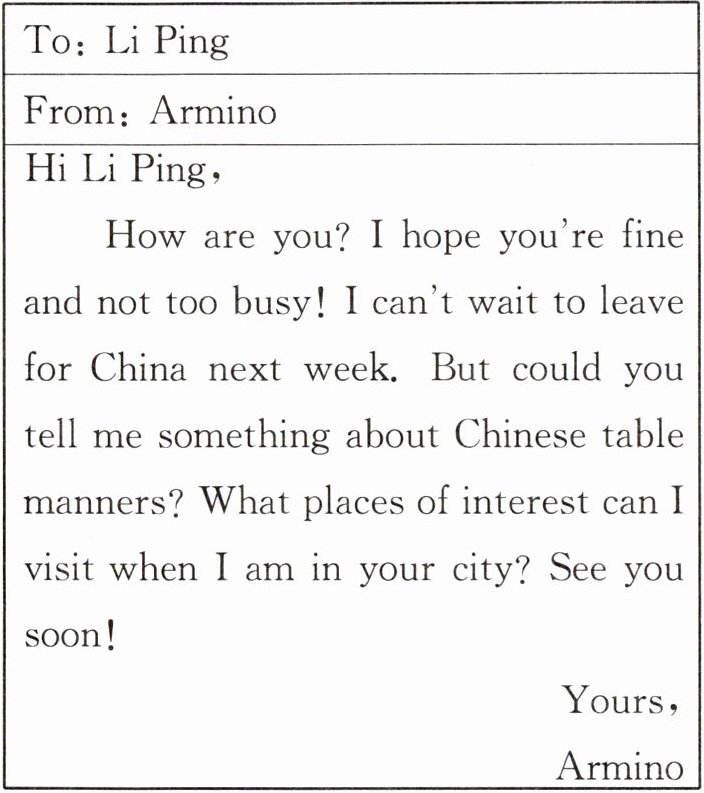
要求:词数80左右。
Hi Armino,
Glad to hear from you and know you are excited about coming to China soon.
假设你是李平,请你对意大利交换生 Armino 的邮件进行回复。
要求:词数80左右。
Hi Armino,
Glad to hear from you and know you are excited about coming to China soon.
答案
One possible version:
Hi Armino,
Glad to hear from you and know you are excited about coming to China soon. There is indeed something you need to know. Let me tell you.
In China, people use chopsticks instead of knives and forks. And there are some important rules when using them. For example, it's impolite to point at someone with chopsticks. Moreover, we don't stick them into the food. Besides, we are not supposed to start eating first if there are older people at the table.
As for places of interest, China National Tea Museum is a good choice. You can enjoy tea art performances there and see various types of tea so you can know more about Chinese tea culture.
Hope you will have a great time in China.
Yours,
Li Ping
(113 words)
Hi Armino,
Glad to hear from you and know you are excited about coming to China soon. There is indeed something you need to know. Let me tell you.
In China, people use chopsticks instead of knives and forks. And there are some important rules when using them. For example, it's impolite to point at someone with chopsticks. Moreover, we don't stick them into the food. Besides, we are not supposed to start eating first if there are older people at the table.
As for places of interest, China National Tea Museum is a good choice. You can enjoy tea art performances there and see various types of tea so you can know more about Chinese tea culture.
Hope you will have a great time in China.
Yours,
Li Ping
(113 words)
解析
【分析】本题要求以李平的身份回复意大利交换生Armino的邮件,需回应对方提出的两个核心问题:中国餐桌礼仪和可参观的景点。解题思路为:1. 开头礼貌回应对方来信,表达欢迎;2. 分两部分解答问题:第一部分介绍中国餐桌礼仪的关键要点,如筷子的使用禁忌(不能指人、不能插食物)、长辈先动筷等;第二部分推荐具有文化特色的景点;3. 结尾送上祝福,符合邮件的亲切正式语气。
【解析】首先,开头承接对方来信,表达得知对方即将来中国的喜悦;接着围绕“餐桌礼仪”展开,说明使用筷子的规则及禁忌,以及长辈优先的礼仪;然后针对“景点推荐”,选择中国国家茶叶博物馆,说明可体验的文化内容;最后以祝福收尾,确保词数符合要求,语言准确流畅,符合邮件格式。
【答案】Hi Armino,
Glad to hear from you and know you are excited about coming to China soon. There is indeed something you need to know. Let me tell you.
In China, people use chopsticks instead of knives and forks. And there are some important rules when using them. For example, it's impolite to point at someone with chopsticks. Moreover, we don't stick them into the food. Besides, we are not supposed to start eating first if there are older people at the table.
As for places of interest, China National Tea Museum is a good choice. You can enjoy tea art performances there and see various types of tea so you can know more about Chinese tea culture.
Hope you will have a great time in China.
Yours,
Li Ping
【知识点】英语邮件写作;中国文化英语表达;餐桌礼仪英语表述
【点评】本题考查学生的英语书面表达能力,要求结合中国文化常识回应对方问题,结构清晰,语言需准确得体,既考查语言运用能力,又渗透文化意识,是常见的书面表达题型。
【难度系数】0.5
【解析】首先,开头承接对方来信,表达得知对方即将来中国的喜悦;接着围绕“餐桌礼仪”展开,说明使用筷子的规则及禁忌,以及长辈优先的礼仪;然后针对“景点推荐”,选择中国国家茶叶博物馆,说明可体验的文化内容;最后以祝福收尾,确保词数符合要求,语言准确流畅,符合邮件格式。
【答案】Hi Armino,
Glad to hear from you and know you are excited about coming to China soon. There is indeed something you need to know. Let me tell you.
In China, people use chopsticks instead of knives and forks. And there are some important rules when using them. For example, it's impolite to point at someone with chopsticks. Moreover, we don't stick them into the food. Besides, we are not supposed to start eating first if there are older people at the table.
As for places of interest, China National Tea Museum is a good choice. You can enjoy tea art performances there and see various types of tea so you can know more about Chinese tea culture.
Hope you will have a great time in China.
Yours,
Li Ping
【知识点】英语邮件写作;中国文化英语表达;餐桌礼仪英语表述
【点评】本题考查学生的英语书面表达能力,要求结合中国文化常识回应对方问题,结构清晰,语言需准确得体,既考查语言运用能力,又渗透文化意识,是常见的书面表达题型。
【难度系数】0.5
