

 登录
登录
Read the article and complete the tasks.( 阅读短文,完成任务。)
Great museums around the world
①Museums are like time machines, carrying us through centuries with ancient artefacts and breathtaking art. Here are four extraordinary museums that connect us to the past.
The Louvre Museum (Paris, France)
②The Louvre Museum is one of the world’s largest art museum, which holds over 480000 treasures, from ancient Greek sculptures to Renaissance ( 文艺复兴 ) masterpieces. Among these is Leonardo da Vinci’s *Mona Lisa*, whose mysterious smile has captivated visitors for over 500 years. At its entrance, the glass Louvre Pyramid glows like a diamond, blending modern design with historic stone walls in perfect harmony.
The Egyptian Museum (Cairo, Egypt)
③The Egyptian Museum is home to more than 170000 artefacts that bring the ancient Egyptian civilization to vivid life. Its Royal Mummy Room displays mummies, coffins, and other ancient treasures, each piece telling stories of the Nile. The gold funerary mask of King Tutankhamun is one of the most famous exhibits there.
The British Museum (London, UK)
④The British Museum has over 8 million objects from different civilizations. It collects great works from ancient Egypt, Greece, and many other countries around the world. The Rosetta Stone( 罗塞塔石碑 )is one of its most famous exhibit. It helped people understand ancient Egyptian writing for the first time. Its rich collections open a wonderful window to the whole history of human culture.
The Palace Museum (Beijing, China)
⑤Standing at the heart of Beijing, the Palace Museum, or the Forbidden City, holds over 1.8 million ancient artefacts — delicate landscape ink paintings and elegant calligraphy flowing like winding rivers. Its wooden halls, such as the Hall of Supreme Harmony, tower like giants, with their red walls and golden roofs, a vivid symbol of the elegance of traditional Chinese architecture.
⑥These museums are more than buildings — they are bridges between yesterday and today, inviting us to wonder and learn.
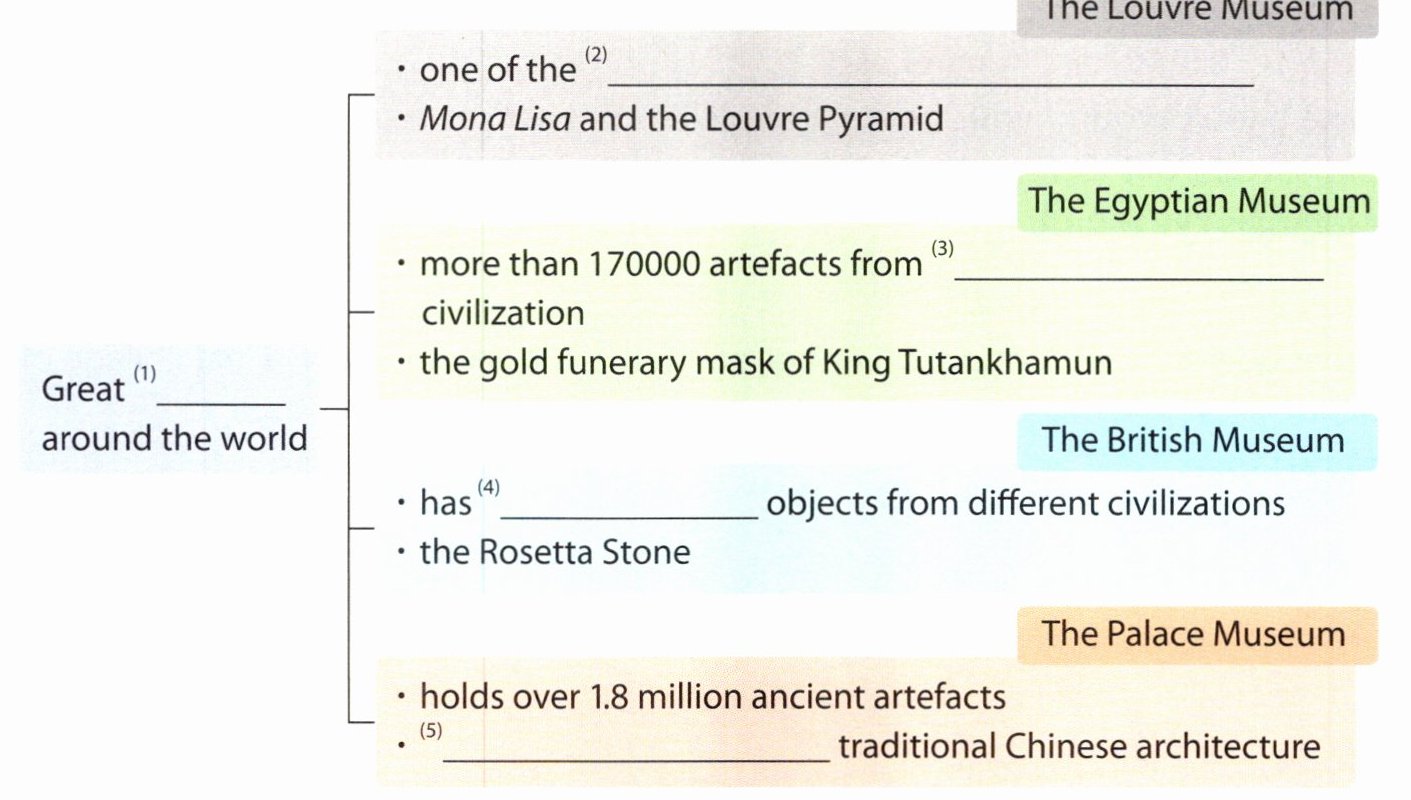
Task 1 Complete the chart.
Great (1)
Task 2 Choose the best answer.
1. What can you infer from the underlined sentence in paragraph ②? (
A. The Louvre Pyramid is made of real diamonds.
B. The Louvre successfully combines modern and traditional architectural styles.
C. The Louvre Pyramid is the most famous exhibit in the museum.
D. The historic stone walls of the Louvre are not old.
2. From paragraph ③, we can infer that . (
A. King Tutankhamun was an important figure in ancient Egypt
B. the Egyptian Museum has no artefacts from the Nile
C. all artefacts in the museum are made of gold
D. the museum only displays mummies
3. What can we infer from paragraph ⑤? (
A. The Palace Museum has very few historical items.
B. Red and gold were unpopular colours in ancient Chinese architecture.
C. All the artefacts in the museum are landscape paintings.
D. The Forbidden City was the centre of culture and power in ancient China.
Great museums around the world
①Museums are like time machines, carrying us through centuries with ancient artefacts and breathtaking art. Here are four extraordinary museums that connect us to the past.
The Louvre Museum (Paris, France)
②The Louvre Museum is one of the world’s largest art museum, which holds over 480000 treasures, from ancient Greek sculptures to Renaissance ( 文艺复兴 ) masterpieces. Among these is Leonardo da Vinci’s *Mona Lisa*, whose mysterious smile has captivated visitors for over 500 years. At its entrance, the glass Louvre Pyramid glows like a diamond, blending modern design with historic stone walls in perfect harmony.
The Egyptian Museum (Cairo, Egypt)
③The Egyptian Museum is home to more than 170000 artefacts that bring the ancient Egyptian civilization to vivid life. Its Royal Mummy Room displays mummies, coffins, and other ancient treasures, each piece telling stories of the Nile. The gold funerary mask of King Tutankhamun is one of the most famous exhibits there.
The British Museum (London, UK)
④The British Museum has over 8 million objects from different civilizations. It collects great works from ancient Egypt, Greece, and many other countries around the world. The Rosetta Stone( 罗塞塔石碑 )is one of its most famous exhibit. It helped people understand ancient Egyptian writing for the first time. Its rich collections open a wonderful window to the whole history of human culture.
The Palace Museum (Beijing, China)
⑤Standing at the heart of Beijing, the Palace Museum, or the Forbidden City, holds over 1.8 million ancient artefacts — delicate landscape ink paintings and elegant calligraphy flowing like winding rivers. Its wooden halls, such as the Hall of Supreme Harmony, tower like giants, with their red walls and golden roofs, a vivid symbol of the elegance of traditional Chinese architecture.
⑥These museums are more than buildings — they are bridges between yesterday and today, inviting us to wonder and learn.
Task 1 Complete the chart.
Great (1)
museums
around the worldTask 2 Choose the best answer.
1. What can you infer from the underlined sentence in paragraph ②? (
B
)A. The Louvre Pyramid is made of real diamonds.
B. The Louvre successfully combines modern and traditional architectural styles.
C. The Louvre Pyramid is the most famous exhibit in the museum.
D. The historic stone walls of the Louvre are not old.
2. From paragraph ③, we can infer that . (
A
)A. King Tutankhamun was an important figure in ancient Egypt
B. the Egyptian Museum has no artefacts from the Nile
C. all artefacts in the museum are made of gold
D. the museum only displays mummies
3. What can we infer from paragraph ⑤? (
D
)A. The Palace Museum has very few historical items.
B. Red and gold were unpopular colours in ancient Chinese architecture.
C. All the artefacts in the museum are landscape paintings.
D. The Forbidden City was the centre of culture and power in ancient China.
答案
Task 1
(1) museums
(2) world’s largest art museum
(3) ancient Egyptian
(4) over 8 million
(5) a vivid symbol of (the elegance of)
Task 2
1. B 2. A 3. D
(1) museums
(2) world’s largest art museum
(3) ancient Egyptian
(4) over 8 million
(5) a vivid symbol of (the elegance of)
Task 2
1. B 2. A 3. D
