

 登录
登录
五、根据课本第36页Section B 1b的语篇内容,完成下面的表格。
Topic Question Answer
Importance of bees How many flowers do bees visit on one trip? 1.
What does bees’ pollination help? 2.
Without bees’ work, about what percentage of the plants in the world cannot grow? 3.
Interesting facts about bees Why do bees create honeycombs?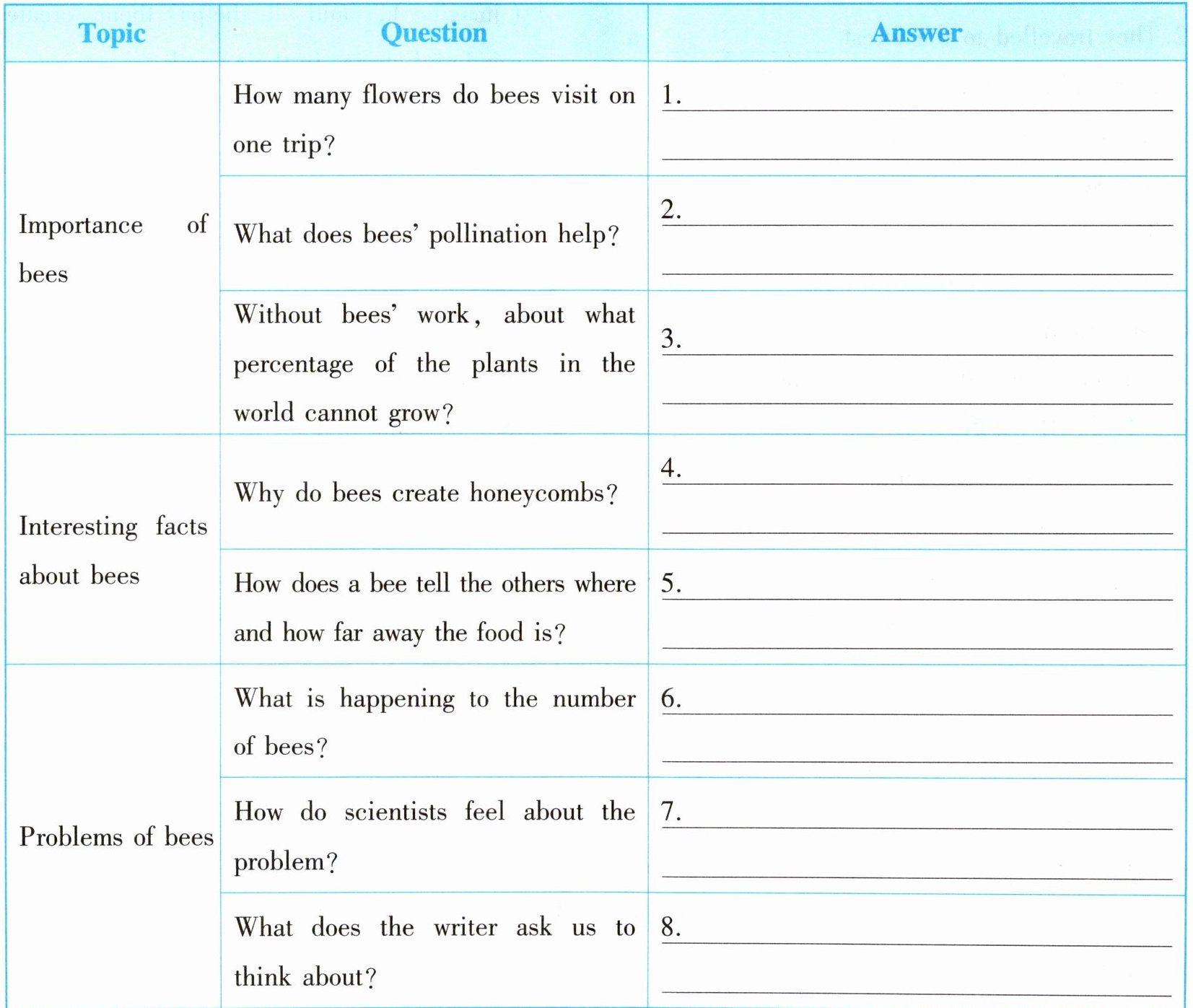 4.
4.
How does a bee tell the others where and how far away the food is? 5.
Problems of bees What is happening to the number of bees? 6.
How do scientists feel about the problem? 7.
What does the writer ask us to think about? 8.
Topic Question Answer
Importance of bees How many flowers do bees visit on one trip? 1.
50 to 100 flowers.
What does bees’ pollination help? 2.
It helps plants grow.
Without bees’ work, about what percentage of the plants in the world cannot grow? 3.
About 80 percent.
Interesting facts about bees Why do bees create honeycombs?
4. To store honey.
How does a bee tell the others where and how far away the food is? 5.
It uses a dance.
Problems of bees What is happening to the number of bees? 6.
The number of bees is dropping.
How do scientists feel about the problem? 7.
They are worried.
What does the writer ask us to think about? 8.
What we can do to protect bees.
答案
1. 50 to 100 flowers.
2. It helps plants grow.
3. About 80 percent.
4. To store honey.
5. It uses a dance.
6. The number of bees is dropping.
7. They are worried.
8. What we can do to protect bees.
2. It helps plants grow.
3. About 80 percent.
4. To store honey.
5. It uses a dance.
6. The number of bees is dropping.
7. They are worried.
8. What we can do to protect bees.
解析
【分析】
本题为课本语篇的细节信息提取题,解题思路是:针对每个问题,在对应主题的语篇内容中定位相关细节,匹配对应的答案即可,无需额外拓展,只需准确提取原文信息。
【解析】
需依据课本第36页Section B 1b的语篇内容,逐一对应问题查找答案:
1. 对应问题“How many flowers do bees visit on one trip?”,答案为50 to 100 flowers;
2. 对应问题“What does bees’ pollination help?”,答案为It helps plants grow;
3. 对应问题“Without bees’ work, about what percentage of the plants in the world cannot grow?”,答案为About 80 percent;
4. 对应问题“Why do bees create honeycombs?”,答案为To store honey;
5. 对应问题“How does a bee tell the others where and how far away the food is?”,答案为It uses a dance;
6. 对应问题“What is happening to the number of bees?”,答案为The number of bees is dropping;
7. 对应问题“How do scientists feel about the problem?”,答案为They are worried;
8. 对应问题“What does the writer ask us to think about?”,答案为What we can do to protect bees。
【答案】
1. 50 to 100 flowers.
2. It helps plants grow.
3. About 80 percent.
4. To store honey.
5. It uses a dance.
6. The number of bees is dropping.
7. They are worried.
8. What we can do to protect bees.
【知识点】
英语阅读理解,细节信息提取
【点评】
本题考查对课本语篇细节信息的掌握,属于基础的信息提取类题目,难度不大,只要认真阅读指定语篇即可完成作答。
【难度系数】
0.4
本题为课本语篇的细节信息提取题,解题思路是:针对每个问题,在对应主题的语篇内容中定位相关细节,匹配对应的答案即可,无需额外拓展,只需准确提取原文信息。
【解析】
需依据课本第36页Section B 1b的语篇内容,逐一对应问题查找答案:
1. 对应问题“How many flowers do bees visit on one trip?”,答案为50 to 100 flowers;
2. 对应问题“What does bees’ pollination help?”,答案为It helps plants grow;
3. 对应问题“Without bees’ work, about what percentage of the plants in the world cannot grow?”,答案为About 80 percent;
4. 对应问题“Why do bees create honeycombs?”,答案为To store honey;
5. 对应问题“How does a bee tell the others where and how far away the food is?”,答案为It uses a dance;
6. 对应问题“What is happening to the number of bees?”,答案为The number of bees is dropping;
7. 对应问题“How do scientists feel about the problem?”,答案为They are worried;
8. 对应问题“What does the writer ask us to think about?”,答案为What we can do to protect bees。
【答案】
1. 50 to 100 flowers.
2. It helps plants grow.
3. About 80 percent.
4. To store honey.
5. It uses a dance.
6. The number of bees is dropping.
7. They are worried.
8. What we can do to protect bees.
【知识点】
英语阅读理解,细节信息提取
【点评】
本题考查对课本语篇细节信息的掌握,属于基础的信息提取类题目,难度不大,只要认真阅读指定语篇即可完成作答。
【难度系数】
0.4
顺、内容完整。
“Hello!”(Hello ... Hello ... )Have you
ever heard an echo(回声)? Do you find it interesting? 1.
Some animals use echoes to help themselves find their ways. Bats(蝙蝠), for example, use echoes to do what other animals do with their eyes. 2.
Humans can do something similar. Blind people may become sensitive(敏感的) to sounds. 3.
Scientists use echoes to explore our planet. 4.
5.
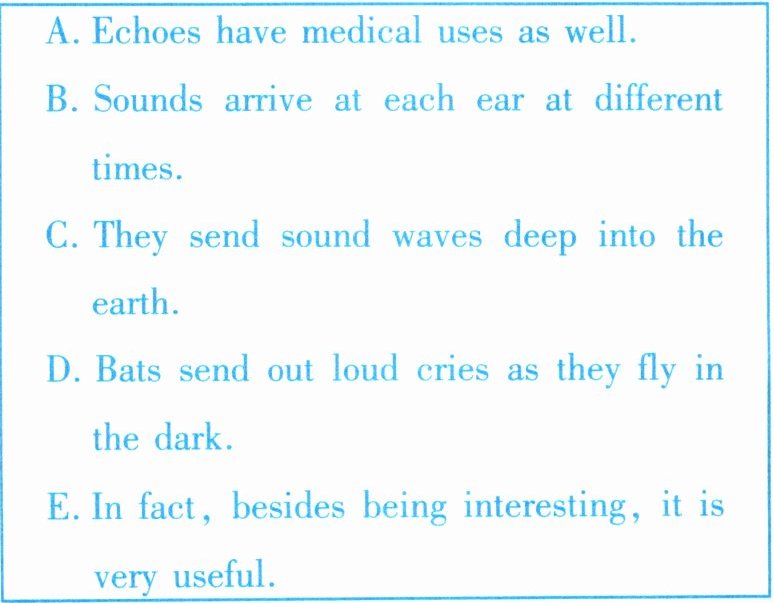
“Hello!”(Hello ... Hello ... )Have you
ever heard an echo(回声)? Do you find it interesting? 1.
E
Some animals use echoes to help themselves find their ways. Bats(蝙蝠), for example, use echoes to do what other animals do with their eyes. 2.
D
When the cries hit an object(物体), echoes appear. The bats listen to the echoes to find exactly where the object is.Humans can do something similar. Blind people may become sensitive(敏感的) to sounds. 3.
B
The blind can feel these differences, and then they use the information to locate(定位) walls and other objects.Scientists use echoes to explore our planet. 4.
C
Different objects send back different echoes. By studying the echoes, scientists can tell what lies below. This can help them find oil and coal.5.
A
The ultrasonic waves(超声波) can easily get into the human body. The waves are used to create pictures of bones and organs(器官). These pictures can help doctors find problems.答案
1. E
2. D
3. B
4. C
5. A
2. D
3. B
4. C
5. A
解析
【分析】本题为英语补全短文题,需结合空格前后句子的语义、逻辑关系匹配选项。解题思路:先通读全文明确每段主旨,再逐一分析空格上下文,寻找语义衔接、逻辑连贯的选项,确保内容通顺完整。
【解析】1. 第1空:前文询问是否觉得回声有趣,后文讲回声的实际应用,E选项“事实上,除了有趣,它非常有用”承上启下,符合语境,故选E。2. 第2空:前文提到蝙蝠用回声,后文说蝙蝠的叫声碰到物体产生回声,D选项“蝙蝠在黑暗中飞行时发出大声的叫声”衔接前后,说明回声产生的前提,故选D。3. 第3空:前文说盲人对声音敏感,后文提到盲人能感知声音差异,B选项“声音到达每只耳朵的时间不同”是声音差异的具体表现,符合语境,故选B。4. 第4空:前文说科学家用回声探索地球,后文讲不同物体返回不同回声,C选项“他们把声波发送到地球深处”衔接探索地球的内容,故选C。5. 第5空:后文讲超声波在人体的医疗应用,A选项“回声也有医疗用途”引出医疗相关内容,故选A。
【答案】1.E 2.D 3.B 4.C 5.A
【知识点】英语补全短文、上下文衔接、语义逻辑
【点评】本题考查学生对短文语境的理解能力和句子间逻辑关系的把握,需结合前后文内容匹配选项,难度适中。
【难度系数】0.5
【解析】1. 第1空:前文询问是否觉得回声有趣,后文讲回声的实际应用,E选项“事实上,除了有趣,它非常有用”承上启下,符合语境,故选E。2. 第2空:前文提到蝙蝠用回声,后文说蝙蝠的叫声碰到物体产生回声,D选项“蝙蝠在黑暗中飞行时发出大声的叫声”衔接前后,说明回声产生的前提,故选D。3. 第3空:前文说盲人对声音敏感,后文提到盲人能感知声音差异,B选项“声音到达每只耳朵的时间不同”是声音差异的具体表现,符合语境,故选B。4. 第4空:前文说科学家用回声探索地球,后文讲不同物体返回不同回声,C选项“他们把声波发送到地球深处”衔接探索地球的内容,故选C。5. 第5空:后文讲超声波在人体的医疗应用,A选项“回声也有医疗用途”引出医疗相关内容,故选A。
【答案】1.E 2.D 3.B 4.C 5.A
【知识点】英语补全短文、上下文衔接、语义逻辑
【点评】本题考查学生对短文语境的理解能力和句子间逻辑关系的把握,需结合前后文内容匹配选项,难度适中。
【难度系数】0.5
