

 登录
登录
(
A.at all
B.in all
C.first of all
D.above all
A
) 8. The student from the UK said he didn’t mind eating Wuxi food like xiaolongbao .A.at all
B.in all
C.first of all
D.above all
答案
8. A
解析
【分析】首先理解句子语境:来自英国的学生表示他一点也不介意吃无锡食物(比如小笼包)。接着辨析四个选项短语的含义,结合句子中的否定结构,选择符合语境的固定搭配。
【解析】句子意为“这位来自英国的学生说他一点也不介意吃像小笼包这样的无锡食物”。逐一分析选项:A.at all,与not构成固定搭配“not...at all”,表示“一点也不”,契合句子的否定语境;B.in all意为“总共”,不符合句意;C.first of all意为“首先”,不符合;D.above all意为“首要的是”,不符合。因此正确答案为A。
【答案】A
【知识点】固定短语辨析;介词短语
【点评】本题考查英语常用介词短语的固定搭配,属于基础词汇辨析题,需学生掌握高频短语的含义及用法,尤其是“not...at all”这一核心固定搭配。
【难度系数】0.5
【解析】句子意为“这位来自英国的学生说他一点也不介意吃像小笼包这样的无锡食物”。逐一分析选项:A.at all,与not构成固定搭配“not...at all”,表示“一点也不”,契合句子的否定语境;B.in all意为“总共”,不符合句意;C.first of all意为“首先”,不符合;D.above all意为“首要的是”,不符合。因此正确答案为A。
【答案】A
【知识点】固定短语辨析;介词短语
【点评】本题考查英语常用介词短语的固定搭配,属于基础词汇辨析题,需学生掌握高频短语的含义及用法,尤其是“not...at all”这一核心固定搭配。
【难度系数】0.5
(
A.exciting
B.excited
C.interesting
D.interested
B
) 9. We could hear shouts from the fans when our team won a goal in the final.A.exciting
B.excited
C.interesting
D.interested
答案
9. B
解析
【分析】要解决这道题,需先明确英语中-ing和-ed结尾形容词的用法差异:-ing类形容词表“令人……的”,修饰事物;-ed类形容词表“感到……的”,多修饰人或与人相关的事物。本题中修饰的是粉丝(人)发出的呼喊,是粉丝“感到兴奋的”呼喊,因此要选-ed结尾的形容词,再结合选项排除不符合的即可。
【解析】本题考查形容词辨析,核心是区分-ing与-ed结尾形容词的用法:
1. -ing形容词(如exciting、interesting):表示“令人……的”,用于修饰事物,描述事物的属性;
2. -ed形容词(如excited、interested):表示“感到……的”,用于修饰人或与人相关的事物,描述人的感受。
题目中修饰的是来自粉丝(fans,人)的shouts,体现粉丝“感到兴奋的”呼喊,故用excited。A选项exciting(令人兴奋的,修饰事物)不符合;C选项interesting(有趣的,修饰事物)、D选项interested(感兴趣的,虽修饰人,但语境不符)均排除,因此选B。
【答案】B
【知识点】形容词辨析(-ing/-ed形容词)
【点评】本题为基础形容词辨析题,重点考查-ing与-ed结尾形容词的核心用法区别,结合语境即可快速判断,属于学生应掌握的基础知识点。
【难度系数】0.7
【解析】本题考查形容词辨析,核心是区分-ing与-ed结尾形容词的用法:
1. -ing形容词(如exciting、interesting):表示“令人……的”,用于修饰事物,描述事物的属性;
2. -ed形容词(如excited、interested):表示“感到……的”,用于修饰人或与人相关的事物,描述人的感受。
题目中修饰的是来自粉丝(fans,人)的shouts,体现粉丝“感到兴奋的”呼喊,故用excited。A选项exciting(令人兴奋的,修饰事物)不符合;C选项interesting(有趣的,修饰事物)、D选项interested(感兴趣的,虽修饰人,但语境不符)均排除,因此选B。
【答案】B
【知识点】形容词辨析(-ing/-ed形容词)
【点评】本题为基础形容词辨析题,重点考查-ing与-ed结尾形容词的核心用法区别,结合语境即可快速判断,属于学生应掌握的基础知识点。
【难度系数】0.7
(
— We must be careful with fire.
A.That’s terrible!
B.Keep calm.
C.I hope not.
D.Don’t worry about it.
A
) 10. — There was a mountain fire in Yuxi on March 17, 2024.— We must be careful with fire.
A.That’s terrible!
B.Keep calm.
C.I hope not.
D.Don’t worry about it.
答案
10. A
解析
【分析】本题为英语情景交际题,解题思路是先理解对话语境:一方告知“2024年3月17日玉溪发生山火”这一坏消息,另一方需选择符合对灾害消息反应的应答语,再逐一分析选项排除错误答案,确定正确选项。
【解析】对话中一方陈述了发生山火的坏消息,另一方的回应需符合对该事件的合理反应:A选项“That’s terrible!”意为“太可怕了!”,是听到灾害消息时的正常反应,符合语境;B选项“Keep calm.”意为“保持冷静”,不符合听到坏消息后的即时情绪反应;C选项“I hope not.”意为“希望不会”,与已发生的事实矛盾;D选项“Don’t worry about it.”意为“别担心”,不符合语境。因此正确答案为A。
【答案】A
【知识点】情景交际、日常对话
【点评】本题考查日常情景交际的应答,需结合语境选择合适的表达,属于基础题型,难度较低。
【难度系数】0.8
【解析】对话中一方陈述了发生山火的坏消息,另一方的回应需符合对该事件的合理反应:A选项“That’s terrible!”意为“太可怕了!”,是听到灾害消息时的正常反应,符合语境;B选项“Keep calm.”意为“保持冷静”,不符合听到坏消息后的即时情绪反应;C选项“I hope not.”意为“希望不会”,与已发生的事实矛盾;D选项“Don’t worry about it.”意为“别担心”,不符合语境。因此正确答案为A。
【答案】A
【知识点】情景交际、日常对话
【点评】本题考查日常情景交际的应答,需结合语境选择合适的表达,属于基础题型,难度较低。
【难度系数】0.8
四、同义句改写
1. When the earthquake shook the room, Lily told herself to stay calm.
When the earthquake shook the room, Lily
2. The earthquake trapped thousands of people and completely damaged their houses.
The earthquake made thousands of people
3. The fog was too thick for me to see anything.
The fog was
1. When the earthquake shook the room, Lily told herself to stay calm.
When the earthquake shook the room, Lily
said
to
herself
to calm
down
.2. The earthquake trapped thousands of people and completely damaged their houses.
The earthquake made thousands of people
trapped
and homeless
.3. The fog was too thick for me to see anything.
The fog was
so
thick that
I couldn’t see anything at
all
.答案
1. said to herself; calm down 2. trapped; homeless 3. so; that; at all
解析
【分析】
1. 第一题需替换原句中Lily后的动作短语及目的短语,回忆“告诉自己做某事”的同义表达为say to oneself to do sth,“保持冷静”的同义短语为calm down,据此填空;
2. 第二题原句意为地震困住人并毁坏房屋,转换为make sb + 形容词的结构,毁坏房屋对应让人们无家可归,保留原动词trapped;
3. 第三题原句too...to...结构的同义表达为so...that...引导的结果状语从句,且“根本不”对应not...at all,据此填空。
【解析】
1. 第一小题:原句“told herself to stay calm”可同义转换为“said to herself to calm down”,其中“tell oneself to do sth”与“say to oneself to do sth”同义,“stay calm”等同于“calm down”,故填空为said to herself; calm down;
2. 第二小题:原句“trapped thousands of people and completely damaged their houses”转换为“made thousands of people trapped and homeless”,“damaged their houses”使人们无家可归,用形容词homeless作宾补,保留原动词trapped,故填空为trapped; homeless;
3. 第三小题:原句“too thick for me to see anything”的同义结构为“so + adj + that + 从句”,“根本不”对应not...at all,故转换为“so thick that I couldn’t see anything at all”,填空为so; that; at all。
【答案】
1. said to herself; calm down 2. trapped; homeless 3. so; that; at all
【知识点】
同义句转换、固定短语搭配、结果状语从句
【点评】
本题考查英语基础同义句转换,涉及常用短语和固定句式的替换,属于初中英语基础题型,需掌握相关同义表达即可完成。
【难度系数】
0.5
1. 第一题需替换原句中Lily后的动作短语及目的短语,回忆“告诉自己做某事”的同义表达为say to oneself to do sth,“保持冷静”的同义短语为calm down,据此填空;
2. 第二题原句意为地震困住人并毁坏房屋,转换为make sb + 形容词的结构,毁坏房屋对应让人们无家可归,保留原动词trapped;
3. 第三题原句too...to...结构的同义表达为so...that...引导的结果状语从句,且“根本不”对应not...at all,据此填空。
【解析】
1. 第一小题:原句“told herself to stay calm”可同义转换为“said to herself to calm down”,其中“tell oneself to do sth”与“say to oneself to do sth”同义,“stay calm”等同于“calm down”,故填空为said to herself; calm down;
2. 第二小题:原句“trapped thousands of people and completely damaged their houses”转换为“made thousands of people trapped and homeless”,“damaged their houses”使人们无家可归,用形容词homeless作宾补,保留原动词trapped,故填空为trapped; homeless;
3. 第三小题:原句“too thick for me to see anything”的同义结构为“so + adj + that + 从句”,“根本不”对应not...at all,故转换为“so thick that I couldn’t see anything at all”,填空为so; that; at all。
【答案】
1. said to herself; calm down 2. trapped; homeless 3. so; that; at all
【知识点】
同义句转换、固定短语搭配、结果状语从句
【点评】
本题考查英语基础同义句转换,涉及常用短语和固定句式的替换,属于初中英语基础题型,需掌握相关同义表达即可完成。
【难度系数】
0.5
五、信息还原 阅读下面短文,然后从短文后所给的选项中选出可以填入空白处的最佳选项(选项中有两项为多余选项)。
Lightning is amazing, and it happens all over the world! Scientists think that there are more than three million lightning strikes (雷击) every day in the world — that’s thirty strikes every second.
So, why does lightning strike? Lightning strikes happen when ice and water in clouds rub (摩擦) together, and cause atmospheric (大气层的) changes.
Lightning is certainly not something to toy with. When lightning strikes, it’s best to stay inside a large building.
A. To stay safe, do not stand under trees, on hills or near water.
B. Lightning can also be very dangerous.
C. It’s the last type of strike that is the most dangerous for humans.
D. When this happens, it creates a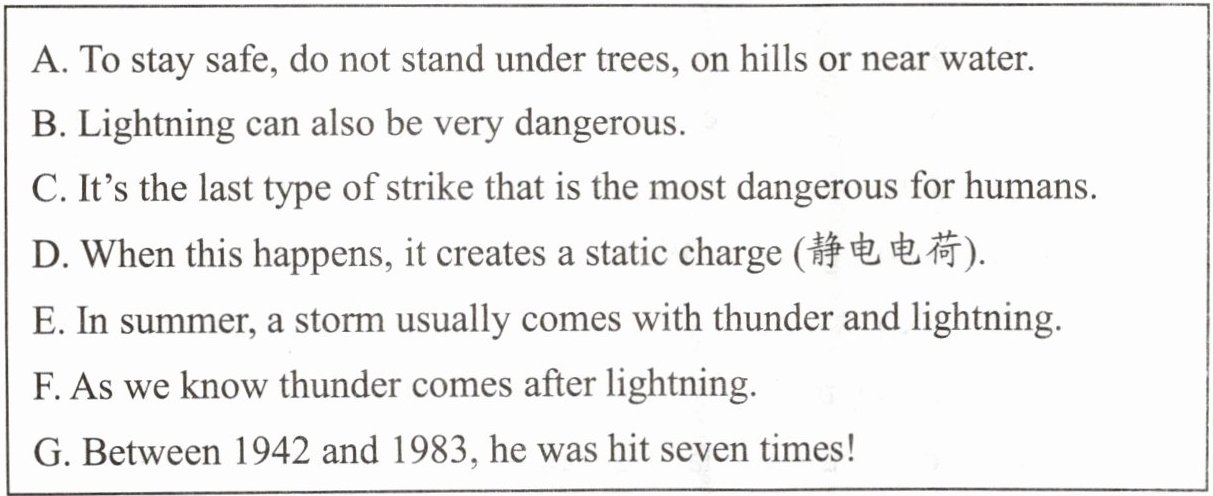 atic charge (静电电荷).
E. In summer, a storm usually comes with thunder and lightning.
F. As we know thunder comes after lightning.
G. Between 1942 and 1983, he was hit seven times!
1.
2.
3.
4.
5.
Lightning is amazing, and it happens all over the world! Scientists think that there are more than three million lightning strikes (雷击) every day in the world — that’s thirty strikes every second.
B
Every year, lightning kills people because it can start big fires or because it reaches temperatures up to 28,000 degrees centigrade. American Roy Sullivan, who worked in a park, holds the record for surviving the most lightning strikes. G
So, why does lightning strike? Lightning strikes happen when ice and water in clouds rub (摩擦) together, and cause atmospheric (大气层的) changes.
D
Lightning can strike inside the cloud, between two clouds and between a cloud and Earth. C
About 1,000 people get struck by lightning every year in the United States, and about 100 of them die as a result.Lightning is certainly not something to toy with. When lightning strikes, it’s best to stay inside a large building.
A
Trees attract lightning. Also, do not lie down on the ground, otherwise the electricity may go through you and cause a heart disease.A. To stay safe, do not stand under trees, on hills or near water.
B. Lightning can also be very dangerous.
C. It’s the last type of strike that is the most dangerous for humans.
D. When this happens, it creates a
atic charge (静电电荷).E. In summer, a storm usually comes with thunder and lightning.
F. As we know thunder comes after lightning.
G. Between 1942 and 1983, he was hit seven times!
1.
B
2.
G
3.
D
4.
C
5.
A
答案
1—5: BGDCA
解析
【分析】
做信息还原题时,需结合上下文的逻辑关系、话题连贯性来选择合适选项。
1. 第一空:前文介绍闪电的数量,后文提到闪电每年致人死亡,需引出闪电的危险性,对应选项B。
2. 第二空:前文提到Roy Sullivan是被闪电击中次数最多且存活的人,需补充他被击中的具体次数,对应选项G。
3. 第三空:前文解释闪电发生的原因(云里的冰和水摩擦),需说明该过程产生的结果,对应选项D。
4. 第四空:前文介绍闪电的类型,后文提到每年被闪电击中的人数,需说明哪种类型对人类最危险,对应选项C。
5. 第五空:前文提到闪电时要待在安全的地方,后文说树吸引闪电,需给出具体的安全注意事项,对应选项A。
【解析】
1. 第一空:前文讲闪电的频率,后文讲闪电致人死亡,B选项“闪电也非常危险”承上启下,符合逻辑,故选B。
2. 第二空:前文提到Roy Sullivan的记录,G选项“1942到1983年间,他被击中七次”补充具体数据,符合语境,故选G。
3. 第三空:前文解释闪电发生的原因(冰和水摩擦),D选项“当这种情况发生时,会产生静电电荷”是该过程的结果,符合逻辑,故选D。
4. 第四空:前文介绍闪电的类型,C选项“最后一种雷击对人类最危险”承接上文类型的内容,符合语境,故选C。
5. 第五空:前文讲闪电时的安全措施,A选项“为了安全,不要站在树下、山上或靠近水的地方”是具体的安全建议,符合逻辑,故选A。
【答案】
BGDCA
【知识点】
英语信息还原、语篇逻辑衔接
【点评】
本题考查英语语篇的逻辑连贯性,需结合上下文话题、指代关系等选择选项,难度适中,侧重考查学生的语篇理解能力。
【难度系数】
0.5
做信息还原题时,需结合上下文的逻辑关系、话题连贯性来选择合适选项。
1. 第一空:前文介绍闪电的数量,后文提到闪电每年致人死亡,需引出闪电的危险性,对应选项B。
2. 第二空:前文提到Roy Sullivan是被闪电击中次数最多且存活的人,需补充他被击中的具体次数,对应选项G。
3. 第三空:前文解释闪电发生的原因(云里的冰和水摩擦),需说明该过程产生的结果,对应选项D。
4. 第四空:前文介绍闪电的类型,后文提到每年被闪电击中的人数,需说明哪种类型对人类最危险,对应选项C。
5. 第五空:前文提到闪电时要待在安全的地方,后文说树吸引闪电,需给出具体的安全注意事项,对应选项A。
【解析】
1. 第一空:前文讲闪电的频率,后文讲闪电致人死亡,B选项“闪电也非常危险”承上启下,符合逻辑,故选B。
2. 第二空:前文提到Roy Sullivan的记录,G选项“1942到1983年间,他被击中七次”补充具体数据,符合语境,故选G。
3. 第三空:前文解释闪电发生的原因(冰和水摩擦),D选项“当这种情况发生时,会产生静电电荷”是该过程的结果,符合逻辑,故选D。
4. 第四空:前文介绍闪电的类型,C选项“最后一种雷击对人类最危险”承接上文类型的内容,符合语境,故选C。
5. 第五空:前文讲闪电时的安全措施,A选项“为了安全,不要站在树下、山上或靠近水的地方”是具体的安全建议,符合逻辑,故选A。
【答案】
BGDCA
【知识点】
英语信息还原、语篇逻辑衔接
【点评】
本题考查英语语篇的逻辑连贯性,需结合上下文话题、指代关系等选择选项,难度适中,侧重考查学生的语篇理解能力。
【难度系数】
0.5
