

 登录
登录
能力提升
三、根据汉语提示完成句子
1.在中国,朋友见面时握手是很正常的。
In China,it's normal to when friends meet.
2.在英国人们见面时亲吻脸颊吗?
Do people on the when they meet in the UK?
3.这对夫妻笑着彼此蹭鼻子。
The couple laughed and
against each other.
4.当他们久别重逢时,他们高兴地碰拳
问候。
When they met after a long time,they happily 1 n
greet i.ng.
5.在传统舞蹈中,舞者们双手合十,以示
尊重。
In traditional dance,dancers together to
show respect.
三、根据汉语提示完成句子
1.在中国,朋友见面时握手是很正常的。
In China,it's normal to when friends meet.
2.在英国人们见面时亲吻脸颊吗?
Do people on the when they meet in the UK?
3.这对夫妻笑着彼此蹭鼻子。
The couple laughed and
against each other.
4.当他们久别重逢时,他们高兴地碰拳
问候。
When they met after a long time,they happily 1 n
greet i.ng.
5.在传统舞蹈中,舞者们双手合十,以示
尊重。
In traditional dance,dancers together to
show respect.
答案
1. shake hands 2. kiss; cheek 3. rubbed noses 4. bumped fists 5. pressed their palms
解析
【分析】本题是根据汉语提示补全英语句子,考查日常交际类的固定短语及动词时态的正确运用。解题时,先明确每个句子的汉语含义,联想对应的英语常用表达;再结合句子的时态(如句中出现的过去式动词laughed、met等,确定需用动词的过去式),最后填入正确的短语,注意短语的搭配和形式变化。
【解析】1. “握手”对应的固定短语是shake hands,符合it's normal to do sth的结构,故填shake hands;2. “亲吻脸颊”的固定表达是kiss on the cheek,结合句子结构,此处填kiss; cheek;3. “蹭鼻子”对应短语rub noses,前面laughed是过去式,故用rub的过去式rubbed,填rubbed noses;4. “碰拳”对应短语bump fists,前面met是过去式,故用bump的过去式bumped,填bumped fists;5. “双手合十”对应短语press one's palms,主语是dancers,故用their,填pressed their palms。
【答案】1. shake hands 2. kiss; cheek 3. rubbed noses 4. bumped fists 5. pressed their palms
【知识点】固定短语搭配;日常交际用语;动词过去式
【点评】本题聚焦英语日常交际的基础短语,既考查短语积累,又涉及动词时态的运用,是巩固日常表达的基础题型。
【难度系数】0.5
【解析】1. “握手”对应的固定短语是shake hands,符合it's normal to do sth的结构,故填shake hands;2. “亲吻脸颊”的固定表达是kiss on the cheek,结合句子结构,此处填kiss; cheek;3. “蹭鼻子”对应短语rub noses,前面laughed是过去式,故用rub的过去式rubbed,填rubbed noses;4. “碰拳”对应短语bump fists,前面met是过去式,故用bump的过去式bumped,填bumped fists;5. “双手合十”对应短语press one's palms,主语是dancers,故用their,填pressed their palms。
【答案】1. shake hands 2. kiss; cheek 3. rubbed noses 4. bumped fists 5. pressed their palms
【知识点】固定短语搭配;日常交际用语;动词过去式
【点评】本题聚焦英语日常交际的基础短语,既考查短语积累,又涉及动词时态的运用,是巩固日常表达的基础题型。
【难度系数】0.5
思维拓展
四、补全对话
A:Hello,Steve ! You must have had an
unusual experience living in France.
B:1.
A:Nervous about what?
B:Well,for one thing,I didn't know what
I should do at the dinner table.
A:2.
B:For example,you shouldn't put your
knife and fork on the table.
A:Where should I put it?
B:You should put it on your plate !
A:3.
B:Now I am used to it.
A:4.
B:You shouldn't put your hands on your
lap.
A:Oh?Where should people put their hands?
B:5.
A:I have to say it's very surprising.
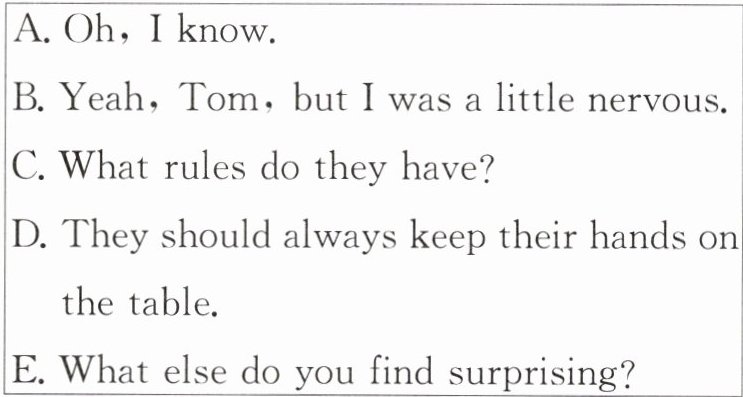
A.Oh,I know.
B.Yeah,Tom,but I was a little nervous.
C.What rules do they have?
D.They should always keep their hands on
the table.
E.What else do you find surprising?
四、补全对话
A:Hello,Steve ! You must have had an
unusual experience living in France.
B:1.
B
A:Nervous about what?
B:Well,for one thing,I didn't know what
I should do at the dinner table.
A:2.
C
B:For example,you shouldn't put your
knife and fork on the table.
A:Where should I put it?
B:You should put it on your plate !
A:3.
A
B:Now I am used to it.
A:4.
E
B:You shouldn't put your hands on your
lap.
A:Oh?Where should people put their hands?
B:5.
D
A:I have to say it's very surprising.
A.Oh,I know.
B.Yeah,Tom,but I was a little nervous.
C.What rules do they have?
D.They should always keep their hands on
the table.
E.What else do you find surprising?
答案
1. B 2. C 3. A 4. E 5. D
解析
【分析】
补全对话需结合上下文语境梳理逻辑:第1空后A询问“Nervous about what?”,说明B的回答要提及“紧张”相关内容;第2空后B举例说明餐桌规则,说明A此处是询问规则;第3空后B说习惯了,A需表达理解;第4空后B回答另一个规则,说明A要询问其他惊讶点;第5空需回答手的放置位置,结合选项匹配即可。
【解析】
1. 第1空:根据A的问题“Nervous about what?”,B的回答需包含“nervous”,选项B“ Yeah, Tom, but I was a little nervous.”符合语境,故选B。
2. 第2空:B接下来举例说明餐桌规则,说明A此处询问餐桌有什么规则,选项C“What rules do they have?”符合,故选C。
3. 第3空:A了解规则后,结合B说“Now I am used to it.”,A需表达理解,选项A“Oh, I know.”符合,故选A。
4. 第4空:B回答另一个规则,说明A询问还有什么惊讶的地方,选项E“What else do you find surprising?”符合,故选E。
5. 第5空:A问手应放哪里,B回答手的放置位置,选项D“They should always keep their hands on the table.”符合,故选D。
【答案】
1.B 2.C 3.A 4.E 5.D
【知识点】
补全对话;日常交际用语
【点评】
本题考查英语日常对话的逻辑衔接,需结合上下文语境选择合适语句,难度适中,适合初中学生巩固日常交际用语。
【难度系数】
0.7
补全对话需结合上下文语境梳理逻辑:第1空后A询问“Nervous about what?”,说明B的回答要提及“紧张”相关内容;第2空后B举例说明餐桌规则,说明A此处是询问规则;第3空后B说习惯了,A需表达理解;第4空后B回答另一个规则,说明A要询问其他惊讶点;第5空需回答手的放置位置,结合选项匹配即可。
【解析】
1. 第1空:根据A的问题“Nervous about what?”,B的回答需包含“nervous”,选项B“ Yeah, Tom, but I was a little nervous.”符合语境,故选B。
2. 第2空:B接下来举例说明餐桌规则,说明A此处询问餐桌有什么规则,选项C“What rules do they have?”符合,故选C。
3. 第3空:A了解规则后,结合B说“Now I am used to it.”,A需表达理解,选项A“Oh, I know.”符合,故选A。
4. 第4空:B回答另一个规则,说明A询问还有什么惊讶的地方,选项E“What else do you find surprising?”符合,故选E。
5. 第5空:A问手应放哪里,B回答手的放置位置,选项D“They should always keep their hands on the table.”符合,故选D。
【答案】
1.B 2.C 3.A 4.E 5.D
【知识点】
补全对话;日常交际用语
【点评】
本题考查英语日常对话的逻辑衔接,需结合上下文语境选择合适语句,难度适中,适合初中学生巩固日常交际用语。
【难度系数】
0.7
