

 登录
登录
听一段对话,回答第11-12小题。答题完毕,请等待“嘀”的信号,进入第一篇短文。
11. What does the woman like most about Mark Twain's works?
A. Wise thoughts.
B. Humorous words.
C. Interesting characters.
12. 信息推断 Where does the conversation probably take place?
A. At home.
B. At school.
C. In a public library.
11. What does the woman like most about Mark Twain's works?
A. Wise thoughts.
B. Humorous words.
C. Interesting characters.
12. 信息推断 Where does the conversation probably take place?
A. At home.
B. At school.
C. In a public library.
答案
11.A 12.B
听第一篇短文,回答第13-15小题。请根据短文内容,选择正确答案,完成信息记录表。答题完毕,请等待“嘀”的信号,进入下一篇短文。
Beyond the written world
Lu Xun He was not only a great writer but also a talented designer and
Charles Dickens Walking offered endless good ideas and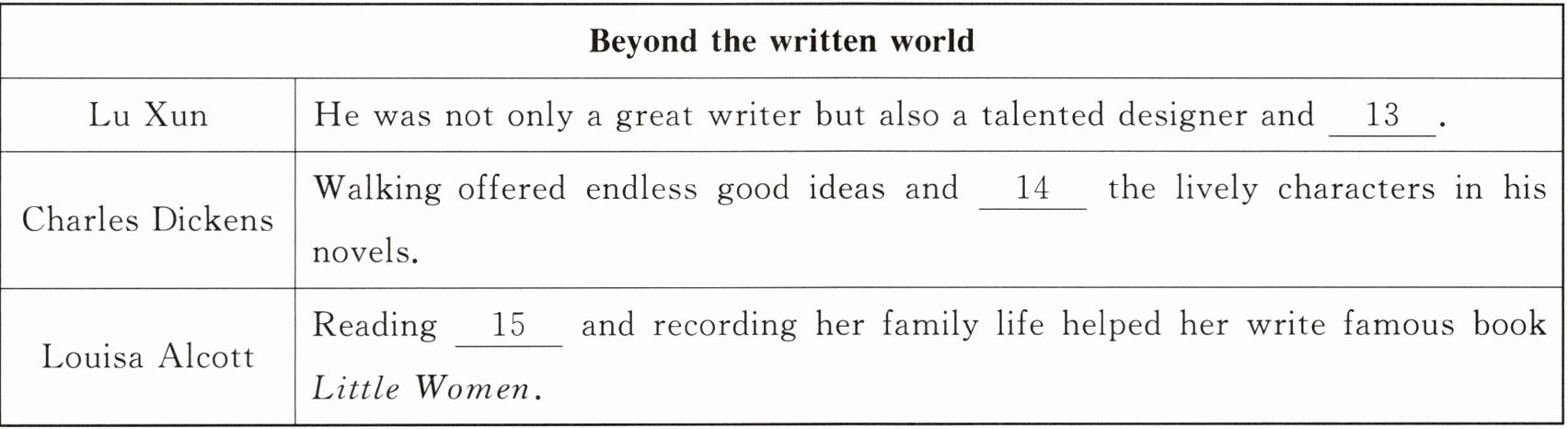 the lively characters in his novels.
Louisa Alcott Reading
13. A. painter B. teacher C. engineer
14. A. shaped B. organized C. introduced
15. A. wildly B. wisely C. widely
Beyond the written world
Lu Xun He was not only a great writer but also a talented designer and
A
.Charles Dickens Walking offered endless good ideas and
A
the lively characters in his novels.Louisa Alcott Reading
C
and recording her family life helped her write famous book Little Women.13. A. painter B. teacher C. engineer
14. A. shaped B. organized C. introduced
15. A. wildly B. wisely C. widely
答案
13.A 14.A 15.C
新素养·学习能力 听第二篇短文,回答第16-20小题。
16. What can we learn about students who never use dictionaries?
A. They read faster than others.
B. They often have poor writing skills.
C. They are good at speaking and writing.
17. Why do students who use small two-language dictionaries have the worst problems?
A. Because the dictionaries have too few word translations.
B. Because they have to look up every new word while reading.
C. Because one English word may have several different meanings.
18. When in the reading does the speaker advise students to use a good dictionary?
A. After the first reading.
B. During the first reading.
C. At the end of the reading.
19. 信息归纳 What does the speaker mainly talk about?
A. What dictionary students should choose and how to use it.
B. Why students should use large college edition dictionaries.
C. Why students shouldn't use small two-language dictionaries.
20. 信息推断 The speaker thinks that
A. students should use dictionaries properly
B. dictionaries are not necessary for students
C. choosing a good dictionary leads to success
16. What can we learn about students who never use dictionaries?
A. They read faster than others.
B. They often have poor writing skills.
C. They are good at speaking and writing.
17. Why do students who use small two-language dictionaries have the worst problems?
A. Because the dictionaries have too few word translations.
B. Because they have to look up every new word while reading.
C. Because one English word may have several different meanings.
18. When in the reading does the speaker advise students to use a good dictionary?
A. After the first reading.
B. During the first reading.
C. At the end of the reading.
19. 信息归纳 What does the speaker mainly talk about?
A. What dictionary students should choose and how to use it.
B. Why students should use large college edition dictionaries.
C. Why students shouldn't use small two-language dictionaries.
20. 信息推断 The speaker thinks that
A
.A. students should use dictionaries properly
B. dictionaries are not necessary for students
C. choosing a good dictionary leads to success
答案
16.B 17.C 18.A 19.A 20.A
