

 登录
Ⅰ. 前人事例 首先,Simon想要先了解一些志愿服务的示例。他了解到肯尼亚有一所为有阅读障碍的学生提供特殊教育的学校 Rare Gem Talent School,让我们一起来看一看吧!
There is a school in Kenya where teachers do things a little differently from other places. Rare Gem Talent School is a space where students with dyslexia(阅读障碍症) learn through sights, sounds and touch. Teachers there 1. a
One common problem for children with dyslexia is that they often have a hard time reading. Luckily, students here can make clear 3. p
So how does it work? Students take part in activities, such as linking letter sounds to colours, learning spelling patterns through songs and 5. u
Rare Gem was set up in 2012. When it first opened, there were fewer than 10 students. Today, the school has around 210. Phyllis Munyi, who 8. f
But getting them into education early is not easy. Geoffrey Karani, himself a former student at Rare Gem, is an art teacher at the school today. “I’m not only teaching; I’m showing kids that I’ve been on the same journey,” he said.
There is a school in Kenya where teachers do things a little differently from other places. Rare Gem Talent School is a space where students with dyslexia(阅读障碍症) learn through sights, sounds and touch. Teachers there 1. a
aim
to help every student learn in their own way, and students are encouraged to express themselves 2. oopenly
and respectfully.One common problem for children with dyslexia is that they often have a hard time reading. Luckily, students here can make clear 3. p
progress
in pronunciation with special teaching methods. They might, for example, mix up letters like “b” and “p”, or even numbers like “9”. Rare Gem is one of the few schools in Kenya where such children can get the help they need. One student told AP News that at his old school, his teacher didn’t understand him. “This school is much better. The support here has 4. ggreatly
changed my life.”So how does it work? Students take part in activities, such as linking letter sounds to colours, learning spelling patterns through songs and 5. u
using
objects to stand for words. Dorothy Kioko said that as a teacher, she cannot just stand in front of students and give lessons. “You teach step by step 6. uuntil
the learner gets what you’re teaching,” she said. Teachers here are 7. rrequired
to be patient and creative to meet the students’ needs.Rare Gem was set up in 2012. When it first opened, there were fewer than 10 students. Today, the school has around 210. Phyllis Munyi, who 8. f
founded
the school, said that if these challenges are identified(发现) early, students can “improve their skills and learn to identify their talents”. Many people offer 9. vvoluntary
help here, and some students even join the school’s service projects for the 10. bbenefit
of new learners.But getting them into education early is not easy. Geoffrey Karani, himself a former student at Rare Gem, is an art teacher at the school today. “I’m not only teaching; I’m showing kids that I’ve been on the same journey,” he said.
答案
【语篇解读】本文是一篇新闻报道,主要介绍了肯尼亚 Rare Gem Talent School 如何通过多感官教学帮助有阅读障碍的学生学习、建立信心并发现自身才能。
1. aim 解析:Teachers 为复数主语,谓语用动词原形。aim to do sth 意为"旨在做某事",表示教师力求帮助每个学生以适合自己的方式学习。故填 aim。
2. openly 解析:空处修饰动词 express,应用副词。express oneself openly and respectfully 意为"坦诚且尊重地表达自己"。故填 openly。
3. progress 解析:make progress in ... 意为"在……方面取得进步",progress 为不可数名词;学生可在发音方面取得明显进步。故填 progress。
4. greatly 解析:空处修饰动词 changed,应用副词。greatly 意为"极大地",表示学校的支持极大改变了该学生的生活。故填 greatly。
5. using 解析:such as 后列举并列活动,前面已有 linking、learning,故此处也用动名词 using;use objects to stand for words 意为"用实物代表单词"。故填 using。
6. until 解析:step by step until ... 意为"循序渐进,直到……为止"。教师要一步一步教,直到学生理解所教的内容。故填 until。
7. required 解析:be required to do sth 意为"被要求做某事"。教师需要有耐心和创造力来满足学生需求。故填 required。
8. founded 解析:Phyllis Munyi 创办了学校;全文叙述过去事实,应用过去式 founded。故填 founded。
9. voluntary 解析:voluntary 作形容词修饰 help,voluntary help 意为"志愿帮助;自愿提供的帮助"。故填 voluntary。
10. benefit 解析:for the benefit of 意为"为了……的利益;为……着想",为固定搭配。学生参与服务项目是为了新学习者的利益。故填 benefit。
Ⅱ. 丰富意义 Simon 的老师告诉他,作为青少年,参与志愿活动能够给他带来丰富的意义,让我们来学习一下志愿活动能够给青少年带来哪些意义吧。
Volunteering is a good way for teenagers to make a difference in their community. It does not always mean doing something big. You can help younger students, clean up a park, read to children, or take care of animals at a shelter.
Volunteering is good for others, but it is also good for you. When you spend time helping people or solving a community problem, you may begin to understand the world around you better. You can also build useful skills, such as working with others, speaking clearly, planning time and solving problems. These experiences may help you become more confident. They can even help you find what you are interested in for the future.
Before you volunteer, think carefully about three things. First, be honest about your time and energy. If you are busy with schoolwork, choose something you can do once in a while or online. Second, keep yourself safe. Learn about the place before you go, and you can volunteer with friends or an adult at first. Third, choose the right activity. A good volunteer job should match both your interests and your abilities. For example, if you enjoy drawing, you may help design posters for a school event.
How can you get started? Make a list of your interests and strengths first. Then look for chances in your school, library, community centre or online. Thirdly, you can also ask teachers, parents or neighbours for ideas. After that, contact the group politely. Tell them what you can do and how much time you can give.
Volunteering is not just about giving help. It is also a way to learn, grow and become part of something bigger.
新考法 思维导图 Simon 整理了一下志愿活动的意义,我们来补充完整吧!(每空不超过三个词)
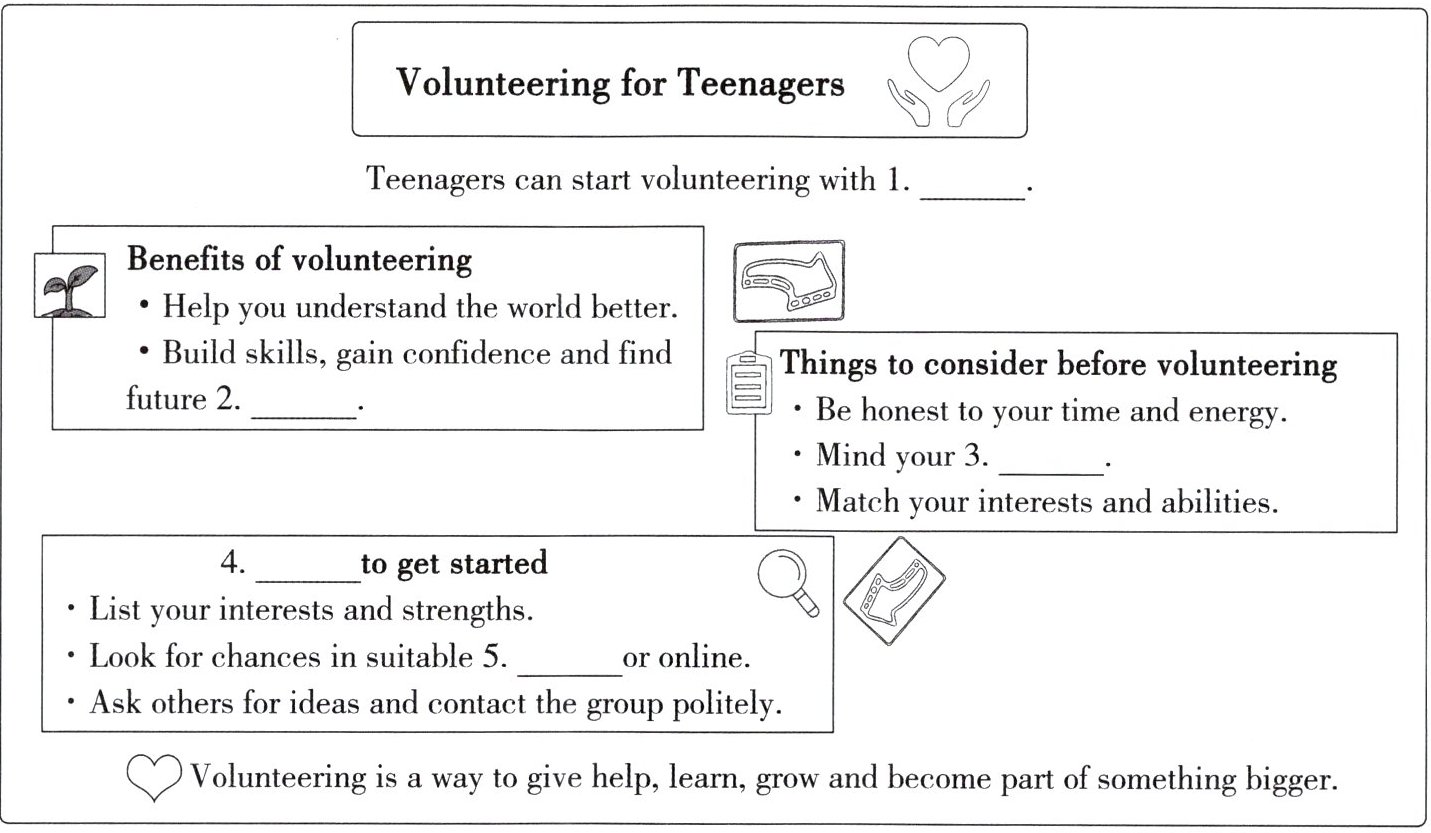
Question: What can you learn from volunteering?
Volunteering is a good way for teenagers to make a difference in their community. It does not always mean doing something big. You can help younger students, clean up a park, read to children, or take care of animals at a shelter.
Volunteering is good for others, but it is also good for you. When you spend time helping people or solving a community problem, you may begin to understand the world around you better. You can also build useful skills, such as working with others, speaking clearly, planning time and solving problems. These experiences may help you become more confident. They can even help you find what you are interested in for the future.
Before you volunteer, think carefully about three things. First, be honest about your time and energy. If you are busy with schoolwork, choose something you can do once in a while or online. Second, keep yourself safe. Learn about the place before you go, and you can volunteer with friends or an adult at first. Third, choose the right activity. A good volunteer job should match both your interests and your abilities. For example, if you enjoy drawing, you may help design posters for a school event.
How can you get started? Make a list of your interests and strengths first. Then look for chances in your school, library, community centre or online. Thirdly, you can also ask teachers, parents or neighbours for ideas. After that, contact the group politely. Tell them what you can do and how much time you can give.
Volunteering is not just about giving help. It is also a way to learn, grow and become part of something bigger.
新考法 思维导图 Simon 整理了一下志愿活动的意义,我们来补充完整吧!(每空不超过三个词)
Question: What can you learn from volunteering?
答案
【语篇解读】本文是一篇说明文。文章主要介绍了青少年做志愿者的好处、做志愿者前需要考虑的事情以及如何开始做志愿者。
1. small things/something small 解析:根据文章第一段"It does not always mean doing something big."可推知结论:青少年做志愿者不一定要做大事,可以从小事做起。故填 small things/something small。
2. interests 解析:根据文章第二段"They can even help you find what you are interested in for the future."可推知结论:志愿服务可以帮助你找到未来的兴趣所在,"what you are interested in"可转化为名词 interests。故填 interests。
3. safety 解析:根据文章第三段"Second, keep yourself safe."可推知结论:做志愿者前要注意自己的安全,"keep yourself safe"相当于"mind your safety"。故填 safety。
4. How 解析:根据文章第四段"How can you get started?"可推知结论:图表该部分主要介绍如何开始做志愿者,用 How 引导。故填 How。
5. places 解析:根据文章第四段"Then look for chances in your school, library, community centre or online."可推知结论:学校、图书馆、社区中心等都属于合适的地点(places)。故填 places。
Question:I can learn to help others, work with a team, and be more responsible.
