

 登录
[开头句]
1. John is a poor boy from Nepal. (描述困境)
2. UNICEF is part of the United Nations.
(介绍国际慈善机构)
[中间句]
1. Diana is working for ORBIS now.
(描述主人公现在的变化)
2. UNICEF provides children in poor areas with clean water and food. (慈善机构提供的帮助)
[结尾句]
1. She is glad to be able to help people see again.
(现在的变化)
2. I hope I can volunteer for this charity one day.
(表达愿望)
[名言警句]
1. Charity sees the need, not the cause.
慈善关注需要,而非缘由。
2. We make a living by what we get, but we make a life by what we give.
我们靠所得谋生,但靠给予创造人生。
写作演练>>
你是一名来自山区的残疾学生。在UNICEF(联合国儿童基金会)的帮助下,你获得
[名师点评]
本文围绕“慈善组织改变男孩人生”这一核心,清晰呈现了慈善活动的关键信息,是一篇结构完整、表达流畅的佳作。
1 开篇自然引入主人公的困境,逐步推进慈善组织的介入与男孩人生的转变,逻辑连贯;
2 文中灵活运用 used to do 结构还原Tim 过去的生活,精准体现时态差异;
3 one afternoon、so、three months later、now、some day 等词汇清晰划分“过去困境——慈善介入——如今改变——未来愿景”的层次,使行文逻辑严密;
4 文中使用了 found 引导的宾语从句,体现了对复合句的灵活运用,是加分亮点。
的机会。请你为一次电视访谈写一篇 90的发言稿,谈谈你以前和现在生活的不说说你的感想。
拨]
人称:以第一人称为主;② 时态:一般过一般现在时;③ 在写作过程中要注意逻达要清晰,同时要表达出感激之情。
纲]
花]
(更多精彩作文素材见“强基手册”)
1. John is a poor boy from Nepal. (描述困境)
2. UNICEF is part of the United Nations.
(介绍国际慈善机构)
[中间句]
1. Diana is working for ORBIS now.
(描述主人公现在的变化)
2. UNICEF provides children in poor areas with clean water and food. (慈善机构提供的帮助)
[结尾句]
1. She is glad to be able to help people see again.
(现在的变化)
2. I hope I can volunteer for this charity one day.
(表达愿望)
[名言警句]
1. Charity sees the need, not the cause.
慈善关注需要,而非缘由。
2. We make a living by what we get, but we make a life by what we give.
我们靠所得谋生,但靠给予创造人生。
写作演练>>
你是一名来自山区的残疾学生。在UNICEF(联合国儿童基金会)的帮助下,你获得
[名师点评]
本文围绕“慈善组织改变男孩人生”这一核心,清晰呈现了慈善活动的关键信息,是一篇结构完整、表达流畅的佳作。
1 开篇自然引入主人公的困境,逐步推进慈善组织的介入与男孩人生的转变,逻辑连贯;
2 文中灵活运用 used to do 结构还原Tim 过去的生活,精准体现时态差异;
3 one afternoon、so、three months later、now、some day 等词汇清晰划分“过去困境——慈善介入——如今改变——未来愿景”的层次,使行文逻辑严密;
4 文中使用了 found 引导的宾语从句,体现了对复合句的灵活运用,是加分亮点。
的机会。请你为一次电视访谈写一篇 90的发言稿,谈谈你以前和现在生活的不说说你的感想。
拨]
人称:以第一人称为主;② 时态:一般过一般现在时;③ 在写作过程中要注意逻达要清晰,同时要表达出感激之情。
纲]
花]
(更多精彩作文素材见“强基手册”)
答案
写作专训
One possible version:
Dear host and dear audience,
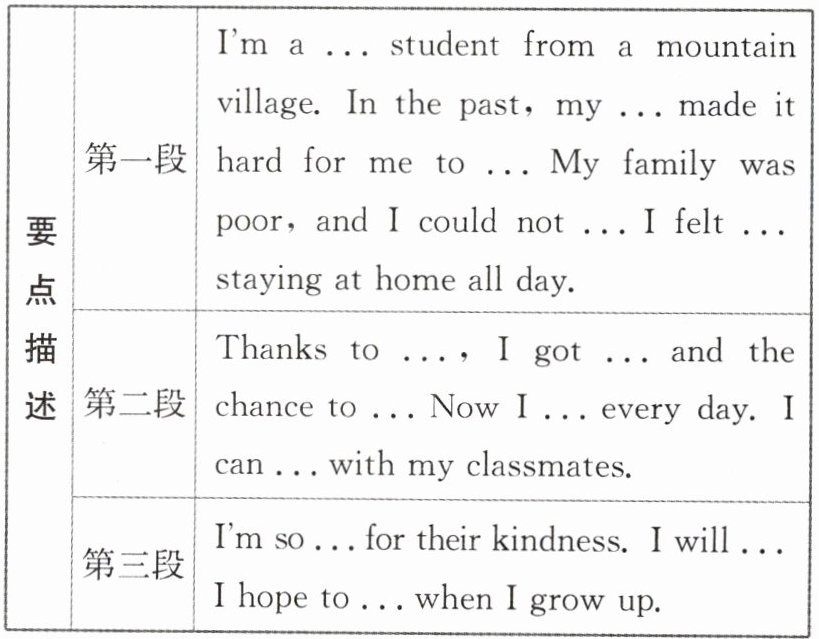
I'm a disabled student from a mountain village. In the past,
my disability made it hard for me to move around. My family was poor, and I could not go to school. I felt lonely and upset staying at home all day.
Thanks to UNICEF, I got a wheelchair and the chance to study. Now I go to school every day. I can read books and play with my classmates.
I'm so thankful for their kindness. I will study hard. I hope to help other disabled kids in need when I grow up.
解析
【分析】
首先明确题目要求:以第一人称写90词左右的电视访谈发言稿,需涵盖三部分核心内容:1. 过去的困境(山区残疾学生,因残疾和家庭贫困无法上学,感受孤独沮丧);2. UNICEF的帮助(获得轮椅和上学机会,现在的日常变化);3. 对慈善机构的感激之情与未来愿望。写作时要注意时态区分(过去时描述过去,现在时描述现在),结构清晰,符合发言稿的称呼格式。
【解析】
1. 确定格式与人称:开头使用发言稿通用称呼“Dear host and dear audience”,全程以第一人称“I”叙述;
2. 填充第一段(过去内容):点明身份(山区残疾学生),说明困境(残疾导致行动不便,家庭贫困无法上学),表达内心感受(lonely and upset);
3. 填充第二段(现在变化):说明UNICEF的帮助(获得轮椅和上学机会),描述现在的生活状态(每天上学,能和同学相处);
4. 填充第三段(感想与愿望):表达对UNICEF的感激,说明未来的愿望(努力学习,帮助其他有需要的残疾孩子);
5. 控制字数在90左右,确保时态正确,逻辑连贯,符合发言稿的表达要求。
【答案】
One possible version:
Dear host and dear audience,
I'm a disabled student from a mountain village. In the past, my disability made it hard for me to move around. My family was poor, and I could not go to school. I felt lonely and upset staying at home all day.
Thanks to UNICEF, I got a wheelchair and the chance to study. Now I go to school every day. I can read books and play with my classmates.
I'm so thankful for their kindness. I will study hard. I hope to help other disabled kids in need when I grow up.
【知识点】
英语应用文写作、时态运用、要点式写作
【点评】
本文严格遵循题目要求,结构清晰,分为过去困境、慈善帮助、现在变化、未来愿望四个层次,逻辑连贯;准确运用一般过去时和一般现在时区分时间,时态正确;内容紧扣要点,表达流畅自然,体现了对慈善机构的感激之情,是一篇符合要求的优秀发言稿。
【难度系数】
0.3
