

 登录
5. It's time
A.of; to go
B.for; go
C.of; go
D.for; to go
for
us to go
to school.A.of; to go
B.for; go
C.of; go
D.for; to go
答案
5. D
解析
【分析】这道题考查英语固定句型的用法,核心是掌握“It's time for sb. to do sth.”这一固定结构,解题时需先确定介词的正确形式,再明确动词的形式要求,通过排除错误选项得出答案。
【解析】首先,固定句型“It's time for sb. to do sth.”表示“到某人做某事的时间了”,第一个空应使用介词for,因此排除使用of的A、C选项;其次,该句型中动词部分需用不定式(to do)形式,第二个空应填to go,排除使用动词原形go的B选项,因此正确选项为D。
【答案】D
【知识点】固定句型;介词用法;动词不定式
【点评】本题属于英语基础语法题,主要考查固定句型的识记与运用,难度较低,需要学生牢记常见固定句式结构,避免混淆介词和动词形式的用法。
【难度系数】0.8
Ⅴ. 按要求完成句子。(每空一词)
1. She has one Finnish lesson and two home economics lessons in the morning. (对下划线部分提问)
2. It's time for work. (改为同义句)
It's time
3. He brushes his teeth at seven o'clock. (对下划线部分提问)
4. They usually watch TV on weekends. (对下划线部分提问)
5. She eats lots of vegetables for lunch. (对下划线部分提问)
1. She has one Finnish lesson and two home economics lessons in the morning. (对下划线部分提问)
What
lessons
does she have
in the morning?2. It's time for work. (改为同义句)
It's time
to
go
to work.3. He brushes his teeth at seven o'clock. (对下划线部分提问)
What
time
does
he brush
his teeth?4. They usually watch TV on weekends. (对下划线部分提问)
When
do
they usually watch TV?5. She eats lots of vegetables for lunch. (对下划线部分提问)
What
does
she eat
for lunch?答案
1. What lessons;have 2. to go 3. What time does;brush 4. When do 5. What does;eat
解析
【分析】
本题为英语句型转换题,包含特殊疑问句转换和同义句转换两类题型。解题思路:1. 对课程类内容提问需用对应疑问词,结合一般现在时的疑问句结构调整动词形式;2. 同义句转换需掌握固定句型的替换规则;3. 针对不同划线内容(课程、时间点、时间状语、事物)选择正确的疑问词,再根据主语的人称和数确定助动词,最后还原动词原形。
【解析】
1. 划线部分为上午的课程内容,提问“什么课程”用疑问词组What lessons,原句是一般现在时第三人称单数,疑问句中助动词用does,后面动词用原形have,故填What lessons; have;
2. 固定句型转换:It's time for + 名词 = It's time to + 动词原形,“去工作”的短语是go to work,故填to go;
3. 划线部分为具体时刻,提问用疑问词组What time,主语he是第三人称单数,一般现在时疑问句助动词用does,后面动词用原形brush,故填What time does; brush;
4. 划线部分为时间状语(周末),提问用疑问词When,主语they是复数,一般现在时疑问句助动词用do,故填When do;
5. 划线部分为食物类事物,提问用疑问词What,主语she是第三人称单数,一般现在时疑问句助动词用does,后面动词用原形eat,故填What does; eat。
【答案】1. What lessons;have 2. to go 3. What time does;brush 4. When do 5. What does;eat
【知识点】特殊疑问句构成、句型转换、固定句型运用
【点评】本题考查初中英语基础句型转换与特殊疑问句的核心用法,涵盖不同疑问词的选择和固定句型替换,是英语学习中需熟练掌握的基础知识点,题目难度适中,适合初中阶段学生练习。
【难度系数】0.7
Ⅵ.综合填空。(用方框中或括号内词的适当形式填空,两处需根据音标写出准确单词,每空1词,限用一次。)
drive he but do
My cousin David is a student, but he usu-ally gets up at 7:20 a. m. He always needs my aunt 1.
drive he but do
My cousin David is a student, but he usu-ally gets up at 7:20 a. m. He always needs my aunt 1.
to dress
(dress) him. He has a good breakfast after brushing his 2. teeth
/tiːθ/. His father is a 3. driver
, so he drives him to school. It takes 4. him
20 minutes. At school, David sometimes breaks school 5. rules
(rule). He doesn't 6. do
his homework and sometimes he talks to his classmates in class. So the teachers aren't very happy with him. At about 4:30 in the af-ternoon, my uncle drives David back home. The boy has dinner 7. quickly
/ˈkwɪkli/. After that he plays with his two pet dogs. They are really 8. friendly
(friend) to him. And then he watches TV for a long time after finishing his homework. He likes lots of TV shows, and his favourite TV shows are car-toons. Sometimes he asks Tim, his best friend, to watch cartoons with him. When they watch cartoons, they usually eat some hamburgers. “The hamburgers taste 9. good
(well)! The cartoons are cool!” he al-ways says. 10. But
I think hamburgers are not healthy food and watching TV for a long time is bad for him.答案
1. to dress 2. teeth 3. driver 4. him 5. rules 6. do 7. quickly 8. friendly 9. good 10. But
解析
【分析】
本题为综合填空题,需结合语法结构、音标提示、固定搭配及语境填写单词的适当形式。解题时先通读全文把握语境,再逐个分析每个空的要求:1. 考查固定搭配需用动词不定式;2. 根据音标直接写单词;3. 结合语境将动词转换为名词;4. 动词后用人称代词宾格;5. 表泛指用名词复数;6. 助动词后接动词原形;7. 根据音标写副词;8. 考查固定短语用形容词;9. 系动词后接形容词;10. 结合转折关系用连词。
【解析】
1. 固定搭配need sb to do sth(需要某人做某事),故填to dress;
2. 音标/tiːθ/对应单词teeth,故填teeth;
3. 语境意为“爸爸是司机”,动词drive的名词形式为driver,故填driver;
4. 动词takes后需用人称代词宾格,he的宾格是him,故填him;
5. “校规”表泛指用复数形式rules,故填rules;
6. 助动词doesn't后接动词原形,故填do;
7. 音标/ˈkwɪkli/对应副词quickly,修饰动词短语has dinner,故填quickly;
8. 固定短语be friendly to(对……友好),故填friendly;
9. 系动词taste后接形容词作表语,well的形容词形式是good,故填good;
10. 前后句为转折关系,用转折连词But,故填But。
【答案】
1. to dress 2. teeth 3. driver 4. him 5. rules 6. do 7. quickly 8. friendly 9. good 10. But
【知识点】
固定搭配、音标拼写、词性转换
【点评】
本题考查综合语言运用能力,涵盖基础语法与词汇知识点,需结合语境灵活运用,难度适中,适合巩固英语基础。
【难度系数】
0.5
Ⅶ.阅读还原。
Maria usually gets up at half past six and has breakfast with her parents at seven o'clock. 1.
school. She has six classes every day, four classes in the morning and two in the after- noon. 2.
half past six. After dinner, she often goes out for a walk(外出散步) with her parents. 3.
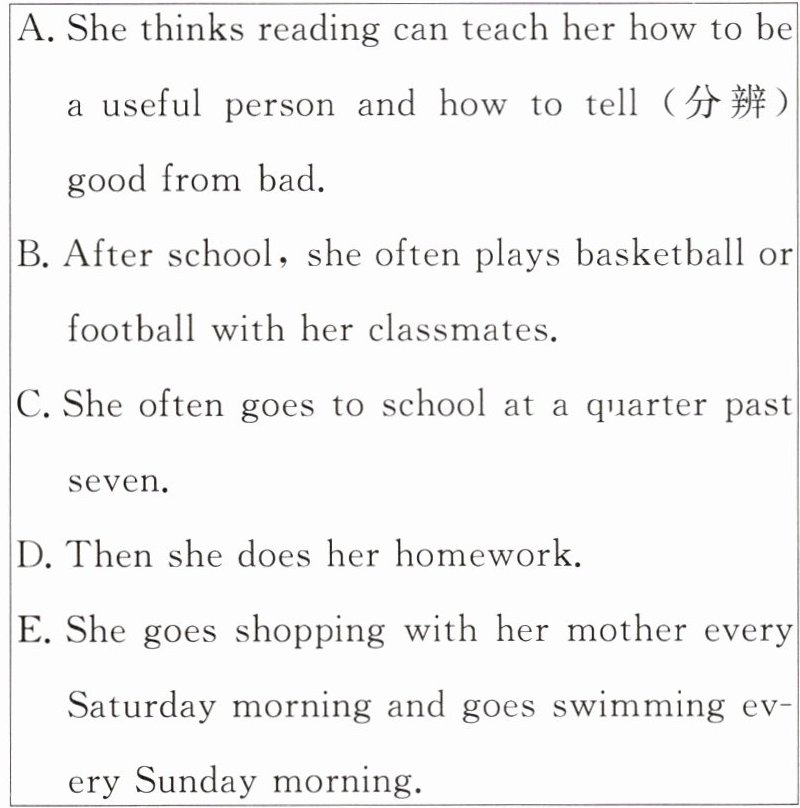
Maria usually gets up at half past six and has breakfast with her parents at seven o'clock. 1.
C
Sometimes she goes to school by bus, sometimes by bike, but seldom(很少) on foot. Maria usually has lunch atschool. She has six classes every day, four classes in the morning and two in the after- noon. 2.
B
They are her favourite sports and are good for her health(健康). Maria usually gets back home by underground(坐地铁) at half past five and has dinner athalf past six. After dinner, she often goes out for a walk(外出散步) with her parents. 3.
D
She seldom watches TV in the evening on weekdays. She often reads her favourite books. 4. A
On weekends, Maria never gets up late. 5. E
She goes to watch a film with her friends twice a week.答案
1. C
2. B
3. D
4. A
5. E
解析
【分析】
做阅读还原题时,需先通读全文把握时间顺序与内容逻辑,再结合空格前后句子的衔接性、话题一致性来匹配选项。比如第1空需衔接早餐后上学的内容,第2空要对应后文提到的运动话题,以此类推,逐步找到匹配项。
【解析】
1. 空格前提到“七点和父母吃早餐”,空格后讲上学的交通方式,选项C“她经常七点一刻去上学”,时间衔接自然,符合逻辑,故选C;
2. 空格后提到“她最喜欢的运动,对健康好”,选项B“放学后经常和同学打篮球或足球”,话题衔接运动,故选B;
3. 空格前讲晚饭后的活动,空格后讲晚上的学习/阅读安排,选项D“然后她做作业”,符合晚饭后到晚上的活动顺序,故选D;
4. 空格前讲“她经常读喜欢的书”,选项A“她觉得读书能教她做有用的人,分辨好坏”,承接读书的话题,故选A;
5. 空格前讲“周末从不晚起”,选项E“每周六上午和妈妈购物,周日游泳”是周末的具体活动,衔接自然,故选E。
【答案】
1.C 2.B 3.D 4.A 5.E
【知识点】
阅读还原、上下文衔接、时间逻辑
【点评】
本题为阅读还原题,考查学生对文章逻辑和内容衔接的理解,需结合上下文的时间顺序、话题关联解题,是初中英语常见题型。
【难度系数】
0.5
