

 登录
阅读下面的短文,根据其内容完成表格(每空限填一词)。
Great white sharks in the Pacific Ocean, wildebeest (角马) in Africa and Arctic terns (北极燕鸥) in the Atlantic. At first, these animals seem quite different. One swims, one walks, and the other flies. But they all have one thing in common—they all migrate (迁徙).
Some animals migrate because of the weather. When it gets cold, they leave the freezing (严寒的) area and move to a place where the weather is not cold. This is because the cold area is too hard for them to live in. Some go to find food or water. These animals travel in groups. But during the trip, they face many different challenges.
One challenge is distance (距离). Some migrating animals take very long trips. For example, one great white shark swam from Australia to South Africa (about 10, 000 kilometres) and then came back the same way. It took the shark nine months!
Another challenge is finding enough food or water during the journey. For example, each Mali elephant needs over 200 litres (升) of water each day. To get this, they need to go from one waterhole to another.
Besides, migrating animals need to stay safe. That’s why they keep away from some animals that can kill and eat them up. For example, zebras must avoid lions, which are strong and can kill them in minutes. Being far from such animals doesn’t help them stay out of harm. Travelling in groups helps keep them safe. When one zebra is in trouble, the other members make a circle around it. By working as a group, migrating animals travel to live better lives.
Animals’ Migration
To find a place that is
What
Distance—a great white shark swam about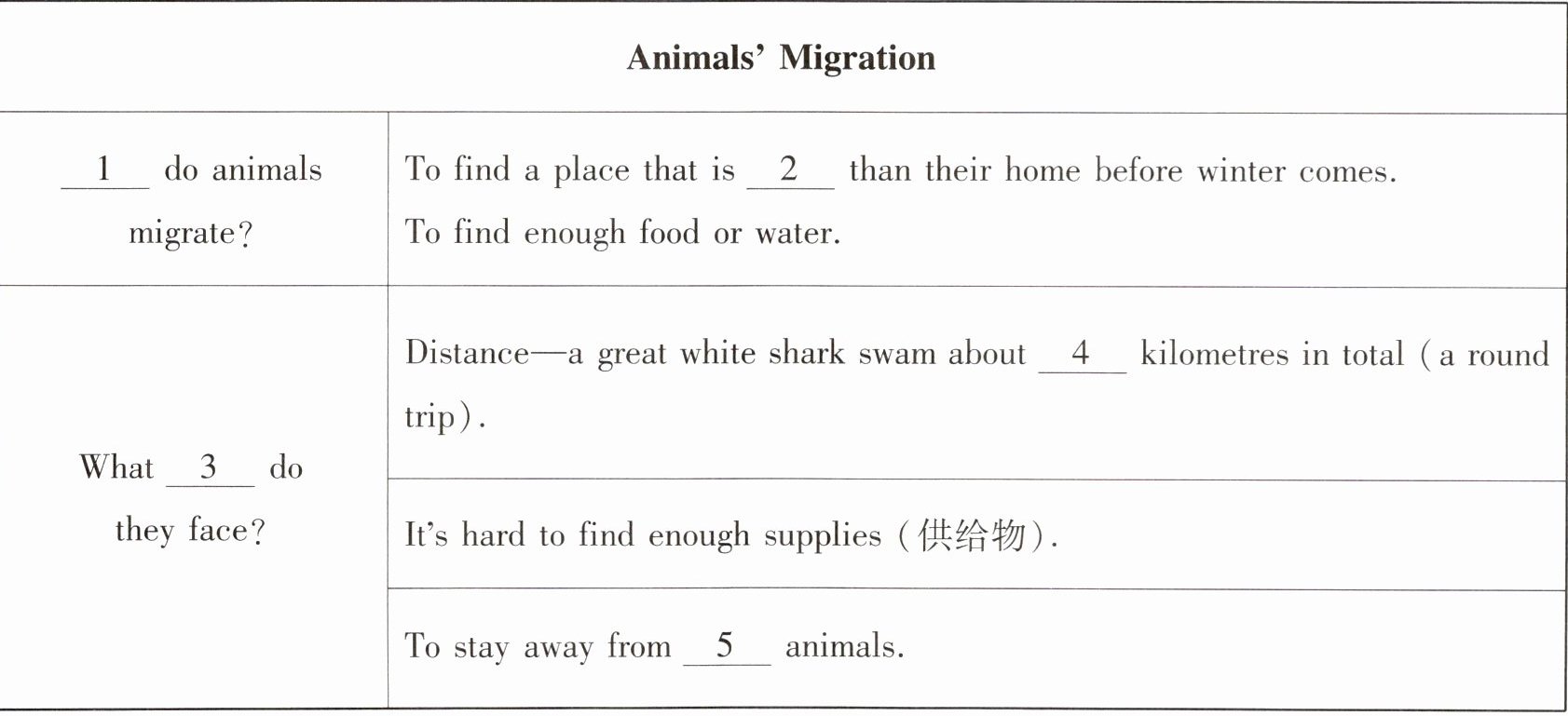
It’s hard to find enough supplies (供给物).
To stay away from
1. 2. 3. 4. 5.
Great white sharks in the Pacific Ocean, wildebeest (角马) in Africa and Arctic terns (北极燕鸥) in the Atlantic. At first, these animals seem quite different. One swims, one walks, and the other flies. But they all have one thing in common—they all migrate (迁徙).
Some animals migrate because of the weather. When it gets cold, they leave the freezing (严寒的) area and move to a place where the weather is not cold. This is because the cold area is too hard for them to live in. Some go to find food or water. These animals travel in groups. But during the trip, they face many different challenges.
One challenge is distance (距离). Some migrating animals take very long trips. For example, one great white shark swam from Australia to South Africa (about 10, 000 kilometres) and then came back the same way. It took the shark nine months!
Another challenge is finding enough food or water during the journey. For example, each Mali elephant needs over 200 litres (升) of water each day. To get this, they need to go from one waterhole to another.
Besides, migrating animals need to stay safe. That’s why they keep away from some animals that can kill and eat them up. For example, zebras must avoid lions, which are strong and can kill them in minutes. Being far from such animals doesn’t help them stay out of harm. Travelling in groups helps keep them safe. When one zebra is in trouble, the other members make a circle around it. By working as a group, migrating animals travel to live better lives.
Animals’ Migration
Why
1 do animals migrate?To find a place that is
warmer
2 than their home before winter comes. To find enough food or water.What
challenges
3 do they face?Distance—a great white shark swam about
20, 000
4 kilometres in total (a round trip). It’s hard to find enough supplies (供给物).
To stay away from
dangerous
5 animals.1. 2. 3. 4. 5.
答案
1. Why 2. warmer 3. challenges 4. 20, 000 5. dangerous
解析
【分析】
要完成表格填空,需根据短文内容定位每个问题对应的信息:
1. 第1空:表格第一行是问句,回答是动物迁徙的原因,对应短文关于迁徙原因的描述,需填疑问词。
2. 第2空:表格提到“比家更……”,对应短文“离开严寒地区去天气不冷的地方”,需用形容词比较级。
3. 第3空:表格第二部分问“面对什么”,短文明确提到迁徙面临的挑战,需填对应名词。
4. 第4空:短文提到大白鲨单程路程,来回总路程是单程的2倍,需计算得出。
5. 第5空:短文提到要远离能捕杀动物的对象,需填对应形容词。
【解析】
1. 第1空:根据短文第二段“Some animals migrate because of the weather...Some go to find food or water.”可知,表格第一行询问动物迁徙的原因,故填疑问词Why。
2. 第2空:根据短文第二段“When it gets cold, they leave the freezing area and move to a place where the weather is not cold.”可知,迁徙是为了找比家更暖和的地方,句中有than,用形容词比较级warmer。
3. 第3空:根据短文第二段“they face many different challenges”可知,表格第二部分询问迁徙面临的挑战,故填challenges。
4. 第4空:根据短文第三段“one great white shark swam from Australia to South Africa (about 10,000 kilometres) and then came back the same way.”可知,来回总路程为10000×2=20000公里,故填20,000。
5. 第5空:根据短文第五段“they need to stay safe. That’s why they keep away from some animals that can kill and eat them up.”可知,要远离危险的动物,故填dangerous。
【答案】
1. Why 2. warmer 3. challenges 4. 20,000 5. dangerous
【知识点】
英语阅读填空;形容词比较级;名词词义
【点评】
本题为细节理解型阅读题,考查学生快速定位原文信息的能力,需结合短文内容对应表格问题,难度适中。
【难度系数】
0.6
