

 登录
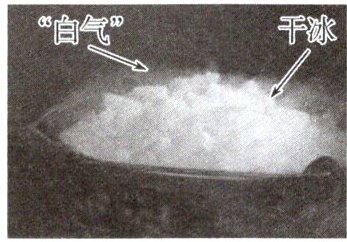
21.(4分)小明和小华网购了一箱冰激凌,箱内有一袋干冰,小明将干冰放在室温下,观察到干冰周围有大量“白气”,且干冰不断变小,如图所示。小明认为“白气”是干冰升华而形成的二氧化碳气体,小华则认为“白气”是干冰先升华而形成的二氧化碳气体又液化形成的二氧化碳小液滴。请你分别分析两人的观点是否正确,阐述你的理由。
答案
21. 两人观点均不正确。二氧化碳气体无色,因此“白气”不是二氧化碳气体,故小明的观点错误。干冰放在室温下,会直接变为二氧化碳气体,这是升华现象,这个过程吸收大量热量,周围温度降低,空气中的水蒸气遇冷液化成小水滴,形成“白气”。二氧化碳的沸点为-78.5 ℃,常温常压下二氧化碳不能液化,“白气”是小水滴而不是二氧化碳小液滴,故小华的观点也错误。
22.(6分)汽车在出厂前要进行测试。某次测试中,先让汽车在模拟公路上以20 m/s的速度行驶6 min,紧接着在模拟山路上以10 m/s的速度行驶4 min。求:
(1)该汽车在模拟公路上以20 m/s的速度行驶6 min的路程;
(2)汽车在整个测试过程中的总路程;
(3)汽车在整个测试过程中的平均速度。
答案
22. 解:(1)根据公式$v=\frac{s}{t}$可知,该汽车在模拟公路上以20 m/s的速度行驶6 min的路程$s_1=v_1t_1=20\ \mathrm{m/s}×6×60\ \mathrm{s}=7\ 200\ \mathrm{m}$。
(2)汽车在模拟山路上以10 m/s的速度行驶4 min的路程$s_2=v_2t_2=10\ \mathrm{m/s}×4×60\ \mathrm{s}=2\ 400\ \mathrm{m}$,汽车在整个测试过程中的总路程$s=s_1+s_2=7\ 200\ \mathrm{m}+2\ 400\ \mathrm{m}=9\ 600\ \mathrm{m}$。
(3)汽车在整个测试过程中的运动时间$t=t_1+t_2=6\ \mathrm{min}+4\ \mathrm{min}=10\ \mathrm{min}=600\ \mathrm{s}$,汽车在整个测试过程中的平均速度$v=\frac{s}{t}=\frac{9\ 600\ \mathrm{m}}{600\ \mathrm{s}}=16\ \mathrm{m/s}$。
23.(12分)某市蝴蝶桥的桥梁的长度为150 m。
(1)若小强同学骑着电动车以18 km/h的速度匀速通过蝴蝶桥,则他用了多少时间?
(2)小强仍按上述速度匀速行驶,若他突然发现前方有意外情况,经过0.6 s(从发现情况到制动刹车的反应时间)开始制动刹车,再经过5.4 s滑行21 m后停止,则从发现情况到完全停止的过程中,其平均速度是多少?
答案
23. 解:(1)小强骑电动车的速度$v=18\ \mathrm{km/h}=5\ \mathrm{m/s}$,
由$v=\frac{s}{t}$得,通过蝴蝶桥用的时间$t=\frac{s}{v}=\frac{150\ \mathrm{m}}{5\ \mathrm{m/s}}=30\ \mathrm{s}$。
(2)由$v=\frac{s}{t}$得,小强在反应时间内骑行的路程$s_1=vt_1=5\ \mathrm{m/s}×0.6\ \mathrm{s}=3\ \mathrm{m}$,
从发现情况到完全停止行驶的总路程$s'=s_1+s_2=3\ \mathrm{m}+21\ \mathrm{m}=24\ \mathrm{m}$,
从发现情况到完全停止行驶的总时间$t'=t_1+t_2=0.6\ \mathrm{s}+5.4\ \mathrm{s}=6\ \mathrm{s}$,
从发现情况到完全停止行驶的平均速度$v'=\frac{s'}{t'}=\frac{24\ \mathrm{m}}{6\ \mathrm{s}}=4\ \mathrm{m/s}$。
