

 登录
登录
一、听录音,选出你所听到的内容。
(
(
(
(
(
(
B. write a sentence
C. say a sentence
(
A
) 1. A. angry B. hungry C. hurry(
B
) 2. A. twelve B. twenty C. twice(
A
) 3. A. letters B. litter C. little(
C
) 4. A. then B. they C. them(
A
) 5. A. talk to B. take to C. talk with(
A
) 6. A. make a sentenceB. write a sentence
C. say a sentence
答案
1.A 2.B 3.A 4.C 5.A 6.A
解析
翻译:
一、听录音,选出你所听到的内容。
( )1. A. 生气的 B. 饥饿的 C. 赶快
( )2. A. 十二 B. 二十 C. 两次
( )3. A. 信件(复数) B. 乱扔垃圾 C. 小的;少量的
( )4. A. 然后;那时 B. 他们;她们;它们 C. 他们;她们;它们(宾格)
( )5. A. 和……交谈 B. 带到…… C. 和……交谈
( )6. A. 造一个句子
B. 写一个句子
C. 说一个句子
一、听录音,选出你所听到的内容。
( )1. A. 生气的 B. 饥饿的 C. 赶快
( )2. A. 十二 B. 二十 C. 两次
( )3. A. 信件(复数) B. 乱扔垃圾 C. 小的;少量的
( )4. A. 然后;那时 B. 他们;她们;它们 C. 他们;她们;它们(宾格)
( )5. A. 和……交谈 B. 带到…… C. 和……交谈
( )6. A. 造一个句子
B. 写一个句子
C. 说一个句子
二、听录音,给下列图片排序。
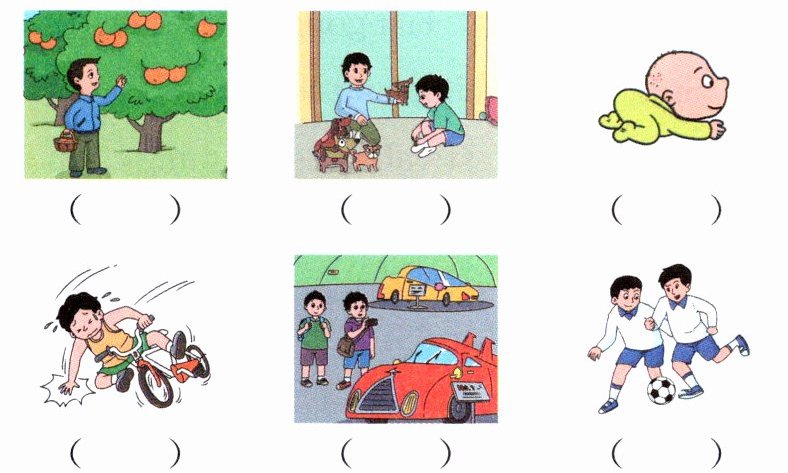
6 2 5 3 1 4
答案
6 2 5 3 1 4
三、听录音,选择正确的答句。
(
C. It’s the sixth of May.
(
C. Yes, I did.
(
C. He couldn’t run.
(
C. Yes, I can.
(
B. They’re at home.
C. They have a party.
(
C
) 1. A. It’s Sunday. B. It’s cloudy.C. It’s the sixth of May.
(
C
) 2. A. Yes, I can. B. Yes, I do.C. Yes, I did.
(
C
) 3. A. He can sing. B. He could read.C. He couldn’t run.
(
C
) 4. A. Yes, I do. B. I can read.C. Yes, I can.
(
A
) 5. A. They watched a film.B. They’re at home.
C. They have a party.
答案
1.C 2.C 3.C 4.C 5.A
解析
翻译:
三、听录音,选择正确的答句。
( )1. A. 今天是星期日。 B. 天气多云。
C. 今天是5月6日。
( )2. A. 是的,我能。 B. 是的,我(经常)这样做。
C. 是的,我做过了。
( )3. A. 他会唱歌。 B. 他(过去)会读书。
C. 他(过去)不能跑步。
( )4. A. 是的,我(经常)这样做。 B. 我会阅读。
C. 是的,我能。
( )5. A. 他们看了一场电影。
B. 他们在家。
C. 他们举办一场派对。
三、听录音,选择正确的答句。
( )1. A. 今天是星期日。 B. 天气多云。
C. 今天是5月6日。
( )2. A. 是的,我能。 B. 是的,我(经常)这样做。
C. 是的,我做过了。
( )3. A. 他会唱歌。 B. 他(过去)会读书。
C. 他(过去)不能跑步。
( )4. A. 是的,我(经常)这样做。 B. 我会阅读。
C. 是的,我能。
( )5. A. 他们看了一场电影。
B. 他们在家。
C. 他们举办一场派对。
四、听录音,根据所听对话及问题,选择正确的答案。
(
B. He played football.
C. He went to the park.
(
B. She could read stories.
C. She could dance.
(
B. Yes, he can.
C. No, he can’t.
(
C. Helen.
(
B. To the Science Museum.
C. To the Great Wall.
(
A
) 1. A. He went fishing.B. He played football.
C. He went to the park.
(
B
) 2. A. She could sing.B. She could read stories.
C. She could dance.
(
C
) 3. A. On Thursday.B. Yes, he can.
C. No, he can’t.
(
A
) 4. A. Mike. B. Tim.C. Helen.
(
A
) 5. A. To the Bund.B. To the Science Museum.
C. To the Great Wall.
答案
1.A 2.B 3.C 4.A 5.A
解析
翻译:
四、听录音,根据所听对话及问题,选择正确的答案。
( )1. A. 他去钓鱼了。
B. 他踢足球了。
C. 他去公园了。
( )2. A. 她会唱歌。
B. 她会读故事。
C. 她会跳舞。
( )3. A. 在星期四。
B. 是的,他会。
C. 不,他不会。
( )4. A. 迈克。
B. 蒂姆。
C. 海伦。
( )5. A. 去外滩。
B. 去科学博物馆。
C. 去长城。
四、听录音,根据所听对话及问题,选择正确的答案。
( )1. A. 他去钓鱼了。
B. 他踢足球了。
C. 他去公园了。
( )2. A. 她会唱歌。
B. 她会读故事。
C. 她会跳舞。
( )3. A. 在星期四。
B. 是的,他会。
C. 不,他不会。
( )4. A. 迈克。
B. 蒂姆。
C. 海伦。
( )5. A. 去外滩。
B. 去科学博物馆。
C. 去长城。
五、听录音,根据所听短文,在相应的括号内画“√”。
( ) 1. They went to the park on Sunday.
(
( ) 3. There isn’t a lake in the zoo.
(
(
( ) 1. They went to the park on Sunday.
(
√
) 2. They went there by bus.( ) 3. There isn’t a lake in the zoo.
(
√
) 4. They watched monkeys in the zoo.(
√
) 5. They left the zoo at three thirty.答案
2. √ 4. √ 5. √
解析
翻译:
五、听录音,根据所听短文,在相应的括号内画“√”。
( )1. 他们周日去了公园。
( )2. 他们乘公共汽车去的那里。
( )3. 动物园里没有湖。
( )4. 他们在动物园里看了猴子。
( )5. 他们三点三十分离开了动物园。
五、听录音,根据所听短文,在相应的括号内画“√”。
( )1. 他们周日去了公园。
( )2. 他们乘公共汽车去的那里。
( )3. 动物园里没有湖。
( )4. 他们在动物园里看了猴子。
( )5. 他们三点三十分离开了动物园。
六、Amy是一名小记者,正在采访历史老师Mr Brown,了解过去和现在生活的变化。请仔细听对话,完成下列各题。
(一)选择正确的答案。
(
A. Through mobile phones.
B. By writing letters.
C. With computers.
(二)补全句子。
1. In the past, people didn’t have
2. Now, we use
3. The biggest difference between then and now is how
(一)选择正确的答案。
(
B
) How did people contact(联系) others far away in the past?A. Through mobile phones.
B. By writing letters.
C. With computers.
(二)补全句子。
1. In the past, people didn’t have
cars
, so they walked or rode horses.2. Now, we use
mobile phones
and computers
to contact people far away.3. The biggest difference between then and now is how
fast
we can contact people.答案
(一) B (二) 1. cars 2. mobile phones; computers 3. fast
解析
翻译:
六、艾米是一名小记者,正在采访历史老师布朗先生,了解过去和现在生活的变化。请仔细听对话,完成下列各题。
(一)选择正确的答案。
( )过去人们是如何联系远方的人的?
A. 通过手机。
B. 通过写信。
C. 通过电脑。
(二)补全句子。
1. 在过去,人们没有______,所以他们步行或骑马。
2. 现在,我们使用______ ______和______来联系远方的人。
3. 过去和现在最大的不同在于我们联系他人的______。
六、艾米是一名小记者,正在采访历史老师布朗先生,了解过去和现在生活的变化。请仔细听对话,完成下列各题。
(一)选择正确的答案。
( )过去人们是如何联系远方的人的?
A. 通过手机。
B. 通过写信。
C. 通过电脑。
(二)补全句子。
1. 在过去,人们没有______,所以他们步行或骑马。
2. 现在,我们使用______ ______和______来联系远方的人。
3. 过去和现在最大的不同在于我们联系他人的______。
