

 登录
登录
一、从诗中找出与所给单词画线部分发音相同的单词。
Look! It's seven o'clock.
The planes go very far.
The butterfly is on the vase.
Oh,I can't find them.
1. four
2. five
Look! It's seven o'clock.
The planes go very far.
The butterfly is on the vase.
Oh,I can't find them.
1. four
2. five
答案
1. far, find
2. very, vase
2. very, vase
解析
1. 先确定所给单词four画线部分字母f的发音为/f/,在给出的文段中找到字母f发/f/音的对应单词即可。
2. 先确定所给单词five画线部分字母v的发音为/v/,在给出的文段中找到字母v发/v/音的对应单词即可。
2. 先确定所给单词five画线部分字母v的发音为/v/,在给出的文段中找到字母v发/v/音的对应单词即可。
二、按要求写单词。
1. mangoes(单数形式)
2. they're(完整形式)
3. do not (缩写形式)
4. library(复数形式)
5. banana(复数形式)
6. sheep(单数形式)
1. mangoes(单数形式)
2. they're(完整形式)
3. do not (缩写形式)
4. library(复数形式)
5. banana(复数形式)
6. sheep(单数形式)
答案
1. mango
2. they are
3. don't
4. libraries
5. bananas
6. sheep
2. they are
3. don't
4. libraries
5. bananas
6. sheep
解析
这道题考查三年级英语的名词单复数变换、单词缩写的基础知识点:
1. mangoes是名词mango的复数变形,去掉复数后缀es即可得到单数形式;
2. they're是代词加be动词的缩略形式,展开后就是完整形式;
3. do not的常用标准缩写形式符合助动词的缩写规则;
4. library是以“辅音字母+y”结尾的名词,变复数的规则是改y为i再加es;
5. banana是常规规则名词,变复数直接在词尾加s即可;
6. sheep是特殊的单复数同形名词,单数和复数的拼写完全一致。
1. mangoes是名词mango的复数变形,去掉复数后缀es即可得到单数形式;
2. they're是代词加be动词的缩略形式,展开后就是完整形式;
3. do not的常用标准缩写形式符合助动词的缩写规则;
4. library是以“辅音字母+y”结尾的名词,变复数的规则是改y为i再加es;
5. banana是常规规则名词,变复数直接在词尾加s即可;
6. sheep是特殊的单复数同形名词,单数和复数的拼写完全一致。
三、仔细看图,找出相对应的句子,将其序号填在方框内。
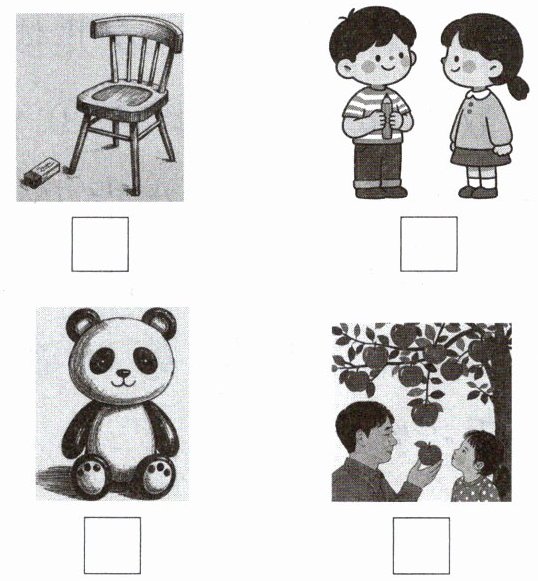
A.— What are these?
— They are apples. This one is for you.
B.— Is this your pencil?
— Yes, it is.
C.— What's that under the chair?
— It's a rubber.
D.— Look at my toy panda.
— It's cute.
A.— What are these?
— They are apples. This one is for you.
B.— Is this your pencil?
— Yes, it is.
C.— What's that under the chair?
— It's a rubber.
D.— Look at my toy panda.
— It's cute.
答案
从上到下、从左到右依次填:C、B、D、A
解析
按顺序匹配图片与对应句子:
1. 第一幅图展示椅子下方有一块橡皮,对应选项C的对话;
2. 第二幅图展示男孩拿着铅笔和女孩对话,对应选项B的对话;
3. 第三幅图展示玩具熊猫,对应选项D的对话;
4. 第四幅图展示结满苹果的果树,大人递苹果给小孩,对应选项A的对话。
1. 第一幅图展示椅子下方有一块橡皮,对应选项C的对话;
2. 第二幅图展示男孩拿着铅笔和女孩对话,对应选项B的对话;
3. 第三幅图展示玩具熊猫,对应选项D的对话;
4. 第四幅图展示结满苹果的果树,大人递苹果给小孩,对应选项A的对话。
四、阅读短文,判断句子是否正确,用“T”和“F”表示。
I have a good friend. It's a cat. Its(它的) name is Lele. It's white and yellow. It's very cute. I often(经常) play with(和……玩耍) it after school. Today I can't find it. Is it behind the door? No, it isn't. It isn't under the bed either (也). In the evening, I want to do my homework (家庭作业). But it is on my chair.
()1. The cat is yellow.
()2. The cat isn't cute.
()3. I play with the cat every day(每天).
()4. The cat is under the bed.
I have a good friend. It's a cat. Its(它的) name is Lele. It's white and yellow. It's very cute. I often(经常) play with(和……玩耍) it after school. Today I can't find it. Is it behind the door? No, it isn't. It isn't under the bed either (也). In the evening, I want to do my homework (家庭作业). But it is on my chair.
()1. The cat is yellow.
()2. The cat isn't cute.
()3. I play with the cat every day(每天).
()4. The cat is under the bed.
答案
1.F 2.F 3.F 4.F
解析
对照短文内容逐题判断:
1. 短文中明确说明小猫是白黄相间的(It's white and yellow),并非只有黄色,该句表述错误。
2. 短文中提到小猫非常可爱(It's very cute),和题目“小猫不可爱”的描述不符,该句表述错误。
3. 短文中只提到“我放学后经常和小猫玩耍”,并没有说明是每天都和小猫玩,且当天找不到小猫,也无法实现每天都玩,该句表述错误。
4. 短文中明确说明小猫不在床底下(It isn't under the bed either),和题目描述不符,该句表述错误。
1. 短文中明确说明小猫是白黄相间的(It's white and yellow),并非只有黄色,该句表述错误。
2. 短文中提到小猫非常可爱(It's very cute),和题目“小猫不可爱”的描述不符,该句表述错误。
3. 短文中只提到“我放学后经常和小猫玩耍”,并没有说明是每天都和小猫玩,且当天找不到小猫,也无法实现每天都玩,该句表述错误。
4. 短文中明确说明小猫不在床底下(It isn't under the bed either),和题目描述不符,该句表述错误。
