

 登录
登录
四、任务型阅读
阅读下面短文,并根据所读内容在文章后的表格里填入最恰当的单词,每个空格只填一个单词。
About 500 years ago in China, there was a cool traveller. He spent 30 years travelling across China. He was Xu Xiake. Almost everyone knows his name.
Xu Xiake was born in Jiangsu Province. When he was a child, Xu showed great interest in reading books about Chinese mountains and rivers. He would like to see them when he grow up.
At that time, many kids were studying hard to become officials. But Xu's father never made him take exams. Instead, he encouraged (鼓励) his son to go out and get to know the world. Xu began his journey when he was about 20. Before he left, his mother made him a travelling hat to encourage him to travel.
Xu travelled to 21 provinces and over 100 cities in China. He climbed thousands of mountains and visited over 350 caves. He was the first person to find the highest peak (山峰) of Huangshan Mountain. He was also the first to find lots of karst caves (喀斯特溶洞). What's more, he found the Yangtze River's headwaters. All of these findings were very important. Xu travelled mainly on foot. He slept and ate in nature. Sometimes he fell into rivers or ran into dangerous animals. But Xu wasn't afraid and he enjoyed his journeys.
Xu kept diaries when travelling. They were edited (编辑) into *Travel Diaries of Xu Xiake*. But it was not printed before his death. The book is still popular today.
Being a traveller and an explorer (探险家) can be very exciting. But it also needs bravery and skills. Do you want to be one like Xu Xiake?
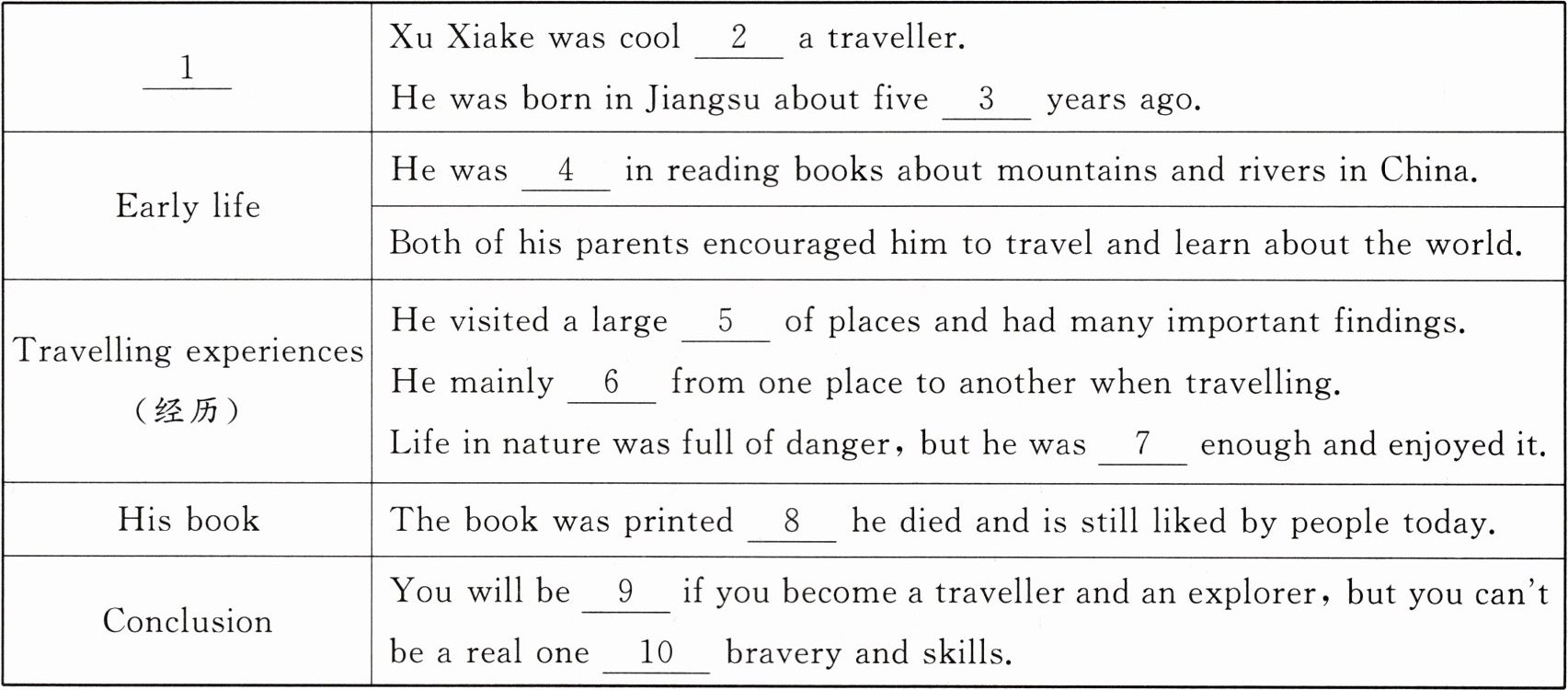
1.
2.
3.
4.
5.
6.
7.
8.
9.
10.
阅读下面短文,并根据所读内容在文章后的表格里填入最恰当的单词,每个空格只填一个单词。
About 500 years ago in China, there was a cool traveller. He spent 30 years travelling across China. He was Xu Xiake. Almost everyone knows his name.
Xu Xiake was born in Jiangsu Province. When he was a child, Xu showed great interest in reading books about Chinese mountains and rivers. He would like to see them when he grow up.
At that time, many kids were studying hard to become officials. But Xu's father never made him take exams. Instead, he encouraged (鼓励) his son to go out and get to know the world. Xu began his journey when he was about 20. Before he left, his mother made him a travelling hat to encourage him to travel.
Xu travelled to 21 provinces and over 100 cities in China. He climbed thousands of mountains and visited over 350 caves. He was the first person to find the highest peak (山峰) of Huangshan Mountain. He was also the first to find lots of karst caves (喀斯特溶洞). What's more, he found the Yangtze River's headwaters. All of these findings were very important. Xu travelled mainly on foot. He slept and ate in nature. Sometimes he fell into rivers or ran into dangerous animals. But Xu wasn't afraid and he enjoyed his journeys.
Xu kept diaries when travelling. They were edited (编辑) into *Travel Diaries of Xu Xiake*. But it was not printed before his death. The book is still popular today.
Being a traveller and an explorer (探险家) can be very exciting. But it also needs bravery and skills. Do you want to be one like Xu Xiake?
1.
Introduction
2.
as
3.
hundred
4.
interested
5.
number
6.
walked
7.
brave
8.
after
9.
excited
10.
without
答案
【文章大意】本文是一篇说明文,详细介绍了徐霞客本人的情况及其作品。
1. Introduction 2. as 3. hundred 4. interested
5. number 6. walked 7. brave 8. after 9. excited
10. without
1. Introduction 2. as 3. hundred 4. interested
5. number 6. walked 7. brave 8. after 9. excited
10. without
解析
【分析】
这是人物介绍类的任务型阅读填空题,解题时首先要通读全文,明确文章围绕徐霞客的生平、旅行经历、著作展开介绍,理清表格的板块逻辑:表格从总述、早年生活、旅行经历、著作、结论五个维度梳理内容。接下来逐空对应定位原文语句,优先匹配原文线索,同时结合固定搭配、词性要求、时态语态规则筛选合适的单词,注意每空只能填入一个单词,保证语义和语法都通顺。
【解析】
1. 表格后续板块分别为早年生活、旅行经历、他的著作、结论,第一部分是对徐霞客的总体引入介绍,因此填Introduction,首字母大写符合板块标题的书写规范。
2. 本句表达“徐霞客作为一名旅行者十分了不起”,介词as有“作为”的含义,填入后语义通顺。
3. 原文第一段直接提到“About 500 years ago in China”,500即five hundred,因此填hundred。
4. 原文第二段提到“Xu showed great interest in reading books about Chinese mountains and rivers”,表格中是be动词后接形容词的结构,固定搭配be interested in表示“对……感兴趣”,因此填interested。
5. 固定短语a large number of表示“大量、许多”,对应原文中徐霞客到访了非常多地点的描述,因此填number。
6. 原文第四段说明“Xu travelled mainly on foot”,即他旅行时主要靠步行往返不同地点,全文叙事为一般过去时,因此填walk的过去式walked。
7. 原文第四段提到“Sometimes he fell into rivers or ran into dangerous animals. But Xu wasn't afraid and he enjoyed his journeys”,说明他足够勇敢,因此填形容词brave。
8. 原文第五段说明“it was not printed before his death”,即这本书在他去世之后才被印刷出版,因此填after。
9. 原文最后一段提到“Being a traveller and an explorer can be very exciting”,本句主语是you,修饰人表示“感到兴奋的”要用以-ed结尾的形容词,因此填excited。
10. 本句表达“没有勇气和技能,你就无法成为真正的旅行者和探险家”,介词without表示“没有”,符合语境逻辑。
【答案】
1. Introduction 2. as 3. hundred 4. interested 5. number 6. walked 7. brave 8. after 9. excited 10. without
【知识点】
任务型阅读,固定搭配,词性转换
【点评】
本题属于基础难度的任务型阅读,大部分空都可以通过定位原文直接找到对应线索,仅少数空需要做同义转换、词性调整,既考查学生快速定位文本信息的能力,也检验学生对初中核心词汇、常用固定短语的掌握程度,同时渗透了徐霞客的相关文化常识。
【难度系数】
0.6
这是人物介绍类的任务型阅读填空题,解题时首先要通读全文,明确文章围绕徐霞客的生平、旅行经历、著作展开介绍,理清表格的板块逻辑:表格从总述、早年生活、旅行经历、著作、结论五个维度梳理内容。接下来逐空对应定位原文语句,优先匹配原文线索,同时结合固定搭配、词性要求、时态语态规则筛选合适的单词,注意每空只能填入一个单词,保证语义和语法都通顺。
【解析】
1. 表格后续板块分别为早年生活、旅行经历、他的著作、结论,第一部分是对徐霞客的总体引入介绍,因此填Introduction,首字母大写符合板块标题的书写规范。
2. 本句表达“徐霞客作为一名旅行者十分了不起”,介词as有“作为”的含义,填入后语义通顺。
3. 原文第一段直接提到“About 500 years ago in China”,500即five hundred,因此填hundred。
4. 原文第二段提到“Xu showed great interest in reading books about Chinese mountains and rivers”,表格中是be动词后接形容词的结构,固定搭配be interested in表示“对……感兴趣”,因此填interested。
5. 固定短语a large number of表示“大量、许多”,对应原文中徐霞客到访了非常多地点的描述,因此填number。
6. 原文第四段说明“Xu travelled mainly on foot”,即他旅行时主要靠步行往返不同地点,全文叙事为一般过去时,因此填walk的过去式walked。
7. 原文第四段提到“Sometimes he fell into rivers or ran into dangerous animals. But Xu wasn't afraid and he enjoyed his journeys”,说明他足够勇敢,因此填形容词brave。
8. 原文第五段说明“it was not printed before his death”,即这本书在他去世之后才被印刷出版,因此填after。
9. 原文最后一段提到“Being a traveller and an explorer can be very exciting”,本句主语是you,修饰人表示“感到兴奋的”要用以-ed结尾的形容词,因此填excited。
10. 本句表达“没有勇气和技能,你就无法成为真正的旅行者和探险家”,介词without表示“没有”,符合语境逻辑。
【答案】
1. Introduction 2. as 3. hundred 4. interested 5. number 6. walked 7. brave 8. after 9. excited 10. without
【知识点】
任务型阅读,固定搭配,词性转换
【点评】
本题属于基础难度的任务型阅读,大部分空都可以通过定位原文直接找到对应线索,仅少数空需要做同义转换、词性调整,既考查学生快速定位文本信息的能力,也检验学生对初中核心词汇、常用固定短语的掌握程度,同时渗透了徐霞客的相关文化常识。
【难度系数】
0.6
