

 登录
七、句子理解。课余时间,佳佳翻看朋友们的生活照片。看图读句子,选出与句子描述相符的配图。
C.
(
(
(
(
(
C.
(
C
)1. I feel ill. My head hurts and I have a runny nose.(
A
)2. We need to eat healthy food. We should exercise too.(
D
)3. My trip to the Jinggangshan Revolution Museum was amazing!(
E
)4. My sister and I pasted fu on the door to welcome the New Year.(
B
)5. I went to Xi'an with my mum and dad. We visited the Terracotta Warriors.答案
1. C 2. A 3. D 4. E 5. B
解析
【分析】首先理解每个英语句子的核心含义,提取关键词,再对应图片内容:1. 句子关键词为“feel ill(生病)、head hurts(头疼)、runny nose(流鼻涕)”,匹配生病相关的图片;2. 句子关键词为“eat healthy food(吃健康食物)、exercise(锻炼)”,匹配有健康食物和运动场景的图片;3. 句子关键词为“Jinggangshan Revolution Museum(井冈山革命博物馆)”,匹配对应建筑的图片;4. 句子关键词为“pasted fu on the door(贴福字)”,匹配贴福字的图片;5. 句子关键词为“Terracotta Warriors(兵马俑)”,匹配兵马俑场景的图片。
【解析】1. 句子1描述生病、头疼、流鼻涕,对应图C(人物卧床,有体温计、纸巾等生病元素),故选C;2. 句子2提到健康食物和锻炼,对应图A(有健康蔬菜盘和跑步的孩子),故选A;3. 句子3提到井冈山革命博物馆,对应图D(建筑标注该名称),故选D;4. 句子4提到贴福字,对应图E(两个女孩在门上贴福字),故选E;5. 句子5提到西安兵马俑,对应图B(展示兵马俑),故选B。
【答案】1.C 2.A 3.D 4.E 5.B
【知识点】英语句子理解、图片信息匹配、日常话题
【点评】本题结合图片考查英语句子理解能力,需学生抓取句子关键信息并与图片对应,难度适中,适合基础阶段学生练习。
【难度系数】0.6
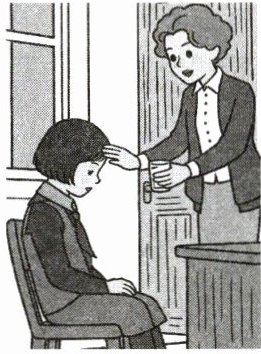
八、情景交际。佳佳身体不舒服,心情也很低落,她正在和 Miss White 谈心。读对话,选择合适的句子补全对话。
A. I'm sorry to hear that.
B. What's the matter, Jiajia?
C. Thank you, Miss White.
D. You can also join after-school clubs.
E. Think about happy things.
Jiajia: Hello, Miss White. I'm not feeling well today.
Miss White: Oh, dear! 1.
Jiajia: I feel ill. My head hurts and I have a runny nose.
Miss White: 2.
Jiajia: I will. But I also feel sad because my good friend Linlin moved to another city.
Miss White: 3.
Jiajia: I tried that, but I still feel unhappy.
Miss White: Don't worry. Maybe you can do some exercise. Exercise can cheer you up. 4.
Jiajia: That sounds good. 5.
Miss White: You're welcome, Jiajia. I hope you feel better soon!
A. I'm sorry to hear that.
B. What's the matter, Jiajia?
C. Thank you, Miss White.
D. You can also join after-school clubs.
E. Think about happy things.
Jiajia: Hello, Miss White. I'm not feeling well today.
Miss White: Oh, dear! 1.
B
Jiajia: I feel ill. My head hurts and I have a runny nose.
Miss White: 2.
A
Maybe you should see a doctor.Jiajia: I will. But I also feel sad because my good friend Linlin moved to another city.
Miss White: 3.
E
You can call your friend or send some emails to her.Jiajia: I tried that, but I still feel unhappy.
Miss White: Don't worry. Maybe you can do some exercise. Exercise can cheer you up. 4.
D
And you can make new friends in clubs.Jiajia: That sounds good. 5.
C
Miss White: You're welcome, Jiajia. I hope you feel better soon!
答案
1. B 2. A 3. E 4. D 5. C
解析
【分析】先通读对话,理解佳佳与Miss White的交流语境,每处空格需结合前后句的逻辑关系选择合适的句子:第一空老师询问佳佳身体状况,第二空老师对佳佳生病表示同情,第三空老师安慰佳佳并给出建议,第四空老师补充建议,第五空佳佳感谢老师,据此逐一匹配选项。
【解析】1. 佳佳说自己不舒服,老师需询问具体情况,对应选项B(What's the matter, Jiajia?),故选B;2. 佳佳告知生病的情况,老师应表达同情,对应选项A(I'm sorry to hear that.),故选A;3. 佳佳因朋友搬走难过,老师给出安慰建议,对应选项E(Think about happy things.),故选E;4. 老师提到做运动后,补充另一个建议,对应选项D(You can also join after-school clubs.),故选D;5. 老师给出建议后,佳佳表达感谢,对应选项C(Thank you, Miss White.),故选C。
【答案】1.B 2.A 3.E 4.D 5.C
【知识点】情景交际、日常用语
【点评】本题考查日常情景对话的运用,需结合上下文语境选择符合逻辑的表达,是基础类情景交际题,适合巩固日常交际用语。
【难度系数】0.6
九、读短文,选答案。春节是中国重要的传统节日之一,佳佳正在给 Mike 介绍春节习俗。阅读短文,完成相应的任务。
The Spring Festival is a traditional festival. People also call it Chinese New Year. There are different names for each year. We all call them the Year of the Monkey, the Year of the Dog, the Year of the Tiger…Before the day of the festival, people are busy shopping and cleaning the house. And there is also a big family dinner. Then all the families stay up late to welcome the new year. At that time, people eat some jiaozi and watch the Spring Festival Gala. On New Year's Eve, people get together to celebrate the coming new year. They paste fu and Spring Festival couplets on their doors and set off fireworks. On
Chinese New Year's Day, people wear new clothes and visit their relatives(亲戚). They always say "Happy New Year" to each other.
任务一:阅读短文,选择合适的答案。
(
A. sing and dance
B. go shopping and clean the house
C. play games
(
A. Because they want to eat some food.
B. Because they want to watch TV.
C. Because they want to welcome the new year.
(
A. visit their relatives B. wear new clothes C. both A and B
(
2026 is the Year of the . 2027 is the Year of the .
A. Horse; Sheep B. Tiger; Sheep C. Snake; Horse
任务二:根据短文填空。
5. There are
At the Spring Festival, people always say "
The Spring Festival is a traditional festival. People also call it Chinese New Year. There are different names for each year. We all call them the Year of the Monkey, the Year of the Dog, the Year of the Tiger…Before the day of the festival, people are busy shopping and cleaning the house. And there is also a big family dinner. Then all the families stay up late to welcome the new year. At that time, people eat some jiaozi and watch the Spring Festival Gala. On New Year's Eve, people get together to celebrate the coming new year. They paste fu and Spring Festival couplets on their doors and set off fireworks. On
Chinese New Year's Day, people wear new clothes and visit their relatives(亲戚). They always say "Happy New Year" to each other.
任务一:阅读短文,选择合适的答案。
(
B
)1. People before the Spring Festival.A. sing and dance
B. go shopping and clean the house
C. play games
(
C
)2. Why do all the families stay up late?A. Because they want to eat some food.
B. Because they want to watch TV.
C. Because they want to welcome the new year.
(
C
)3. On Chinese New Year's Day, people usually .A. visit their relatives B. wear new clothes C. both A and B
(
A
)4. 2024 is the Year of the Dragon. 2025 is the Year of the Snake.2026 is the Year of the . 2027 is the Year of the .
A. Horse; Sheep B. Tiger; Sheep C. Snake; Horse
任务二:根据短文填空。
5. There are
12/twelve
Chinese Zodiac(生肖) animals.At the Spring Festival, people always say "
Happy New Year
" to each other.答案
1. B 2. C 3. C 4. A 5. 12/twelve Happy New Year
解析
【分析】首先通读短文,理解短文介绍的春节习俗及相关知识;针对每个小题,精准定位短文中的对应语句,对比选项内容,选出匹配的答案;任务二的填空需结合原文信息及常识(如生肖数量)完成。
【解析】1. 定位短文“Before the day of the festival, people are busy shopping and cleaning the house”,可知春节前人们忙于购物和打扫房子,对应选项B;2. 定位短文“Then all the families stay up late to welcome the new year”,可知熬夜是为了迎接新年,对应选项C;3. 定位短文“On Chinese New Year's Day, people wear new clothes and visit their relatives”,可知新年当天人们穿新衣、走亲戚,对应选项C;4. 十二生肖顺序为鼠、牛、虎、兔、龙、蛇、马、羊……2024龙年,2025蛇年,2026马年,2027羊年,对应选项A;5. 常识可知中国生肖有12个,短文最后提到新年人们互相说“Happy New Year”,故填12/twelve和Happy New Year。
【答案】1.B 2.C 3.C 4.A 5.12/twelve Happy New Year
【知识点】英语阅读理解、传统节日常识、十二生肖知识
【点评】本题结合春节习俗的英语阅读材料,主要考查学生提取文本细节信息的能力,题目难度适中,只要认真阅读原文即可正确解答。
【难度系数】0.8
