

 登录
登录
五、任务型阅读。(2026·江苏南通如皋期末)
阅读短文,从短文后A至F六个选项中选出五个可以填入空白处的最佳选项。
Drinking milk tea with friends? That's "city". Visiting the Great Wall of China? Very "city". 1 Quite "city".
This simple question quickly caught the attention of Chinese netizens. If you don't get it, let me explain it to you. The popularity of the phrase "City bu city?" has recently risen online. It's used to describe whether someone or something feels urban(都市的),modern,and stylish.
2 It was first popularized by American blogger Paul Mike Ashton, known online as "Bao Bao Xiong". He has lived in Shanghai for years with his sister and sometimes shares his travel experiences on Douyin and Xiaohongshu. 3 His popularity soared after he posted a video asking his sister "City bu city?" while visiting the Great Wall.
With "city" being used this way, one key change is clear: 4 According to Ashton, it not only refers to something happening in the city but also describes "something that gives you a great love for life".
In recent years, many foreign visitors like Ashton have been sharing their experiences in China online. 5 Topics about travelling in China are gaining global attention, allowing people worldwide to learn about modern China and its way of life. Still, these stories are shared in an emotional,friendly,and natural style that resonates with many.
A. But where did this interesting phrase come from?
B. The word itself has now taken on a new role as an adjective.
C. He often uses humorous ways to show his life in China.
D. Riding a bike down Shanghai's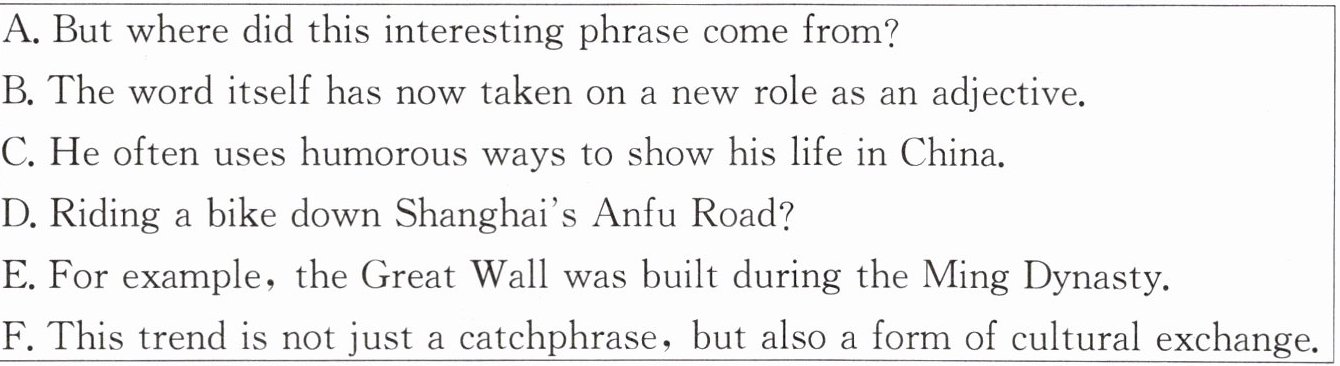 Road?
Road?
E. For example, the Great Wall was built during the Ming Dynasty.
F. This trend is not just a catchphrase, but also a form of cultural exchange.
1.
阅读短文,从短文后A至F六个选项中选出五个可以填入空白处的最佳选项。
Drinking milk tea with friends? That's "city". Visiting the Great Wall of China? Very "city". 1 Quite "city".
This simple question quickly caught the attention of Chinese netizens. If you don't get it, let me explain it to you. The popularity of the phrase "City bu city?" has recently risen online. It's used to describe whether someone or something feels urban(都市的),modern,and stylish.
2 It was first popularized by American blogger Paul Mike Ashton, known online as "Bao Bao Xiong". He has lived in Shanghai for years with his sister and sometimes shares his travel experiences on Douyin and Xiaohongshu. 3 His popularity soared after he posted a video asking his sister "City bu city?" while visiting the Great Wall.
With "city" being used this way, one key change is clear: 4 According to Ashton, it not only refers to something happening in the city but also describes "something that gives you a great love for life".
In recent years, many foreign visitors like Ashton have been sharing their experiences in China online. 5 Topics about travelling in China are gaining global attention, allowing people worldwide to learn about modern China and its way of life. Still, these stories are shared in an emotional,friendly,and natural style that resonates with many.
A. But where did this interesting phrase come from?
B. The word itself has now taken on a new role as an adjective.
C. He often uses humorous ways to show his life in China.
D. Riding a bike down Shanghai's
Road?E. For example, the Great Wall was built during the Ming Dynasty.
F. This trend is not just a catchphrase, but also a form of cultural exchange.
1.
D
2. A
3. C
4. B
5. F
答案
五、1. D 2. A 3. C 4. B 5. F
解析
【分析】本题为任务型阅读的句子还原题,需结合上下文语境与句子间的逻辑关系,选出合适选项填入空白处。解题时先通读全文,明确文章围绕“city”这一流行短语的来源、含义及文化意义展开;再逐个分析空白处前后内容:第1空前文是用“city”形容不同场景的举例,需继续举例的句子;第2空后文介绍短语起源,需引出来源的问句;第3空前后提到博主分享经历与走红,需衔接分享方式的句子;第4空前文提“关键变化”,需对应词性变化的句子;第5空前后讲外国博主分享与文化影响,需点明文化意义的句子,最终匹配选项。
【解析】1. 第1空:前文列举了用“city”形容的两个场景,D选项“Riding a bike down Shanghai's Anfu Road?”是继续举例,符合语境,故选D。2. 第2空:后文介绍该短语的起源,A选项“But where did this interesting phrase come from?”提出来源问题,引出下文,故选A。3. 第3空:前文提到博主分享旅行经历,后文说他因视频走红,C选项“He often uses humorous ways to show his life in China.”说明其分享方式,衔接上下文,故选C。4. 第4空:前文提到“one key change is clear”,B选项“The word itself has now taken on a new role as an adjective.”对应“关键变化”,说明词性新变化,故选B。5. 第5空:前文说外国博主分享中国经历,后文讲话题受全球关注,F选项“This trend is not just a catchphrase, but also a form of cultural exchange.”点明文化意义,衔接自然,故选F。
【答案】1.D 2.A 3.C 4.B 5.F
【知识点】任务型阅读、语篇逻辑衔接
【点评】本题考查任务型阅读中句子的衔接还原,要求学生梳理文章脉络,把握句子间的逻辑关系,难度适中,能有效考查学生的阅读理解与逻辑推理能力。
【难度系数】0.5
【解析】1. 第1空:前文列举了用“city”形容的两个场景,D选项“Riding a bike down Shanghai's Anfu Road?”是继续举例,符合语境,故选D。2. 第2空:后文介绍该短语的起源,A选项“But where did this interesting phrase come from?”提出来源问题,引出下文,故选A。3. 第3空:前文提到博主分享旅行经历,后文说他因视频走红,C选项“He often uses humorous ways to show his life in China.”说明其分享方式,衔接上下文,故选C。4. 第4空:前文提到“one key change is clear”,B选项“The word itself has now taken on a new role as an adjective.”对应“关键变化”,说明词性新变化,故选B。5. 第5空:前文说外国博主分享中国经历,后文讲话题受全球关注,F选项“This trend is not just a catchphrase, but also a form of cultural exchange.”点明文化意义,衔接自然,故选F。
【答案】1.D 2.A 3.C 4.B 5.F
【知识点】任务型阅读、语篇逻辑衔接
【点评】本题考查任务型阅读中句子的衔接还原,要求学生梳理文章脉络,把握句子间的逻辑关系,难度适中,能有效考查学生的阅读理解与逻辑推理能力。
【难度系数】0.5
