

 登录
Ⅰ. 根据首字母提示写出单词
1. It's i
2. You won't get enough vitamins u
3. You don't r
4. We were deeply m
5. If your studies t
1. It's i
impolite
to look around when someone is talking to you.2. You won't get enough vitamins u
unless
you include more fruits and vegetables in your everyday meals.3. You don't r
realize/realise
how important this is to Sally. You should take it seriously.4. We were deeply m
moved
by the kind doctor who helped many poor people.5. If your studies t
trouble
you, you could ask teachers and classmates for help.答案
1. impolite 2. unless 3. realize/realise 4. moved 5. trouble
Ⅱ.用方框中所给内容的正确形式填空
walk peace behave in one's way accept
1. The cat and the hen refused
2. I'm used to
3. We sat there together, enjoying the wonderful and
4. As a student, your personal
5. He saw a big box was
walk peace behave in one's way accept
1. The cat and the hen refused
to accept
the ugly duckling because he couldn't purr or lay eggs.2. I'm used to
walking
to school now and it's good for my health.3. We sat there together, enjoying the wonderful and
peaceful
sunset.4. As a student, your personal
behavior/behaviour
outside school also reflects the school.5. He saw a big box was
in his/others' way
, so he moved it aside to make the hallway clear.答案
1. to accept 解析:refuse to do sth意为“拒绝做某事”,故用动词不定式;根据句意,猫和母鸡拒绝接纳丑小鸭。故填to accept。
归纳总结 accept vs receive:“accept”表“主动接受”,“receive”表“被动收到”(如“accept a gift”接受礼物,“receive a gift”收到礼物)。
2. walking 解析:be used to doing sth意为“习惯于做某事”,其中to为介词,后接动名词。故填walking。
3. peaceful 解析:空处与wonderful并列修饰sunset,应用形容词;peace的形容词形式为peaceful。故填peaceful。
4. behavior/behaviour 解析:personal为形容词,后接名词;behave的名词形式为behaviour,意为“行为;举止”。故填behavior/behaviour。
5. in his/others' way 解析:in one's way意为“挡住某人的路”。根据语境one's可用his/others'。故填in his/others' way。
1. —Dale, you'd better mind your
It's impolite to talk loudly in the hospital.
—Sorry, Mum. I'll remember what you said.
A.customs
B.manners
C.values
D.methods
B
.It's impolite to talk loudly in the hospital.
—Sorry, Mum. I'll remember what you said.
A.customs
B.manners
C.values
D.methods
答案
1. B 解析:A选项customs意为“习俗”;B选项manners意为“礼貌,礼仪”;C选项values意为“价值观”;D选项methods意为“方法”。根据后文“It's impolite to talk loudly in the hospital.”可知,此处指“注意你的礼仪”,故选B。
2. —How was your trip to Sanya with your family last week, Sally?
—It was
A.pleasant; pleased
B.pleased; pleased
C.pleased; pleasant
D.pleasant; pleasant
—It was
pleasant
. All my family were pleased
with it.A.pleasant; pleased
B.pleased; pleased
C.pleased; pleasant
D.pleasant; pleasant
答案
2. A 解析:pleasant修饰物,pleased修饰人。第一空修饰trip,用pleasant;第二空修饰All my family,用pleased,“be pleased with”是固定搭配,意为“对……满意”,故选A。
3. English people are usually
A.too gentle
B.gentle enough
C.too impatient
D.patient enough
A
to push past you. They don't mind waiting.A.too gentle
B.gentle enough
C.too impatient
D.patient enough
答案
3. A 解析:本题考查too+形容词+to do sth这个核心句型,含义是“太……而不能做某事”,正好契合句子的逻辑关系。干扰项enough的用法是“形容词+enough+to do sth”,若用gentle enough或patient enough,代入后句子会变成“英国人通常足够温和/有耐心去挤过你”,和后半句“他们不介意等待”的语义完全矛盾,故选A。
4. —Mum, I won the first prize in the school writing competition.
—
A.Have a good time!
B.Good luck!
C.Best wishes!
D.Congratulations!
—
D
I'm proud of you.A.Have a good time!
B.Good luck!
C.Best wishes!
D.Congratulations!
答案
4. D 解析:A选项Have a good time!意为“玩得开心!”;B选项Good luck!意为“祝你好运!”;C选项Best wishes!意为“最美好的祝愿!”;D选项Congratulations!意为“恭喜你!”。根据前文“I won the first prize in the school writing competition”可知,此处应表示祝贺,故选D。
5. What should you do when you answer a phone according to the message below?
Telephone manners
• Answer the phone politely with a greeting.
• Ask who is calling and who he/she would like to speak to.
• Offer to take a me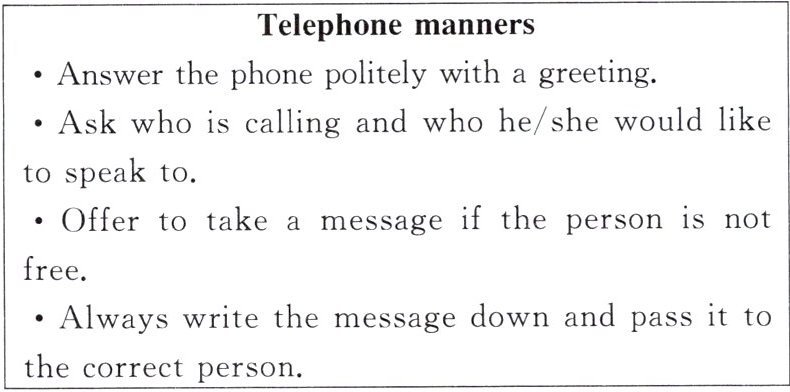 age if the person is not free.
• Always write the message down and pass it to the correct person.
A.Keep the caller's message secret.
B.Stay silent until the other person speaks.
C.Offer to take a message if needed.
D.Say "thank you" after you pick up the phone.
Telephone manners
• Answer the phone politely with a greeting.
• Ask who is calling and who he/she would like to speak to.
• Offer to take a me
age if the person is not free.• Always write the message down and pass it to the correct person.
A.Keep the caller's message secret.
B.Stay silent until the other person speaks.
C.Offer to take a message if needed.
D.Say "thank you" after you pick up the phone.
答案
C 解析:根据表格中“Telephone manners”的内容:“Answer the phone politely with a greeting.”、“Ask who is calling and who he/she would like to speak to.”、“Offer to take a message if the person is not free.”、“Always write the message down and pass it to the correct person.”可知,A选项“将留言保密”、B选项“等对方先说话”、D选项“接电话后说谢谢”均不符合礼貌的电话礼仪;C选项“必要时主动提出捎口信”与表格内容一致,故选C。
Ⅳ. 阅读理解
新素材 动物利用交通规则 Birds don't have very large brains, but they are super clever!
In 2025, Vladimir Dinets reported in Frontiers in Ethology that an immature Cooper’s hawk in New Jersey appeared to use pedestrian-crossing sound signals and the
resulting queues of cars as cover when hunting. This was discovered by Vladimir Dinets, who is both an animal expert and a mathematician, and his research was published on May 23, 2025, in Frontiers in Ethology. Other studies have pointed out that birds often use human buildings and vehicles(机动车) to help them hunt, but recognizing traffic lights is a first.
In the winter of 2021, Dinets saw a young Cooper’s Hawk standing in a tree near the traffic lights. It flew low with the cover of stopped cars, and disappeared into the front yard across the street. A moment later, it reappeared, catching a sparrow. This hunt left a deep impression on Dinets. It seemed to know when the traffic light was red.
Through continued observation(观察), Dinets believed it recognized traffic lights through the buzzing sound when the red light was on at a certain time. Also, the hawk knew that sparrows would be at a certain house because the residents regularly ate outside and left breadcrumbs and other small leftovers. So, the hawk used the cars which lined up to get close to the sparrows without being seen, making it easier to catch them.
This is more difficult than imagined.
The Cooper’s Hawk can’t see its prey(猎物) from the tree. So it has to remember the surroundings and work out a route. Also, it has to know that some buzzing sounds have something to do with traffic lights. This behaviour must come from careful calculations(计算), a great memory, and complex(复杂的) thinking skills. In a word, having this hunting skill needs a lot of intelligence(智力).
Maybe other animals can do the same, but
this Cooper’s Hawk is the first wild animal they’ve discovered. These birds fly through here when migrating(迁徙) in summer and winter. This means the Cooper’s Hawk probably learned to do this in just a few days or weeks.
Finally, Dinets also saw a Cooper’s Hawk hunting in the same manner the following winter (2022), and he believed it was the same hawk, now an adult. However, in the summer of the year after that, the sound signal from the streetlight was gone, the people living there moved away, and there were no longer any sparrows there. From then on, until the article was published, Dinets never saw the Cooper’s Hawk nearby again.
1. What did the Cooper’s Hawk use to judge the traffic lights?
A. Traffic lights' colours.B. The surroundings.
C. The stopped cars. D. The buzzing sound.
2. What does the underlined sentence “It flew low with the cover of stopped cars” mean?
A. The cars hid the hawk from sparrows.
B. The cars stopped the hawk from flying.
C. The hawk landed on the cars.
D. The hawk followed the moving cars.
3. 新考法 写作手法 How does the writer support the idea “This is more difficult than imagined”?
A. By quoting(引用) an expert’s words.
B. By giving numbers.
C. By making comparisons.
D. By presenting facts.
4. Which is the best title for the passage?
A. A Discovery About the Cooper’s Hawk
B. A Hawk Hiding Behind Stopped Cars
C. Sparrows Near One House
D. A Streetlight with No Signal
答案
1. D 2. A 3. D 4. A
【语篇解读】本文是一篇说明文,讲述研究者Vladimir Dinets观察到一只库珀鹰会借助行人过街信号声和由此形成的长车队作掩护捕猎。
1. D 解析:细节理解题。根据题干关键词“judge the traffic lights”,定位第四段“it recognized traffic lights through the buzzing sound when the red light was on”。可知库珀鹰通过红灯亮起时的嗡嗡声判断交通信号,D项与原文对应。故选D。
2. A 解析:句意猜测题。根据画线句后的动作和第四段“get close to the sparrows without being seen”可知,鹰借停着、排队的汽车作掩护,低飞靠近麻雀。A项“汽车把鹰遮挡在麻雀视线之外”准确概括句意。B项误把汽车理解为阻止鹰飞行,C、D项均无原文依据。故选A。
3. D 解析:写作手法题。画线句后列举了鹰看不见树下猎物、必须记住周围环境并规划路线、还要把嗡嗡声与交通灯联系起来等具体事实,以说明这种捕猎方式的难度。因此作者采用的是呈现事实的方式。文中没有采用引用专家原话、列数字或作比较这几种写作手法。故选D。
4. A 解析:标题归纳题。文章从研究者发现库珀鹰利用交通信号和停驶车辆捕猎写起,继而说明这种行为所需的复杂思维、它的学习速度以及后续观察,全文的中心是一项关于库珀鹰的发现。A项既点明研究对象,又能概括全文。B项只对应借停着的汽车隐蔽靠近猎物的一个情节,C项只写麻雀出现的地点,D项只写结尾街灯信号消失的细节,均不能覆盖全文。故选A。
