

 登录
二、翻译句子。
1. 探索太空有三个很好的理由。
2. 为太空开发的技术也能造福地球上的我们。
3. 一些卫星能帮助我们应对气候变化带来的问题。
4. 在遥远的未来,我们可能会在外太空找到新的资源。
5. 祝融号火星车成功登陆火星。
1. 探索太空有三个很好的理由。
There are three good reasons to explore space.
2. 为太空开发的技术也能造福地球上的我们。
Technology developed for space can benefit us here on Earth.
3. 一些卫星能帮助我们应对气候变化带来的问题。
Some satellites help us deal with problems caused by climate change.
4. 在遥远的未来,我们可能会在外太空找到新的资源。
In the distant future, we may find new resources in outer space.
5. 祝融号火星车成功登陆火星。
Zhurong rover successfully landed on Mars.
答案
二、1. There are three good reasons to explore space.
2. Technology developed for space can benefit us here on Earth.
3. Some satellites help us deal with problems caused by climate change.
4. In the distant future, we may find new resources in outer space.
5. Zhurong rover successfully landed on Mars.
解析
【分析】做汉译英时,先拆解中文句子的核心结构与常用表达:1. 第一句“有三个很好的理由”对应there be句型的固定结构“there are + 数量 + 名词 + to do sth”,“探索太空”译为explore space;2. 第二句“为太空开发的技术”需用过去分词developed作后置定语表被动,“造福”用benefit;3. 第三句“应对”对应固定搭配deal with,“气候变化带来的问题”译为problems caused by climate change;4. 第四句“遥远的未来”是固定短语in the distant future,“外太空”为outer space;5. 第五句“祝融号火星车”是专有名词,直接译为Zhurong rover,“登陆火星”用land on Mars,因是已发生事件用过去式landed。
【解析】1. 对应there be句型,译为There are three good reasons to explore space.;2. 过去分词作定语修饰technology,译为Technology developed for space can benefit us here on Earth.;3. 用deal with表达“应对”,译为Some satellites help us deal with problems caused by climate change.;4. 按时间状语+主谓宾结构,译为In the distant future, we may find new resources in outer space.;5. 专有名词+动词过去式,译为Zhurong rover successfully landed on Mars.
【答案】二、1. There are three good reasons to explore space.
2. Technology developed for space can benefit us here on Earth.
3. Some satellites help us deal with problems caused by climate change.
4. In the distant future, we may find new resources in outer space.
5. Zhurong rover successfully landed on Mars.
【知识点】英语句子翻译,there be句型,过去分词作定语
【点评】本题为基础汉译英练习题,考察常用句型、固定搭配及专有名词的翻译,注重英语表达的准确性,适合巩固基础。
【难度系数】0.8
三、(新情境)情景交际。从方框中选择合适的句子补全对话,有两项多余。
Anna: Hi Ms Wang! How was your life in space?
Ms Wang: It was amazing! I will never forget it.
Anna: 1.
Ms Wang: Well, it's really different from life on Earth. Everything floats!
Anna: That sounds fun! 2.
Ms Wang: We have to eat special food in bags. We can't eat normal meals there.
Anna: Oh, I see. 3.
Ms Wang: We have to tie ourselves down when we sleep, or we might float away!
Anna: Wow, that's cool! 4.
Ms Wang: The view of Earth from the space station is the most beautiful thing I've ever seen.
Anna: 5.
A. What's the most unforgettable part for you?
B. What do you usually eat there?
C. What is it like living in space?
D. How do you sleep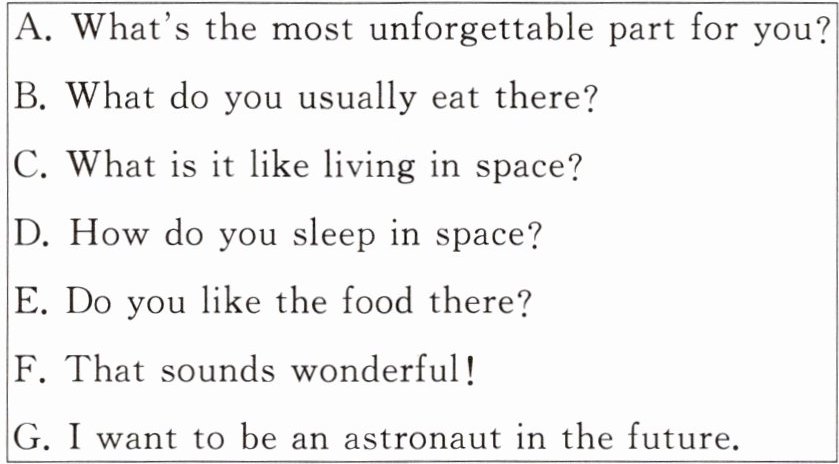 space?
E. Do you like the food there?
F. That sounds wonderful!
G. I want to be an astronaut in the future.
Anna: Hi Ms Wang! How was your life in space?
Ms Wang: It was amazing! I will never forget it.
Anna: 1.
C
Ms Wang: Well, it's really different from life on Earth. Everything floats!
Anna: That sounds fun! 2.
B
Ms Wang: We have to eat special food in bags. We can't eat normal meals there.
Anna: Oh, I see. 3.
D
Ms Wang: We have to tie ourselves down when we sleep, or we might float away!
Anna: Wow, that's cool! 4.
A
Ms Wang: The view of Earth from the space station is the most beautiful thing I've ever seen.
Anna: 5.
F
I hope I can visit space one day too!A. What's the most unforgettable part for you?
B. What do you usually eat there?
C. What is it like living in space?
D. How do you sleep
space?E. Do you like the food there?
F. That sounds wonderful!
G. I want to be an astronaut in the future.
答案
三、1-5 CBDAF
解析
【分析】
通读对话,理解上下文语境:Anna依次询问Ms Wang的太空生活相关情况,需根据Ms Wang的答语匹配对应的问句或答句。第1空,Ms Wang回答太空生活与地球不同,对应询问太空生活状况的句子;第2空,Ms Wang回答吃的特殊食物,对应询问饮食的句子;第3空,Ms Wang回答睡觉的方式,对应询问睡觉方式的句子;第4空,Ms Wang提到最难忘的是地球景色,对应询问最难忘部分的句子;第5空,Anna听完后表达赞叹,对应表示赞叹的句子。
【解析】
1. 根据下文答语“it's really different from life on Earth. Everything floats!”可知,此处询问太空生活是什么样的,对应选项C,故选C。
2. 根据下文答语“We have to eat special food in bags.”可知,此处询问在太空通常吃什么,对应选项B,故选B。
3. 根据下文答语“We have to tie ourselves down when we sleep...”可知,此处询问在太空如何睡觉,对应选项D,故选D。
4. 根据下文答语“The view of Earth from the space station is the most beautiful thing I've ever seen.”可知,此处询问最难忘的部分,对应选项A,故选A。
5. 根据上文Ms Wang描述地球景色很美,此处Anna表达赞叹,对应选项F,故选F。
【答案】
CBDAF
【知识点】
情景交际
【点评】
本题为情景交际题,需结合上下文逻辑选择合适句子,难度适中,学生理清对话前后关联即可作答。
【难度系数】
0.5
四、选词填空。用方框中所给单词的适当形式填空。
scientist important make three curious and head we universe in
Scientists found an exciting new thing in space. It is called 3I/Atlas, 1.
3.
3I/Atlas is very far from the earth. Scientists found that it will never come close to 7.
Why are scientists so 8.
scientist important make three curious and head we universe in
Scientists found an exciting new thing in space. It is called 3I/Atlas, 1.
and
it's a kind of special comet(彗星). What 2. makes
it so special? This comet comes from outside our solar system! We call such things interstellar(星际的) travellers.3.
In
the solar system, many comets go around the sun. But 3I/Atlas is different. It's just passing by on its long trip through space. This is actually the 4. third
time that scientists have found such a visitor from another star system. When people first heard about this strange comet, some asked: "Could it be an alien spaceship?" 5. Scientists
found that it's surely a natural thing. Like all comets, it has a bright 6. head
and sometimes shows a tail when it gets near the sun.3I/Atlas is very far from the earth. Scientists found that it will never come close to 7.
our
planet, so everyone can feel safe.Why are scientists so 8.
curious
about this space visitor? Because it can help us learn more about other star systems in the 9. universe
. We can find out how planets and stars form in different parts of space by exploring these interstellar travellers. Who knows? Maybe one day you will make an 10. important
discovery about space, too!答案
四、1. and 2. makes 3. In 4. third
5. Scientists 6. head 7. our
8. curious 9. universe 10. important
解析
【分析】首先通读全文,理解文章关于发现星际彗星3I/Atlas的内容。解题思路:1. 明确方框内单词的词义与词性;2. 逐句分析每个空的语境,结合语法(如词性、时态、序数词、物主代词等)选择合适单词并调整适当形式;3. 验证所选内容是否符合上下文逻辑与语法规则。
【解析】1. 空格前后为并列句子,需用连词连接,方框中and符合,故填and;2. 主语what为单数,时态是一般现在时,动词make需用第三人称单数形式makes,故填makes;3. 表示“在太阳系里”用介词in,句首首字母大写,故填In;4. 此处表“第三次”,需用序数词,three的序数词是third,故填third;5. 句子缺主语,结合语境是“科学家们”的发现,方框中scientist的复数Scientists,句首首字母大写,故填Scientists;6. 此处指彗星的明亮“头”,名词head符合,故填head;7. 空格后是名词planet,需用形容词性物主代词,we的形容词性物主代词是our,故填our;8. 此处为形容词作表语,be curious about是固定搭配,意为“对……好奇”,方框中curious符合,故填curious;9. in the universe是固定短语,意为“在宇宙中”,故填universe;10. 空格后是名词discovery,需用形容词修饰,方框中important符合,故填important。
【答案】1. and 2. makes 3. In 4. third 5. Scientists 6. head 7. our 8. curious 9. universe 10. important
【知识点】介词的用法、动词的适当形式、形容词的用法
【点评】本题为选词填空题型,考查学生对词汇在具体语境中的运用能力,需结合上下文逻辑和语法知识解题,难度适中,是初中英语常见基础题型。
【难度系数】0.6
