

 登录
1. 正十边形的每个中心角的度数都是(
A.$72°$
B.$36°$
C.$30°$
D.$18°$
B
)A.$72°$
B.$36°$
C.$30°$
D.$18°$
答案
1. B
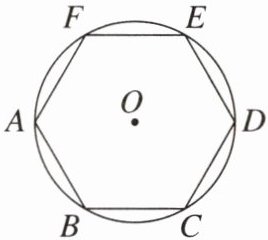
2. 如图,正六边形ABCDEF内接于$\odot O$.若$\odot O$的周长是$12π$,则点F到BC的距离是(
A.$3$
B.$3\sqrt{3}$
C.$6$
D.$6\sqrt{3}$
D
)A.$3$
B.$3\sqrt{3}$
C.$6$
D.$6\sqrt{3}$
答案
2. D
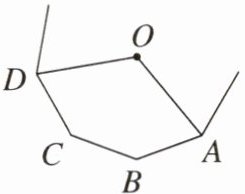
3.如图,点A,B,C,D为一个正多边形的部分顶点,点O为正多边形的中心.若∠AOD=120°,则这个正多边形的边数为
9
答案
3. 9
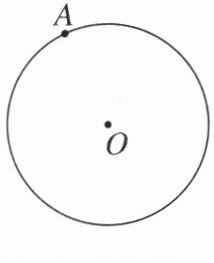
4.如图,点A是$\odot O$上一点.请利用直尺和圆规画出$\odot O$的内接正三角形ABC.(保留作图痕迹,不写作法)
答案
【解】如图,$△ ABC$即为所求。
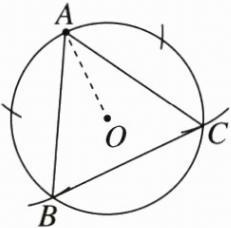
5.如图,$\odot O$的直径为20,根据八个方位将圆八等分.过点E作$\odot O$的切线,与AG的延长线相交于点M,连接AE,EG.
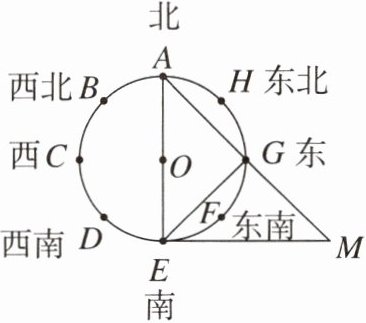
(1)相邻两个方位之间的弧所对的圆心角的度数为
(2)求AG的长.
(3)求线段ME与EG的长.
(1)相邻两个方位之间的弧所对的圆心角的度数为
45°
.(2)求AG的长.
(3)求线段ME与EG的长.
答案
5. 【解】(1)$45°$
(2)$\because AE$ 为$\odot O$ 的直径,
$\therefore∠ AGE=90°.$
$\because\overset{\frown}{AG}=\overset{\frown}{EG},$
$\therefore AG=EG.$
在 $\mathrm{Rt}△ AGE$ 中,根据勾股定理,得 $AG^2+EG^2=AE^2.$
$\therefore AG=\frac{\sqrt{2}}{2}AE=\frac{\sqrt{2}}{2}×20=10\sqrt{2}.$
(3)$\because ME$ 为$\odot O$ 的切线,
$\therefore∠ AEM=90°.$
由(2)可知$∠ AGE=90°,EG=AG=10\sqrt{2}.$
$\therefore∠ GAE=45°.$
$\therefore∠ M=180°-90°-45°=45°.$
$\therefore ME=AE=20.$
6. 如图,正三角形、正方形、正六边形等正$n$边形与圆的形状有差异,我们将正$n$边形与圆的接近程度称为“接近度”.
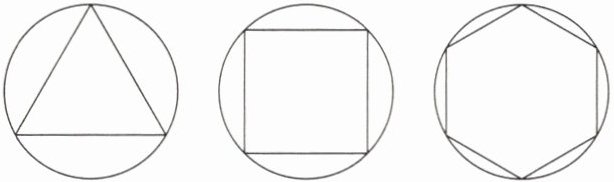
(1)定义正$n$边形的角的“接近度”:设正$n$边形的每个内角都为$m°$,将正$n$边形的角的“接近度”定义为$|180 - m|$.于是$|180 - m|$的值越小,该正$n$边形就越接近圆.
①正三角形的角的“接近度”的值为
②当正$n$边形的角的“接近度”的值为
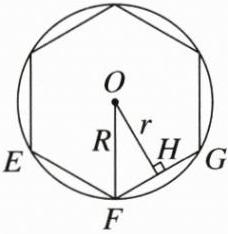
(2)定义正$n$边形的边的“接近度”:设正$n$边形的外接圆的半径为$R$,正$n$边形的边心距为$r$,将正$n$边形的边的“接近度”定义为$\left| \frac{r}{R} - 1 \right|$.分别计算当$n=3$, $n=6$时,正$n$边形的边的“接近度”的值,并猜测当正$n$边形的边的“接近度”的值为多少时,正$n$边形就成了圆.
(1)定义正$n$边形的角的“接近度”:设正$n$边形的每个内角都为$m°$,将正$n$边形的角的“接近度”定义为$|180 - m|$.于是$|180 - m|$的值越小,该正$n$边形就越接近圆.
①正三角形的角的“接近度”的值为
120
;正二十边形的角的“接近度”的值为18
.②当正$n$边形的角的“接近度”的值为
0
时,正$n$边形就成了圆.(2)定义正$n$边形的边的“接近度”:设正$n$边形的外接圆的半径为$R$,正$n$边形的边心距为$r$,将正$n$边形的边的“接近度”定义为$\left| \frac{r}{R} - 1 \right|$.分别计算当$n=3$, $n=6$时,正$n$边形的边的“接近度”的值,并猜测当正$n$边形的边的“接近度”的值为多少时,正$n$边形就成了圆.
答案
6. 【解】(1)①120 18
②0
(2)如图,当 $n=3$ 时,$\odot O$ 为正三角形 $ABC$ 的外接圆,连接 $OA$,$OD⊥ AB$,垂足为 $D$.
易得 $∠ CAB = 60°$,$∠ OAD=30°,∠ ODA=90°.$
$\therefore\frac{OD}{OA}=\frac{r}{R}=\frac{1}{2}.$
$\therefore\left| \frac{r}{R}-1 \right|=\frac{1}{2}.$

如图,当 $n=6$ 时,$\odot O$ 为正六边形的外接圆,连接 $OF$,$OH⊥ FG$,垂足为 $H$.
易得 $∠ EFG = 120°$,$∠ OFH=60°.$
$\because∠ OHF=90°,$
$\therefore∠ FOH=180°-90°-60°=30°.$
$\therefore FH=\frac{1}{2}OF.$
在 $\mathrm{Rt}△ OFH$ 中,根据勾股定理,得 $OH^2+FH^2=OF^2.$
$\therefore OH=\frac{\sqrt{3}}{2}OF.$
$\therefore\frac{OH}{OF}=\frac{r}{R}=\frac{\sqrt{3}}{2}.$
$\therefore\left| \frac{r}{R}-1 \right|=1-\frac{\sqrt{3}}{2}.$
当正 $n$ 边形的边的“接近度”的值为 0 时,正 $n$ 边形就成了圆.
