

 登录
登录
Ⅵ. 完形填空。
Chinese names have a long history. Many Chinese families have a family
Generally, Chinese
We Chinese put family names first,
()1. A. box B. tree C. map D. page
()2. A. think B. tell C. want D. see
()3. A. family names B. first names C. full names D. middle names
()4. A. tidy B. happy C. right D. sad
()5. A. country B. class C. school D. family
()6. A. on B. at C. in D. of
()7. A. and B. or C. but D. so
()8. A. We B. They C. You D. He
()9. A. four B. three C. two D. one
()10. A. middle B. first C. last D. third
Chinese names have a long history. Many Chinese families have a family
B
1. You can D
2 all the family members(成员) in it.Generally, Chinese
A
3 are passed down(传承). Many Chinese are B
4 when they meet a new friend with the same family name. As an old saying(谚语) goes, “People with the same family name were from the same D
5 500 years ago.” There are lots of family names C
6 China.We Chinese put family names first,
C
7 English people are different from us. B
8 put their family names last. And they usually have B
9 names: a first name, a middle name and a last name. People don’t use their A
10 names very often. So John Henry Brown is often called John Brown.()1. A. box B. tree C. map D. page
()2. A. think B. tell C. want D. see
()3. A. family names B. first names C. full names D. middle names
()4. A. tidy B. happy C. right D. sad
()5. A. country B. class C. school D. family
()6. A. on B. at C. in D. of
()7. A. and B. or C. but D. so
()8. A. We B. They C. You D. He
()9. A. four B. three C. two D. one
()10. A. middle B. first C. last D. third
答案
Ⅵ. 1. B 2. D 3. A 4. B 5. D 6. C 7. C
8. B 9. B 10. A
8. B 9. B 10. A
解析
【分析】
先通读全文,明确文章主题是介绍中英姓名文化差异,尤其是中国姓氏的传承特点和英国姓名的结构。解题时需结合上下文语境、词义辨析、固定搭配及文化常识逐一判断每个空的选项,确保逻辑通顺、符合文意。
【解析】
1. 选B。固定搭配“family tree”意为“家谱”,符合“能在家谱里看到所有家庭成员”的语境,其余选项(box盒子、map地图、page页)均不符合。
2. 选D。see表示“看见”,句意是在家谱中可看到所有家庭成员,think(想)、tell(告诉)、want(想要)不符合语境。
3. 选A。文章核心围绕中国姓氏展开,“family names(姓氏)”符合“中国姓氏代代传承”的主题,first names(名)、full names(全名)、middle names(中间名)偏离主题。
4. 选B。遇到同姓新朋友,中国人会感到开心,happy符合情感逻辑,tidy(整洁的)、right(正确的)、sad(难过的)不符合。
5. 选D。谚语“五百年前是一家”对应“same family(同一个家族)”,country(国家)、class(班级)、school(学校)不符合文化常识。
6. 选C。“在中国”用介词in,是固定用法,on(在…上)、at(在…点)、of(…的)搭配错误。
7. 选C。前半句说中国人姓在前,后半句转折说明英国人不同,用but表转折,and(和)、or(或者)、so(所以)逻辑不符。
8. 选B。指代前文的“English people”用复数代词they,we(我们)、you(你/你们)、he(他)指代错误。
9. 选B。后文提到“first name, middle name, last name”共三个名字,故填three,其余数量不符合。
10. 选A。举例John Henry Brown常被简称为John Brown,说明不常用中间名,middle符合文意,first(名)、last(姓)、third(第三)不符合。
【答案】
1.B 2.D 3.A 4.B 5.D 6.C 7.C 8.B 9.B 10.A
【知识点】
完形填空、名词辨析、介词用法
【点评】
本题围绕中英姓名文化展开,考察词汇运用、语境理解及基础文化常识,是初中英语常见题型,侧重基础应用能力。
【难度系数】
0.6
先通读全文,明确文章主题是介绍中英姓名文化差异,尤其是中国姓氏的传承特点和英国姓名的结构。解题时需结合上下文语境、词义辨析、固定搭配及文化常识逐一判断每个空的选项,确保逻辑通顺、符合文意。
【解析】
1. 选B。固定搭配“family tree”意为“家谱”,符合“能在家谱里看到所有家庭成员”的语境,其余选项(box盒子、map地图、page页)均不符合。
2. 选D。see表示“看见”,句意是在家谱中可看到所有家庭成员,think(想)、tell(告诉)、want(想要)不符合语境。
3. 选A。文章核心围绕中国姓氏展开,“family names(姓氏)”符合“中国姓氏代代传承”的主题,first names(名)、full names(全名)、middle names(中间名)偏离主题。
4. 选B。遇到同姓新朋友,中国人会感到开心,happy符合情感逻辑,tidy(整洁的)、right(正确的)、sad(难过的)不符合。
5. 选D。谚语“五百年前是一家”对应“same family(同一个家族)”,country(国家)、class(班级)、school(学校)不符合文化常识。
6. 选C。“在中国”用介词in,是固定用法,on(在…上)、at(在…点)、of(…的)搭配错误。
7. 选C。前半句说中国人姓在前,后半句转折说明英国人不同,用but表转折,and(和)、or(或者)、so(所以)逻辑不符。
8. 选B。指代前文的“English people”用复数代词they,we(我们)、you(你/你们)、he(他)指代错误。
9. 选B。后文提到“first name, middle name, last name”共三个名字,故填three,其余数量不符合。
10. 选A。举例John Henry Brown常被简称为John Brown,说明不常用中间名,middle符合文意,first(名)、last(姓)、third(第三)不符合。
【答案】
1.B 2.D 3.A 4.B 5.D 6.C 7.C 8.B 9.B 10.A
【知识点】
完形填空、名词辨析、介词用法
【点评】
本题围绕中英姓名文化展开,考察词汇运用、语境理解及基础文化常识,是初中英语常见题型,侧重基础应用能力。
【难度系数】
0.6
Ⅶ.阅读短文,完成练习。
How to Make New Friends
Everyone needs friends. Friends can share difficulties(苦难) and happiness(快乐). But how can we make friends? Here are some good ways.
1.
If you want to make friends, first you need to go out to meet people. Remember, friends can't come to you when you sit at home and play on your computer all day.
2.
If you are interested in music, just join the guitar club or the violin(小提琴) club. If you like drawing, just join the art club. This is a great way to make friends with people who have the same hobbies as you.
3.
You will not make friends if you do not talk to others. Some small talk can help you start a friendship. So don't be shy. Just talk to others by greeting them with "Good morning".
4.
You can help at the old people's home, a hospital or a school in your free time. Volunteering is a good way for you to meet others. By working with them, you can know them and make friends with them.
5.
If you want to make good friends, you need to be a good friend first. No one wants to make friends with people who don't look friendly.
A.选择恰当的小标题,其中有一项是多余选项。
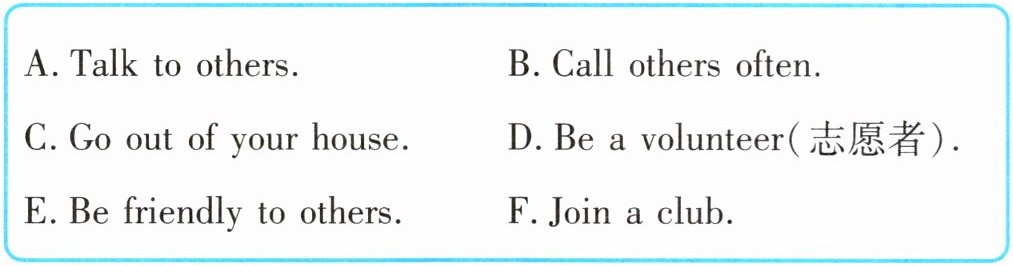
A. Talk to others. B. Call others often.
C. Go out of your house. D. Be a volunteer(志愿者).
E. Be friendly to others. F. Join a club.
B.你能想起其他有关交友的好方法吗?写出一条或多条。
Your good way(s):
How to Make New Friends
Everyone needs friends. Friends can share difficulties(苦难) and happiness(快乐). But how can we make friends? Here are some good ways.
1.
If you want to make friends, first you need to go out to meet people. Remember, friends can't come to you when you sit at home and play on your computer all day.
2.
If you are interested in music, just join the guitar club or the violin(小提琴) club. If you like drawing, just join the art club. This is a great way to make friends with people who have the same hobbies as you.
3.
You will not make friends if you do not talk to others. Some small talk can help you start a friendship. So don't be shy. Just talk to others by greeting them with "Good morning".
4.
You can help at the old people's home, a hospital or a school in your free time. Volunteering is a good way for you to meet others. By working with them, you can know them and make friends with them.
5.
If you want to make good friends, you need to be a good friend first. No one wants to make friends with people who don't look friendly.
A.选择恰当的小标题,其中有一项是多余选项。
A. Talk to others. B. Call others often.
C. Go out of your house. D. Be a volunteer(志愿者).
E. Be friendly to others. F. Join a club.
B.你能想起其他有关交友的好方法吗?写出一条或多条。
Your good way(s):
答案
Ⅶ. A. 1. C 2. F 3. A 4. D 5. E
B. 1. Don't be shy!
2. Ask questions.
3. Don't forget to share.(答案不唯一,仅供参考)
B. 1. Don't be shy!
2. Ask questions.
3. Don't forget to share.(答案不唯一,仅供参考)
解析
【分析】
本题分为A、B两部分,A部分是信息匹配题,需提取每个段落的核心主旨,匹配对应的交友方法小标题;B部分是开放性题目,需结合交友常识写出合理的方法。解题时,先逐段分析段落核心:第1段强调要出门接触他人,对应选项C;第2段围绕加入兴趣俱乐部展开,对应选项F;第3段核心是与他人交谈,对应选项A;第4段提到做志愿活动,对应选项D;第5段强调要对他人友好,对应选项E。B部分围绕交友的有效行为作答即可。
【解析】
A部分:1. 第1段关键信息“go out to meet people”,匹配选项C“Go out of your house”;2. 第2段围绕加入音乐、绘画等俱乐部展开,匹配选项F“Join a club”;3. 第3段核心是“talk to others”,匹配选项A“Talk to others”;4. 第4段提到在养老院、医院等场所做志愿,匹配选项D“Be a volunteer”;5. 第5段强调要对他人友好,匹配选项E“Be friendly to others”。
B部分:为开放性题目,围绕交友的合理方法作答即可,例如主动微笑打招呼、分享小物品等。
【答案】
A. 1.C 2.F 3.A 4.D 5.E;B. 示例:主动微笑打招呼;分享自己的小物品;记住对方的名字;多参加集体活动;耐心倾听他人的话(答案不唯一)
【知识点】
英语阅读理解;信息匹配;话题应用
【点评】
本题考查学生对短文的理解、信息提取及拓展应用能力,围绕交友主题贴近学生生活,难度适中。
【难度系数】
0.6
本题分为A、B两部分,A部分是信息匹配题,需提取每个段落的核心主旨,匹配对应的交友方法小标题;B部分是开放性题目,需结合交友常识写出合理的方法。解题时,先逐段分析段落核心:第1段强调要出门接触他人,对应选项C;第2段围绕加入兴趣俱乐部展开,对应选项F;第3段核心是与他人交谈,对应选项A;第4段提到做志愿活动,对应选项D;第5段强调要对他人友好,对应选项E。B部分围绕交友的有效行为作答即可。
【解析】
A部分:1. 第1段关键信息“go out to meet people”,匹配选项C“Go out of your house”;2. 第2段围绕加入音乐、绘画等俱乐部展开,匹配选项F“Join a club”;3. 第3段核心是“talk to others”,匹配选项A“Talk to others”;4. 第4段提到在养老院、医院等场所做志愿,匹配选项D“Be a volunteer”;5. 第5段强调要对他人友好,匹配选项E“Be friendly to others”。
B部分:为开放性题目,围绕交友的合理方法作答即可,例如主动微笑打招呼、分享小物品等。
【答案】
A. 1.C 2.F 3.A 4.D 5.E;B. 示例:主动微笑打招呼;分享自己的小物品;记住对方的名字;多参加集体活动;耐心倾听他人的话(答案不唯一)
【知识点】
英语阅读理解;信息匹配;话题应用
【点评】
本题考查学生对短文的理解、信息提取及拓展应用能力,围绕交友主题贴近学生生活,难度适中。
【难度系数】
0.6
