

 登录
登录
7.求函数$f(x)=\tan^2 x - \tan x, x\in[-\dfrac{π}{4},\dfrac{π}{4}]$的最大值与最小值之和。
答案
解:令$t=\tan x$。因为$x\in[-\dfrac{π}{4},\dfrac{π}{4}]$,所以$t\in[-1,1]$,
则原函数等价于$y=t^2-t=(t-\dfrac{1}{2})^2-\dfrac{1}{4}$,
所以$y=t^2-t$的图象的对称轴方程为$t=\dfrac{1}{2}$,
所以$y=t^2-t$在$t\in[-1,\dfrac{1}{2}]$上单调递减,在$t\in(\dfrac{1}{2},1]$上单调递增。
当$t=-1$时,$y=2$,当$t=1$时,$y=0$,
所以当$t=-1$时,$y_{\max}=2$,当$t=\dfrac{1}{2}$时,$y_{\min}=-\dfrac{1}{4}$,
故函数$f(x)=\tan^2 x - \tan x, x\in[-\dfrac{π}{4},\dfrac{π}{4}]$的最大值与最小值之和为$2-\dfrac{1}{4}=\dfrac{7}{4}$。
则原函数等价于$y=t^2-t=(t-\dfrac{1}{2})^2-\dfrac{1}{4}$,
所以$y=t^2-t$的图象的对称轴方程为$t=\dfrac{1}{2}$,
所以$y=t^2-t$在$t\in[-1,\dfrac{1}{2}]$上单调递减,在$t\in(\dfrac{1}{2},1]$上单调递增。
当$t=-1$时,$y=2$,当$t=1$时,$y=0$,
所以当$t=-1$时,$y_{\max}=2$,当$t=\dfrac{1}{2}$时,$y_{\min}=-\dfrac{1}{4}$,
故函数$f(x)=\tan^2 x - \tan x, x\in[-\dfrac{π}{4},\dfrac{π}{4}]$的最大值与最小值之和为$2-\dfrac{1}{4}=\dfrac{7}{4}$。
8.(多选)对于函数$f(x)=\tan(2x+\frac{π}{4})$,则(
A.$f(x)$的最小正周期为$\frac{π}{2}$
B.$f(x)$的图象关于$x=-\frac{π}{8}$对称
C.$f(x)$在$(0,\frac{π}{4})$上单调递增
D.$f(x)$的图象关于点$(\frac{3π}{8},0)$对称
AD
)A.$f(x)$的最小正周期为$\frac{π}{2}$
B.$f(x)$的图象关于$x=-\frac{π}{8}$对称
C.$f(x)$在$(0,\frac{π}{4})$上单调递增
D.$f(x)$的图象关于点$(\frac{3π}{8},0)$对称
答案
AD 函数$f(x)=\tan(2x+\dfrac{π}{4})$的最小正周期为$\dfrac{π}{2}$,A正确;
正切函数$y=\tan x$没有对称轴,因此$f(x)$的图象不关于$x=-\dfrac{π}{8}$对称,B错误;
当$x\in(0,\dfrac{π}{4})$时,$2x+\dfrac{π}{4}\in(\dfrac{π}{4},\dfrac{3π}{4})$,正切函数$y=\tan x$在$(\dfrac{π}{4},\dfrac{3π}{4})$上不单调,因此函数$f(x)$在$(0,\dfrac{π}{4})$上不单调,C错误;
由$f(\dfrac{3π}{8})=\tanπ=0$,得$f(x)$的图象关于点$(\dfrac{3π}{8},0)$对称,D正确。
正切函数$y=\tan x$没有对称轴,因此$f(x)$的图象不关于$x=-\dfrac{π}{8}$对称,B错误;
当$x\in(0,\dfrac{π}{4})$时,$2x+\dfrac{π}{4}\in(\dfrac{π}{4},\dfrac{3π}{4})$,正切函数$y=\tan x$在$(\dfrac{π}{4},\dfrac{3π}{4})$上不单调,因此函数$f(x)$在$(0,\dfrac{π}{4})$上不单调,C错误;
由$f(\dfrac{3π}{8})=\tanπ=0$,得$f(x)$的图象关于点$(\dfrac{3π}{8},0)$对称,D正确。
9.下列不等式成立的是 (
A.$\tan 1 > -\tan 2$
B.$\tan 735° > \tan 800°$
C.$\tan \frac{5π}{7} > \tan \frac{4π}{7}$
D.$\tan \frac{9π}{8} > \tan \frac{π}{7}$
C
)A.$\tan 1 > -\tan 2$
B.$\tan 735° > \tan 800°$
C.$\tan \frac{5π}{7} > \tan \frac{4π}{7}$
D.$\tan \frac{9π}{8} > \tan \frac{π}{7}$
答案
C 由$0<1<\dfrac{π}{3}$且$\dfrac{π}{2}<2<\dfrac{2π}{3}$,以及正切函数$y=\tan x$的性质,得$0<\tan1<\tan\dfrac{π}{3}=\sqrt{3}$,$\tan2<0$且$\tan2<\tan\dfrac{2π}{3}=-\sqrt{3}$,
所以$-\tan2>\sqrt{3}$,所以$\tan1<-\tan2$,所以A不成立。
由$\tan735°=\tan15°$,$\tan800°=\tan80°$,以及正切函数$y=\tan x$的单调性可得,$\tan15°<\tan80°$,即$\tan735°<\tan800°$,所以B不成立。
由正切函数$y=\tan x$在$(\dfrac{π}{2},π)$上单调递增,且$\dfrac{4π}{7}<\dfrac{5π}{7}$,得$\tan\dfrac{5π}{7}>\tan\dfrac{4π}{7}$,所以C成立。
由$\tan\dfrac{9π}{8}=\tan(π+\dfrac{π}{8})=\tan\dfrac{π}{8}$,$\dfrac{π}{8}<\dfrac{π}{7}$,以及正切函数$y=\tan x$的单调性,得$\tan\dfrac{π}{8}<\tan\dfrac{π}{7}$,即$\tan\dfrac{9π}{8}<\tan\dfrac{π}{7}$,所以D不成立。
所以$-\tan2>\sqrt{3}$,所以$\tan1<-\tan2$,所以A不成立。
由$\tan735°=\tan15°$,$\tan800°=\tan80°$,以及正切函数$y=\tan x$的单调性可得,$\tan15°<\tan80°$,即$\tan735°<\tan800°$,所以B不成立。
由正切函数$y=\tan x$在$(\dfrac{π}{2},π)$上单调递增,且$\dfrac{4π}{7}<\dfrac{5π}{7}$,得$\tan\dfrac{5π}{7}>\tan\dfrac{4π}{7}$,所以C成立。
由$\tan\dfrac{9π}{8}=\tan(π+\dfrac{π}{8})=\tan\dfrac{π}{8}$,$\dfrac{π}{8}<\dfrac{π}{7}$,以及正切函数$y=\tan x$的单调性,得$\tan\dfrac{π}{8}<\tan\dfrac{π}{7}$,即$\tan\dfrac{9π}{8}<\tan\dfrac{π}{7}$,所以D不成立。
10.函数$y=|\tan x - \sin x| - \tan x - \sin x$在区间$(\frac{π}{2},\frac{3π}{2})$内的图象是(
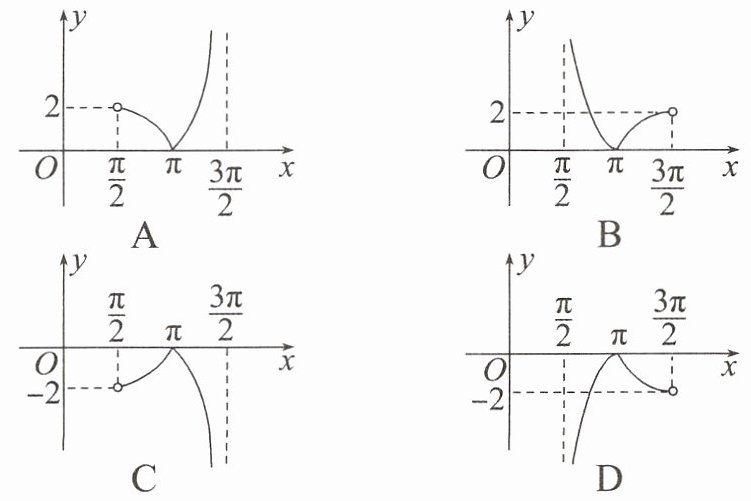
B
)答案
B 因为函数$y=|\tan x - \sin x| - \tan x - \sin x,x\in(\dfrac{π}{2},\dfrac{3π}{2})$,(分$x\in(\dfrac{π}{2},π]$和$x\in(π,\dfrac{3π}{2})$两种情况讨论,去掉绝对值判断)
所以当$x\in(\dfrac{π}{2},π]$时,$\tan x - \sin x<0$,
所以$y=|\tan x - \sin x| - \tan x - \sin x=\sin x - \tan x - \tan x - \sin x=-2\tan x$,
此时函数在该区间上单调递减,且$y\ge0$,可排除选项C,D;
当$x\in(π,\dfrac{3π}{2})$时,$\tan x - \sin x>0$,
所以$y=|\tan x - \sin x| - \tan x - \sin x=\tan x - \sin x - \tan x - \sin x=-2\sin x$,
此时函数在该区间上单调递增,且$0<y<2$,可排除选项A。
所以当$x\in(\dfrac{π}{2},π]$时,$\tan x - \sin x<0$,
所以$y=|\tan x - \sin x| - \tan x - \sin x=\sin x - \tan x - \tan x - \sin x=-2\tan x$,
此时函数在该区间上单调递减,且$y\ge0$,可排除选项C,D;
当$x\in(π,\dfrac{3π}{2})$时,$\tan x - \sin x>0$,
所以$y=|\tan x - \sin x| - \tan x - \sin x=\tan x - \sin x - \tan x - \sin x=-2\sin x$,
此时函数在该区间上单调递增,且$0<y<2$,可排除选项A。
11.已知函数$f(x)=\tan(2ω x+\dfrac{π}{3})$($ω>0$)在$[0,\dfrac{π}{2}]$上单调递增,则$ω$的取值范围为
(提示:先确定内层函数在区间$[0,\dfrac{π}{2}]$上的取值范围,再根据正切函数的单调性,确定该范围在正切函数的某个单调递增区间内,最后通过解不等式求出$ω$的取值范围)
$(0,\dfrac{1}{6})$
。(提示:先确定内层函数在区间$[0,\dfrac{π}{2}]$上的取值范围,再根据正切函数的单调性,确定该范围在正切函数的某个单调递增区间内,最后通过解不等式求出$ω$的取值范围)
答案
$(0,\dfrac{1}{6})$ 当$x\in[0,\dfrac{π}{2}]$时,$2ω x+\dfrac{π}{3}\in[\dfrac{π}{3},ωπ+\dfrac{π}{3}]$。
因为$f(x)$在$[0,\dfrac{π}{2}]$上单调递增,结合正切函数的单调性,得$\dfrac{π}{3}<ωπ+\dfrac{π}{3}<\dfrac{π}{2}$,解得$0<ω<\dfrac{1}{6}$,
所以$ω$的取值范围为$(0,\dfrac{1}{6})$。
因为$f(x)$在$[0,\dfrac{π}{2}]$上单调递增,结合正切函数的单调性,得$\dfrac{π}{3}<ωπ+\dfrac{π}{3}<\dfrac{π}{2}$,解得$0<ω<\dfrac{1}{6}$,
所以$ω$的取值范围为$(0,\dfrac{1}{6})$。
12.已知函数$f(x)=3\tan(\frac{1}{2}x-\frac{π}{3})$.
(1)求$f(x)$的定义域、值域;
(2)求$f(x)$的最小正周期、奇偶性和单调区间.
答案 P63
(1)求$f(x)$的定义域、值域;
(2)求$f(x)$的最小正周期、奇偶性和单调区间.
答案 P63
答案
解:(1)令$\dfrac{1}{2}x-\dfrac{π}{3}≠ \dfrac{π}{2}+kπ,k\in\mathbf{Z}$,得$x≠ \dfrac{5π}{3}+2kπ,k\in\mathbf{Z}$,
所以$f(x)$的定义域为$\{x∣ x≠ \dfrac{5π}{3}+2kπ,k\in\mathbf{Z}\}$。
因为函数$y=\tan x$的值域为$\mathbf{R}$,
所以$f(x)$的值域为$\mathbf{R}$。
(2)因为函数$f(x)$中的$ω=\dfrac{1}{2}$,所以函数$f(x)$的最小正周期$T=\dfrac{π}{ω}=2π$。
因为$f(x)$的定义域为$\{x∣ x≠ \dfrac{5π}{3}+2kπ,k\in\mathbf{Z}\}$,且$f(0)=3\tan(-\dfrac{π}{3})=-3\sqrt{3}≠0$,所以函数$f(x)$为非奇非偶函数。
令$-\dfrac{π}{2}+kπ<\dfrac{1}{2}x-\dfrac{π}{3}<\dfrac{π}{2}+kπ,k\in\mathbf{Z}$,
所以$-\dfrac{π}{3}+2kπ<x<\dfrac{5π}{3}+2kπ,k\in\mathbf{Z}$。
因为函数$f(x)$中的$A=3>0,ω=\dfrac{1}{2}>0$,
所以函数$f(x)$的单调递增区间为$(-\dfrac{π}{3}+2kπ,\dfrac{5π}{3}+2kπ),k\in\mathbf{Z}$,没有单调递减区间。
所以$f(x)$的定义域为$\{x∣ x≠ \dfrac{5π}{3}+2kπ,k\in\mathbf{Z}\}$。
因为函数$y=\tan x$的值域为$\mathbf{R}$,
所以$f(x)$的值域为$\mathbf{R}$。
(2)因为函数$f(x)$中的$ω=\dfrac{1}{2}$,所以函数$f(x)$的最小正周期$T=\dfrac{π}{ω}=2π$。
因为$f(x)$的定义域为$\{x∣ x≠ \dfrac{5π}{3}+2kπ,k\in\mathbf{Z}\}$,且$f(0)=3\tan(-\dfrac{π}{3})=-3\sqrt{3}≠0$,所以函数$f(x)$为非奇非偶函数。
令$-\dfrac{π}{2}+kπ<\dfrac{1}{2}x-\dfrac{π}{3}<\dfrac{π}{2}+kπ,k\in\mathbf{Z}$,
所以$-\dfrac{π}{3}+2kπ<x<\dfrac{5π}{3}+2kπ,k\in\mathbf{Z}$。
因为函数$f(x)$中的$A=3>0,ω=\dfrac{1}{2}>0$,
所以函数$f(x)$的单调递增区间为$(-\dfrac{π}{3}+2kπ,\dfrac{5π}{3}+2kπ),k\in\mathbf{Z}$,没有单调递减区间。
